ACADEMIC WRITING SAMPLE ANSWERS

Academic Writing Sample Answers Practice 17 Test 01

This original practice page includes Task 1 (Dynamic Multiple-Line Graph) and Task 2 (Discuss Both Views and Give Your Opinion), with Band 9, Band 8, and Band 7 sample answers for IELTS preparation.
Academic Writing Task 1

Task 1 · Dynamic Multiple-Line Graph

Task 1 Prompt

You should spend about 20 minutes on this task. Write at least 150 words.

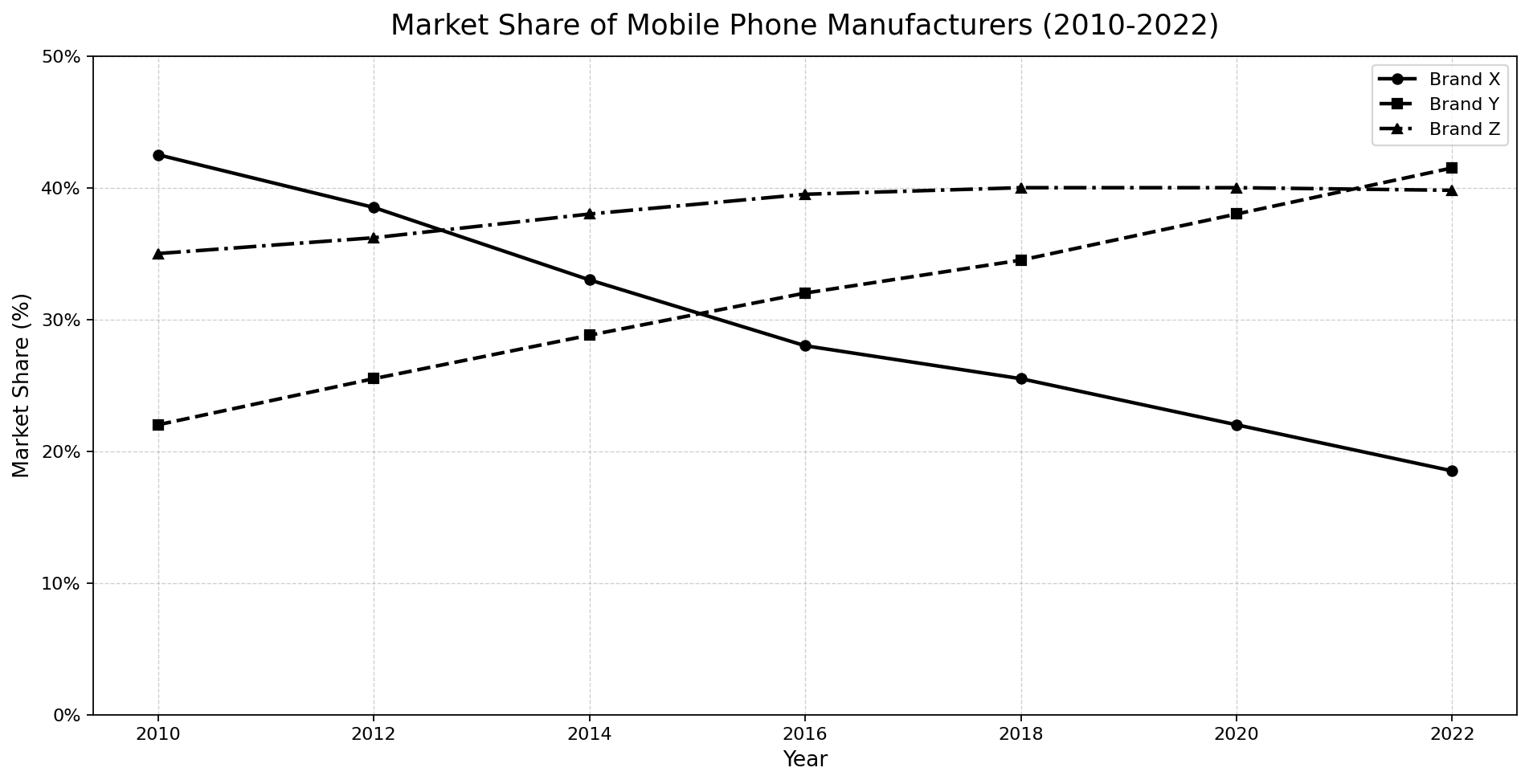
The line graph below shows the market share of three major mobile phone manufacturers (Brand X, Brand Y, and Brand Z) in a region from 2010 to 2022.

Summarise the information by selecting and reporting the main features, and make comparisons where relevant.
Academic Writing Task 1 Dynamic Multiple-Line Graph practice image
BAND 9

Part 1 · Band 9 Sample Answer

The line graph compares the percentage of the regional mobile phone market held by Brands X, Y and Z at two-year intervals between 2010 and 2022.

Overall, Brand X experienced a sustained and substantial loss of market share, whereas Brand Y followed the opposite trajectory and ultimately became the market leader. Brand Z rose more moderately before levelling off at approximately 40%. By the end of the period, the once-dominant Brand X had fallen to a distant third place.

In 2010, Brand X accounted for roughly 42.5% of the market, almost twice Brand Y’s figure of 22%. Brand Z occupied an intermediate position at 35%. Over the next four years, X’s share declined steadily to 33%, while those of Y and Z climbed to 29% and 38% respectively. Consequently, Brand Z overtook Brand X sometime between 2012 and 2014.

From 2014 onwards, the divergence between X and Y became more pronounced. Brand X’s proportion dropped by five percentage points to 28% in 2016 and continued falling to about 18.5% in 2022. In contrast, Brand Y advanced consistently, reaching 32% in 2016 and 38% in 2020. It then surpassed Brand Z to finish at approximately 41.5%. Brand Z increased slightly to around 39.5% in 2016, remained at 40% from 2018 to 2020, and ended the period at virtually the same level.

BAND 8

Part 1 · Band 8 Sample Answer

The graph illustrates changes in the market shares of three leading mobile phone producers in a particular region from 2010 to 2022.

Overall, Brand X’s share fell throughout the period, while Brand Y’s increased continuously. Brand Z recorded a smaller rise and then remained broadly stable. Although Brand X was the clear leader in 2010, Brand Y had the largest proportion by 2022.

At the beginning, Brand X controlled about 42.5% of the market, compared with 35% for Brand Z and only 22% for Brand Y. By 2012, X had declined to approximately 38.5%, whereas Y and Z had risen to around 25.5% and 36% respectively. Two years later, Brand Z became the leading manufacturer with 38%, as Brand X dropped to 33%. Brand Y also grew, reaching 29%.

After 2014, Brand X continued to lose ground, falling to 28% in 2016 and about 25.5% in 2018. Its share then decreased further to 22% in 2020 and roughly 18.5% in the final year. Meanwhile, Brand Y rose steadily from 32% in 2016 to 38% in 2020, before reaching approximately 41.5% in 2022 and moving ahead of Brand Z. The latter increased to nearly 40% in 2016 and remained close to this figure for the rest of the period.

BAND 7

Part 1 · Band 7 Sample Answer

The line graph shows the market share percentages of Brands X, Y and Z in one region between 2010 and 2022.

Overall, Brand X showed a clear downward trend, while Brand Y increased steadily. Brand Z rose gradually during the first half of the period and then stayed almost unchanged. By 2022, Brand Y had become the largest manufacturer by market share, and Brand X had become the smallest.

In 2010, Brand X had the highest share, at about 42.5%. Brand Z was second with 35%, while Brand Y had just 22%. Brand X’s figure then fell to around 38.5% in 2012 and 33% in 2014. In comparison, Brand Z increased to 36% and then 38% in these years, overtaking Brand X by 2014. Brand Y also grew to approximately 25.5% in 2012 and 29% two years later.

The same general trends continued after 2014. Brand X declined to 28% in 2016, about 25.5% in 2018 and only 18.5% in 2022. By contrast, Brand Y climbed to 32% in 2016 and around 34.5% in 2018. It reached 38% in 2020 before finishing at roughly 41.5%, slightly above Brand Z. Brand Z remained close to 40% from 2016 onwards and ended at about 40%.

Academic Writing Task 2

Task 2 · Discuss Both Views and Give Your Opinion

Task 2 Prompt

You should spend about 40 minutes on this task. Write at least 250 words.

Write about the following topic:

The rise of multinational companies has led to the homogenization of products and cultures around the world. Some people see this as a positive development, while others believe it undermines local diversity and identity.

Discuss both views and give your own opinion.

Give reasons for your answer and include any relevant examples from your own knowledge or experience.

BAND 9

Part 2 · Band 9 Sample Answer

The global expansion of multinational corporations has made the same brands, goods and cultural influences visible in countries thousands of kilometres apart. While this convergence can improve living standards and promote mutual familiarity, it can also erode distinctive local traditions. In my view, international business is broadly beneficial, but only when governments and consumers actively protect cultural variety rather than treating homogenisation as inevitable.

Supporters of this trend point first to consistency, affordability and choice. A company operating across many markets can produce on a vast scale, reducing costs and making reliable products accessible to a wider population. Common technical standards are also useful: travellers can replace a broken phone charger or obtain familiar medicine without having to understand an entirely different system. Moreover, multinational firms do not merely export products; they expose employees and customers to ideas from elsewhere. International streaming services, for example, can introduce audiences to films made in languages they might never otherwise encounter. Shared products and experiences may therefore create points of connection between people from different societies.

Nevertheless, the commercial power behind this process is uneven. A global chain can afford prominent premises, extensive advertising and temporary discounts that a family-run competitor cannot match. If independent shops, food producers and craftspeople disappear, communities lose more than consumer choice: they may also lose skills, meeting places and traditions passed between generations. Cultural products are similarly vulnerable. Multinational entertainment companies tend to favour content capable of attracting the largest possible audience, which can marginalise regional languages and stories. Even when corporations incorporate local elements, these may be simplified into marketable symbols rather than representing the culture in its full complexity.

I therefore believe the answer is not to exclude multinational companies, but to prevent them from overwhelming local ecosystems. Planning rules can reserve commercial space for independent businesses, schools can teach regional history and languages, and public funding can support local artists. Consumers also exercise influence whenever they choose locally produced food or media alongside global alternatives. Crucially, international firms themselves can adapt their products and employ local creators instead of imposing a single formula everywhere.

In conclusion, multinational companies bring efficiency, dependable goods and opportunities for cultural exchange, yet uncontrolled homogenisation can weaken the identities that make communities meaningful. Their rise is positive only if economic openness is combined with deliberate protection and continued renewal of local culture.

BAND 8

Part 2 · Band 8 Sample Answer

Multinational businesses now sell similar products and promote similar lifestyles in a large number of countries. Some people welcome the convenience and global connections this creates, whereas others are concerned that local cultures are becoming less distinctive. I believe these companies offer important advantages, although sensible action is needed to ensure that smaller businesses and traditions can survive.

On the positive side, international companies often make good-quality products widely available at competitive prices. Because they manufacture and distribute on a large scale, they can lower costs and maintain consistent standards. This is particularly valuable in places where certain technologies or specialised goods were previously difficult to obtain. Their presence can also create employment, introduce modern working practices and encourage domestic firms to improve. In cultural terms, sharing brands, music and entertainment can give people from different countries common interests. A young person visiting another country may feel less isolated when some food, services or digital platforms are familiar.

However, widespread uniformity has clear disadvantages. Local firms generally have fewer financial resources and may be unable to compete with the advertising budgets and low prices of global corporations. When a neighbourhood market is replaced by identical chain stores, the area can lose both its character and part of its local economy. The effects extend beyond retail. Global media and advertising often present a narrow image of a desirable lifestyle, encouraging younger generations to value internationally popular fashions more highly than regional clothing, food or languages. Once traditional knowledge or a minority language stops being passed on, it is extremely difficult to recover.

In my opinion, banning or severely restricting multinational companies would sacrifice too many benefits and would not stop cultural change. A better approach is to create a fairer balance. Governments could provide grants or favourable rental arrangements for independent shops, enforce competition rules and fund cultural education. Multinationals should also be encouraged to source materials locally and adapt their services with genuine input from local communities. Individuals can help by dividing their spending between convenient international brands and local producers.

To conclude, greater similarity across countries can provide affordable goods, employment and shared experiences, but it may also reduce economic and cultural diversity. Overall, multinational growth is beneficial provided that communities retain the means and confidence to preserve their own identities.

BAND 7

Part 2 · Band 7 Sample Answer

The growth of multinational companies means that people in many countries can now buy the same products and experience similar forms of entertainment. Some regard this change as beneficial, while others worry about the loss of local identity. In my view, multinational companies have more advantages than disadvantages, but local cultures need proper protection.

There are several reasons why the spread of global companies can be seen positively. First, these businesses often provide a wide range of products at reasonable prices. Their large production systems allow them to reduce costs, while customers usually know what level of quality to expect. They may also bring new jobs and training opportunities when they open factories, offices or shops in another country. In addition, common brands and popular culture can help people from different backgrounds understand one another. For example, international films and online services give users access to ideas and stories from outside their own societies.

On the other hand, multinational companies can make cities and cultures increasingly similar. A small local shop may struggle to compete with a major chain that can spend much more on advertising and offer lower prices. If many such shops close, town centres may become filled with the same businesses found everywhere else. Traditional food, clothing and crafts can also lose popularity, especially among younger people who are strongly influenced by global advertising. This can weaken the connection between generations because older people no longer have opportunities to pass their knowledge and skills to the young. Local languages may face a similar problem if most popular media is produced in a few widely spoken languages.

I believe countries should accept multinational investment while taking practical steps to maintain diversity. Governments can offer support to small businesses, organise local cultural events and ensure that regional history and languages are taught in schools. Large companies can contribute by employing local workers, buying from nearby suppliers and adjusting some products to local preferences. Consumers also have a responsibility to support independent businesses rather than choosing global brands every time.

In conclusion, multinational companies make useful goods more accessible and can increase contact between cultures. However, their influence can harm local businesses and traditions. Their overall impact can remain positive if governments, companies and consumers all help protect local identity.

FREE PRACTICE RESOURCES

Download the IELTS Practice PDF Pack.

Get Listening, Reading, and Writing practice materials for self-study. Use a computer to download the 1.9GB pack.

Download PDF Pack
Chat History
My Notes