ACADEMIC WRITING SAMPLE ANSWERS

Academic Writing Sample Answers Practice 13 Test 01

This original practice page includes Task 1 (Process Diagram) and Task 2 (Discuss Both Views and Give Your Opinion), with Band 9, Band 8, and Band 7 sample answers for IELTS preparation.
Academic Writing Task 1

Task 1 · Process Diagram

Task 1 Prompt

You should spend about 20 minutes on this task. Write at least 150 words.

The diagram below illustrates the process by which a new medicine is developed, tested and approved for public use, followed by monitoring after it enters the market.

Summarise the information by selecting and reporting the main features.
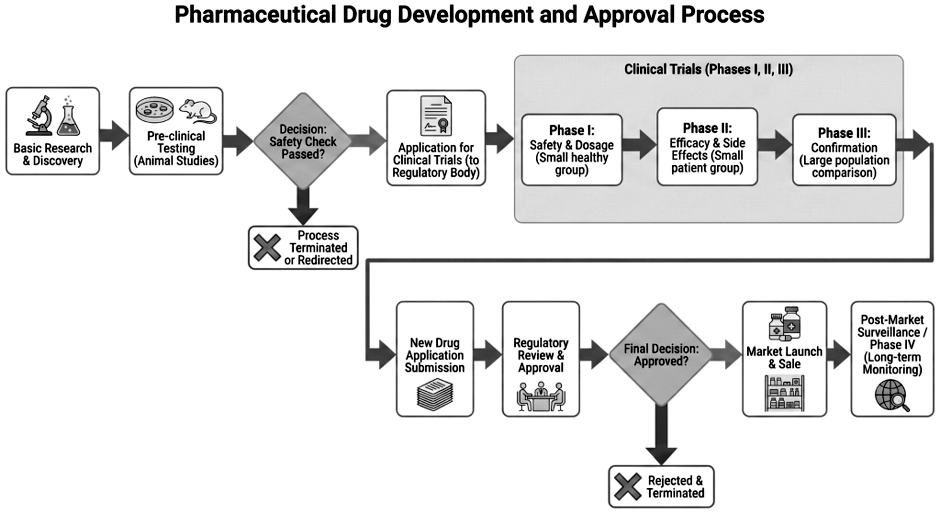
Academic Writing Task 1 Process Diagram practice image
BAND 9

Part 1 · Band 9 Sample Answer

The diagram traces the development of a pharmaceutical medicine from the earliest research activities to regulatory approval and long-term observation after commercial release.

Overall, the procedure consists of discovery, pre-clinical assessment, three progressively larger clinical trials, and a formal approval stage. There are two decisive checkpoints at which an unsuccessful medicine may leave the process, while a product that clears both can enter the market but remains subject to continuing surveillance.

Initially, basic research and discovery produce a potential medicine, which is then examined in pre-clinical animal studies. The results are used for an initial safety decision. If the safety check is not passed, development is either terminated or redirected. By contrast, a successful candidate proceeds to an application to the regulatory body for permission to begin clinical trials.

Testing on humans is divided into three phases. Phase I establishes safety and dosage in a small group of healthy participants. Phase II uses a small patient group to evaluate efficacy and side effects, after which Phase III confirms the findings through comparison across a large population. Once these trials have been completed, a new drug application is submitted for regulatory review and approval.

A final decision then determines the outcome. Rejected applications are terminated, whereas approved medicines can be launched and sold. Following release, post-market surveillance, also described as Phase IV, provides long-term monitoring of the medicine in public use.

BAND 8

Part 1 · Band 8 Sample Answer

The diagram shows the stages involved in creating, testing and approving a new pharmaceutical product, as well as the monitoring that takes place after it is sold.

Overall, a medicine passes through research, animal testing, human trials and regulatory assessment before it can reach the market. The process contains two important decisions: failure at the first safety check leads to termination or redirection, while rejection at the final stage ends the application. Approved drugs continue to be monitored after launch.

The procedure begins with basic research and discovery. A promising product then undergoes pre-clinical testing on animals, followed by a decision about whether it has passed a safety check. An unsuccessful result causes the process to stop or move in another direction. If the medicine passes, an application to conduct clinical trials is made to the regulatory body.

There are three clinical phases. Phase I examines safety and dosage using a small group of healthy people. Phase II focuses on efficacy and side effects in a small group of patients. Phase III then confirms the results by making comparisons within a much larger population.

After the trials, the developer submits a new drug application. This is examined through regulatory review, leading to the final approval decision. A rejected medicine is terminated, whereas an approved one proceeds to market launch and sale. The final stage is post-market surveillance, or Phase IV, during which its long-term performance is monitored.

BAND 7

Part 1 · Band 7 Sample Answer

The diagram describes how a new medicine is researched, tested and approved before public sale, and how it is monitored afterwards.

Overall, the process starts with basic scientific research and ends with long-term monitoring after the medicine reaches the market. Before launch, the product must pass animal studies, three stages of human trials and regulatory review. It can be stopped at either of the two decision points if it does not meet the required conditions.

First, a possible new medicine is identified through basic research and discovery. It is then tested on animals during the pre-clinical stage. A safety check is carried out next. If the product fails this check, the work is terminated or redirected. If it passes, the developer applies to the regulatory body for permission to start clinical trials.

The clinical testing stage has three phases. Phase I tests safety and dosage on a small group of healthy people. Phase II studies whether the medicine is effective and records side effects in a small patient group. Phase III uses a large population to confirm the results and compare performance.

Next, a new drug application is submitted and reviewed by the regulator. A final decision is then made. Rejection causes the process to end, while approval allows the medicine to be launched and sold. Finally, post-market surveillance, known as Phase IV, monitors the medicine over the long term.

Academic Writing Task 2

Task 2 · Discuss Both Views and Give Your Opinion

Task 2 Prompt

You should spend about 40 minutes on this task. Write at least 250 words.

Write about the following topic:

In many societies, the proportion of elderly people is increasing rapidly. Some people believe that the government should raise the legal retirement age to address the challenges this creates. Others think that alternative solutions, such as encouraging immigration or increasing taxes, should be considered instead.

Discuss both views and give your own opinion.

Give reasons for your answer and include any relevant examples from your own knowledge or experience.

BAND 9

Part 2 · Band 9 Sample Answer

Population ageing is placing pension systems, healthcare services and the supply of workers under growing pressure. Although raising the statutory retirement age can form part of a credible response, I do not believe that a uniform increase is sufficient or fair. A flexible rise, combined with carefully designed immigration and tax policies, would be more effective.

Supporters of a higher retirement age point to a basic imbalance: people are spending longer in retirement while a smaller working population finances their pensions and care. Extending working lives would increase tax receipts and reduce the number of years for which public pensions are paid. It could also ease labour shortages and allow employers to retain valuable experience. An older engineer or nurse, for example, may continue contributing professionally and mentoring younger colleagues well beyond the traditional retirement age.

Nevertheless, a blanket increase treats unequal circumstances as if they were identical. Continuing to work may be realistic for a healthy office employee, but far harder for someone whose body has been affected by decades of construction, factory or care work. Life expectancy and employment opportunities also vary considerably. If suitable jobs are unavailable, raising the official age may merely move people from a pension into unemployment or disability support rather than produce genuine savings.

Alternative measures therefore deserve serious consideration. Immigration can provide working-age taxpayers relatively quickly and fill shortages in areas such as healthcare and engineering. However, it requires investment in housing, language provision and integration, and it cannot permanently halt ageing because migrants themselves grow older. Higher taxes can help fund pensions and care more directly, but relying heavily on payroll or income taxes would place an excessive burden on younger workers. A broader and more moderate approach, including taxes on consumption, property or accumulated wealth where appropriate, could distribute the cost more fairly.

In my view, governments should gradually adjust retirement ages as healthy life expectancy rises, while protecting people in strenuous occupations and offering flexible or partial retirement. This should be supported by selective immigration, stronger incentives for older people who wish to remain employed, and balanced tax reform. Ageing is a multidimensional challenge, so no single policy should be expected to solve it.

BAND 8

Part 2 · Band 8 Sample Answer

As elderly people make up a larger share of the population, governments face higher spending on pensions and healthcare as well as possible shortages of workers. Raising the retirement age is one practical response, but other policies may achieve similar aims. In my opinion, a moderate and gradual increase is necessary in many countries, although it should be combined with immigration and limited tax reform.

The main argument for later retirement is financial. When people live for many years after leaving work, the state must support them for longer, while proportionally fewer employees are paying taxes. If healthy adults remain in employment for an additional two or three years, they continue contributing to public revenue and delay claiming a pension. Businesses may also benefit from retaining experienced staff, particularly in sectors where specialist knowledge takes years to develop.

However, this policy can be unfair to some groups. Manual workers may be physically unable to continue until a higher age, and older employees who lose their jobs sometimes struggle to find new positions. A single retirement age therefore ignores differences in health, occupation and personal circumstances. Without exceptions, the government could reduce pension expenditure only to face higher claims for unemployment or disability benefits.

Those who favour alternatives often suggest immigration. Younger migrants can enter the workforce, pay taxes and fill important vacancies, including jobs in health and social care. Yet large-scale immigration may also increase short-term demand for housing, schools and public services, so it needs careful planning. Increasing taxes is another option because it provides direct funding for age-related services. Nevertheless, sharp rises in income or employment taxes could reduce workers’ disposable income and discourage businesses from hiring.

I would adopt a mixed policy. The legal retirement age should rise slowly in line with improvements in health and longevity, but people in demanding occupations should be allowed earlier access to pensions. At the same time, countries can accept migrants with needed skills and spread modest tax increases across different sources rather than targeting salaries alone. This combination shares the responsibility among older workers, taxpayers and new entrants to the labour market, making it more balanced than any single solution.

BAND 7

Part 2 · Band 7 Sample Answer

The rapid growth of the elderly population creates difficulties for governments because more money is needed for pensions, medical treatment and care services. Some people argue that the legal retirement age should be increased, while others prefer measures such as immigration or higher taxes. I believe that raising the retirement age can help, but it should be used together with other solutions.

There are clear benefits to asking people to work for longer. Older workers continue paying income tax and do not begin receiving their state pensions as early. This can reduce pressure on public finances when there are fewer working-age people supporting a growing retired population. Employers can also keep experienced staff for a longer period. For example, senior employees may train younger colleagues and pass on knowledge that would otherwise be lost when they retire.

On the other hand, increasing the retirement age is not suitable for everyone. People who have spent many years doing physically demanding work may not be healthy enough to remain employed. It may also be difficult for an older person to find another job after being made redundant. In these cases, a higher retirement age could leave people without either a salary or a full pension.

Immigration offers another possible response. Young migrants can fill job vacancies and contribute taxes, especially when a country lacks workers in essential services. However, population growth may create additional demand for homes, transport and schools. Raising taxes could provide more money for pensions and elderly care, but large increases would make life harder for current workers and might raise employment costs for businesses.

In my view, governments should not depend on only one measure. The retirement age could rise gradually for people who are healthy and able to continue working, while those in demanding jobs should be allowed to retire earlier. Controlled immigration can increase the labour supply, and small tax rises can provide additional funding without placing too much pressure on one group.

In conclusion, a higher retirement age is a useful part of the response to an ageing society, but it is neither fair nor effective as a complete solution. A balanced combination of flexible retirement, immigration and reasonable taxation is more likely to succeed.

FREE PRACTICE RESOURCES

Download the IELTS Practice PDF Pack.

Get Listening, Reading, and Writing practice materials for self-study. Use a computer to download the 1.9GB pack.

Download PDF Pack
Chat History
My Notes