ACADEMIC WRITING SAMPLE ANSWERS

Academic Writing Sample Answers Practice 5 Test 04

This original practice page includes Task 1 (Process Diagram) and Task 2 (Discuss Both Views and Give Your Opinion), with Band 9, Band 8, and Band 7 sample answers for IELTS preparation.
Academic Writing Task 1

Task 1 · Process Diagram

Task 1 Prompt

You should spend about 20 minutes on this task. Write at least 150 words.

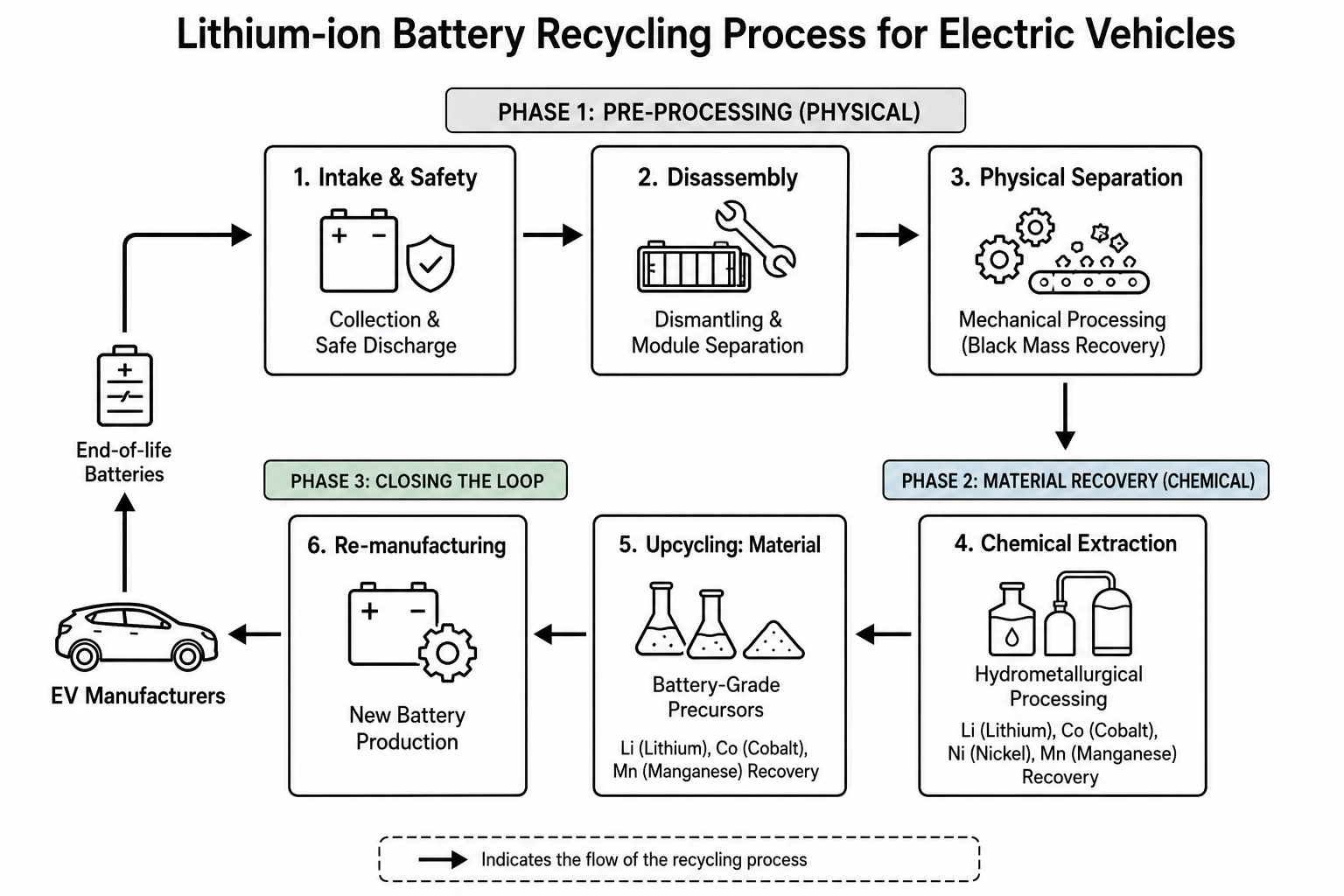
The diagram below illustrates the process of recycling lithium-ion batteries from end-of-life electric vehicles and shows how recovered materials are used to produce new batteries.

Summarise the information by selecting and reporting the main features.
Academic Writing Task 1 Process Diagram practice image
BAND 9

Part 1 · Band 9 Sample Answer

The diagram depicts a closed-loop system for recycling lithium-ion batteries removed from electric vehicles, from their collection and treatment to the manufacture of replacement batteries.

Overall, the cycle comprises six steps grouped into three phases: physical pre-processing, chemical material recovery and closure of the production loop. End-of-life batteries are first made safe and mechanically broken down; valuable metals are then extracted and upgraded into battery-grade inputs before being incorporated into new batteries for electric-vehicle manufacturers. These batteries eventually reach the end of their service life and re-enter the same process.

In the first phase, used batteries from electric vehicles are collected at the intake stage and safely discharged to eliminate electrical hazards. They are subsequently dismantled, with their modules separated. The resulting components then undergo mechanical processing during physical separation. This produces a concentrated material known as black mass, which proceeds to chemical treatment.

The second phase begins with hydrometallurgical processing. Through chemical extraction, four elements—lithium, cobalt, nickel and manganese—are recovered from the black mass. The extracted material is then upcycled to create battery-grade precursors suitable for reuse; lithium, cobalt and manganese are specifically identified among the materials recovered at this point.

Finally, the process enters its closing-the-loop phase. The battery-grade precursors are supplied for re-manufacturing and used in new battery production. Completed batteries are returned to electric-vehicle manufacturers and installed in vehicles. Once these batteries are no longer usable, they become end-of-life units and are directed back to collection and safe discharge, thereby completing the recycling cycle.

BAND 8

Part 1 · Band 8 Sample Answer

The diagram shows how lithium-ion batteries from end-of-life electric vehicles are recycled and how the recovered resources are returned to battery production.

Overall, this is a circular process containing six main steps and three phases. The batteries first undergo physical pre-processing, followed by chemical recovery and upcycling of valuable materials. These materials are then used to manufacture new batteries, which return to electric-vehicle producers and can eventually enter the recycling system again.

At the beginning of the pre-processing phase, expired vehicle batteries are collected and safely discharged. This safety procedure is followed by disassembly, during which the batteries are dismantled and their modules are separated. Mechanical treatment then divides the physical components and recovers black mass, the material that is passed to the chemical stage.

During the second phase, hydrometallurgical processing is used for chemical extraction. This step recovers lithium, cobalt, nickel and manganese from the black mass. The recovered substances subsequently undergo an upcycling stage, where they are processed into battery-grade precursors. The diagram identifies lithium, cobalt and manganese as recovered materials at this point.

In the final phase, described as closing the loop, these battery-grade inputs are used in the re-manufacturing stage to produce new batteries. The finished products are supplied to electric-vehicle manufacturers. After being installed and used in vehicles, the batteries ultimately reach the end of their useful lives. They are then sent back to the intake and safety stage, allowing the entire sequence of physical separation, chemical recovery and new production to be repeated.

BAND 7

Part 1 · Band 7 Sample Answer

The diagram illustrates the recycling process for lithium-ion batteries from electric vehicles. It also shows how recovered materials are used to make new batteries.

Overall, there are six steps divided into three phases. First, end-of-life batteries are made safe and physically separated. Next, useful metals are recovered through chemical processing and prepared for reuse. Finally, these materials are used to manufacture new batteries, which are returned to electric-vehicle manufacturers. The process is therefore a cycle.

In the first phase, used batteries are collected from electric vehicles and safely discharged. They are then dismantled, and the battery modules are separated. After this, the components go through mechanical processing. This physical separation stage produces black mass, which contains materials that can be recovered.

The black mass then moves into the chemical material recovery phase. Hydrometallurgical processing is used to extract lithium, cobalt, nickel and manganese. In the following upcycling step, the recovered material is converted into battery-grade precursors. Lithium, cobalt and manganese are listed as materials recovered during this part of the process.

The final phase closes the loop. The battery-grade materials are sent to the re-manufacturing stage, where they are used to produce new batteries. These batteries are supplied to electric-vehicle manufacturers and used in vehicles. When they reach the end of their useful life, they become end-of-life batteries. They are collected and safely discharged again, and the same six-step recycling process begins once more.

Academic Writing Task 2

Task 2 · Discuss Both Views and Give Your Opinion

Task 2 Prompt

You should spend about 40 minutes on this task. Write at least 250 words.

Write about the following topic:

Algorithms and artificial intelligence are increasingly being used to support decisions in the justice system, such as whether to grant bail or how to sentence offenders. Some people believe that these technologies can reduce human bias and make judicial decisions more consistent. Others argue that they may reproduce existing prejudices, reduce the role of human judgement and make decisions difficult to understand or challenge.

Discuss both these views and give your own opinion.

Give reasons for your answer and include any relevant examples from your own knowledge or experience.

BAND 9

Part 2 · Band 9 Sample Answer

Algorithms used in bail and sentencing promise decisions less affected by fatigue, intuition and personal prejudice. Supporters believe statistical tools can treat comparable cases alike, while critics fear technology may conceal inherited discrimination behind an appearance of objectivity. In my view, audited systems can assist judges, but no opaque model should determine an individual’s liberty or punishment.

Supporters are right that human judgement is not automatically fair or consistent. Two defendants with similar circumstances may receive different outcomes because judges interpret risk differently or are influenced by irrelevant impressions. An algorithm can examine the same defined factors in every case and compare a current defendant with previous decisions. Used properly, it could identify disparities, provide a consistent starting point and alert a court when its proposed decision differs sharply from outcomes in comparable cases. It may therefore reduce arbitrary variation rather than remove judicial responsibility.

However, an algorithm learns from data produced by existing institutions. If communities have historically been policed more heavily, their members may appear frequently in arrest or conviction records even when underlying behaviour is similar elsewhere. A system may then reproduce that imbalance while never explicitly using ethnicity. Neutral variables such as postcode, employment history or income can act as indirect substitutes for social background. Consistency is not justice if a model consistently applies patterns created by earlier prejudice.

Opacity creates a further threat. A defendant must be able to understand and challenge the evidence used against them. This becomes difficult when a model is protected as confidential or when its designers cannot explain the weighting of numerous variables. Judges may also develop automation bias, accepting a numerical risk score despite individual circumstances that the system cannot capture, such as family responsibilities, coercion or genuine rehabilitation.

For these reasons, AI should occupy a strictly advisory role. Courts could use transparent tools to organise precedents, check sentencing ranges and highlight possible inconsistencies. Any risk assessment should rely on legally relevant factors, undergo independent testing for unequal outcomes and produce an intelligible explanation. Defendants must be allowed to inspect and contest both the data and the reasoning, while a judge remains responsible for the final decision and records any reliance on the system.

In conclusion, algorithms may improve consistency and expose some forms of human bias, but they can also preserve structural inequality and weaken due process. Their legitimate purpose is to inform accountable human judgement, not to replace it. In decisions affecting freedom, explainability and the right to challenge an outcome are more important than computational efficiency.

BAND 8

Part 2 · Band 8 Sample Answer

Artificial intelligence is beginning to influence decisions about bail and punishment. Some people expect these systems to reduce personal bias and ensure that similar cases receive similar outcomes. Others are concerned that algorithms may repeat discrimination contained in historical data and weaken human responsibility. I believe AI can provide useful information to judges, but it should never make the final decision in cases involving a person’s freedom.

There are clear advantages to using technology as a judicial aid. Human decision-makers can be affected by tiredness, emotion or unconscious assumptions. They may also interpret similar facts differently, leading to unequal sentences for comparable offences. An algorithm can apply the same criteria to every case and quickly examine patterns across many previous decisions. It could show judges the normal sentencing range for an offence or warn them when an intended decision is unusually severe. This may improve consistency and encourage judges to examine their own reasoning.

Nevertheless, algorithms are only as reliable as the information on which they are trained. Historical crime data may reflect unequal policing rather than equal measurement of offending. If residents of a disadvantaged area have been stopped and arrested more frequently, a system may classify that area as high risk and continue penalising its residents. Removing direct information about ethnicity or wealth would not entirely solve the problem because factors such as postcode and employment can produce similar effects.

Another concern is that complex models can be difficult to explain. A defendant should know why bail was refused or why a particular sentence was imposed. If the decision depends on a score generated by private software, the person may be unable to check whether the underlying information was wrong or whether the model was unfair. Judges might also trust a computer-generated score too readily and give insufficient attention to personal circumstances, remorse or evidence of rehabilitation.

Governments should therefore set strict conditions for judicial AI. Systems must be independently tested for accuracy and unequal effects before use, and their main reasoning should be open to defendants and legal representatives. Individuals need a clear right to correct inaccurate data and challenge algorithmic assessments. Most importantly, the judge should treat the output as one piece of evidence, explain how it influenced the decision and remain legally responsible for the outcome.

Overall, AI can help courts compare cases and reduce some inconsistency, but it cannot guarantee fairness. Because historical bias and lack of transparency may cause serious injustice, these systems should support rather than replace human judgement.

BAND 7

Part 2 · Band 7 Sample Answer

Algorithms and artificial intelligence may help courts decide whether a person should receive bail or what sentence should be given. Supporters believe that computers can make these decisions more consistent and less affected by personal bias. Critics argue that the systems may repeat existing prejudice and make justice less understandable. In my opinion, AI should be used only to provide advice, while judges should continue making and explaining final decisions.

One benefit of algorithms is that they can process many previous cases quickly. A judge could use this information to compare a current case with similar ones and see the usual range of decisions. Unlike people, a computer does not become tired or react emotionally to a defendant’s appearance or manner. If the same rules are applied each time, courts may avoid large differences between the treatment of people who committed similar offences.

However, computers are not automatically neutral. Their results depend on the data and instructions provided by humans. If past decisions were unfair to poorer communities or certain ethnic groups, an algorithm trained on those decisions may learn the same pattern. It might also use a person’s postcode, education or employment as a sign of risk. Although these factors may appear neutral, they can disadvantage people from particular social backgrounds.

A further problem is the lack of explanation. People affected by judicial decisions have a right to understand and challenge them. A simple risk score does not show clearly why the system considers someone dangerous. If the software belongs to a private company, its method may not be available to defendants or lawyers. Judges could also rely too heavily on the result and fail to consider individual facts, such as evidence that a person has changed their behaviour.

AI should therefore be controlled by clear rules. Before a system is used, independent experts should test whether it produces accurate and fair results for different groups. Defendants should be allowed to see the information used about them, correct mistakes and challenge the algorithm’s conclusion. Judges should explain in ordinary language whether the system influenced their decision. They must also have the authority to reject its recommendation when it conflicts with the evidence or the circumstances of the case.

In conclusion, artificial intelligence can help courts compare cases and may reduce some human inconsistency. Nevertheless, it can reproduce unfair historical patterns and make decisions harder to question. It should remain a transparent supporting tool, with human judges fully responsible for every final decision.

FREE PRACTICE RESOURCES

Download the IELTS Practice PDF Pack.

Get Listening, Reading, and Writing practice materials for self-study. Use a computer to download the 1.9GB pack.

Download PDF Pack
Chat History
My Notes