ACADEMIC WRITING SAMPLE ANSWERS

Academic Writing Sample Answers Practice 10 Test 04

This original practice page includes Task 1 (Process Diagram) and Task 2 (Discuss Both Views and Give Your Opinion), with Band 9, Band 8, and Band 7 sample answers for IELTS preparation.
Academic Writing Task 1

Task 1 · Process Diagram

Task 1 Prompt

You should spend about 20 minutes on this task. Write at least 150 words.

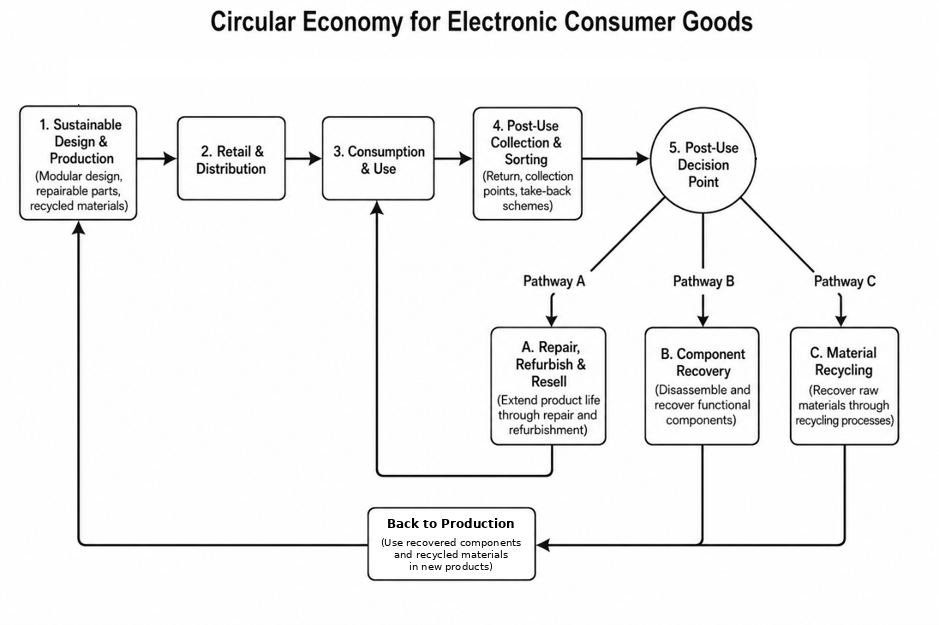
The diagram below illustrates the circular economy model for electronic consumer goods, showing the stages from sustainable design and production to retail, consumption, post-use collection and sorting, and three possible recovery pathways: repair and resale, component recovery and material recycling.

Summarise the information by selecting and reporting the main features.
Academic Writing Task 1 Process Diagram practice image
BAND 9

Part 1 · Band 9 Sample Answer

The diagram depicts a circular system for electronic consumer goods, beginning with sustainable product design and continuing through sale, use and post-use handling. It also shows how products, components and raw materials can re-enter the cycle through three recovery routes.

Overall, goods pass through five stages before reaching a decision point, where they are directed towards repair and resale, component recovery or material recycling. None of these routes constitutes a final endpoint: repaired products return to consumers, whereas recovered components and recycled materials are fed back into production.

The process starts with sustainable design and production. At this stage, products are made using modular construction, repairable parts and recycled materials. Finished electronics are then supplied through retail and distribution channels before entering the consumption and use phase. Once consumers have finished with them, the goods are returned through collection points or take-back schemes. They are subsequently sorted and sent to the post-use decision point.

Under Pathway A, suitable goods are repaired or refurbished and then resold. This extends their useful life and leads them back to the consumption stage without requiring remanufacture. Pathway B is used when functional components can be recovered: products are disassembled and usable parts are removed. In Pathway C, the remaining goods are processed to reclaim raw materials through recycling.

The outputs of the latter two pathways converge at the return-to-production stage. Recovered components and recycled materials are incorporated into new products and transferred back to sustainable design and production, thereby completing the larger loop.

BAND 8

Part 1 · Band 8 Sample Answer

The diagram shows the circular economy process for electronic consumer products. It follows goods from sustainable design and manufacturing through distribution and use to collection, sorting and three different methods of recovery.

Overall, the system contains five main stages before used products reach a decision point. They can then be repaired and resold, taken apart to recover working components, or recycled for raw materials. All three pathways return either products or resources to an earlier stage, making the process circular.

First, electronic goods are designed and produced using modular designs, parts that can be repaired and recycled materials. They then pass to retailers and distributors before being purchased and used by consumers. At the end of this period, products are returned through collection points or take-back programmes. After being collected and sorted, they arrive at the post-use decision point.

The first option is to repair, refurbish and resell suitable products. This pathway extends their life and sends them directly back to the consumption and use stage. Alternatively, products can be disassembled so that functional components are recovered. The third route involves material recycling, through which raw materials are obtained.

Components from the second pathway and materials from the third are brought together at the back-to-production stage. These recovered resources are used in new electronic goods. They then return to the initial sustainable design and production stage, completing the main cycle.

BAND 7

Part 1 · Band 7 Sample Answer

The diagram illustrates how electronic consumer goods move through a circular economy. It shows the main stages from design and production to use and collection, followed by three possible ways of recovering used products.

Overall, electronics pass through five stages before a decision is made about their future. They may be repaired and sold again, separated into reusable components or recycled into raw materials. Each route returns products or resources to an earlier part of the process.

First, electronic goods are designed and produced. This stage uses modular designs, repairable parts and recycled materials. The products are then sent to retail and distribution before reaching the consumption and use stage. When they are no longer required, consumers return them through collection points or take-back schemes. The goods are sorted before reaching the post-use decision point.

In Pathway A, suitable products are repaired or refurbished and then resold. This extends their useful life, and they return directly to the consumption stage. In Pathway B, products are taken apart so that working components can be recovered. Pathway C uses recycling processes to obtain raw materials from the used goods.

The components recovered through Pathway B and the materials produced through Pathway C both go to the back-to-production stage. They are used to make new products and return to sustainable design and production. This connection completes the cycle, while repaired goods form a shorter loop back to consumers.

Academic Writing Task 2

Task 2 · Discuss Both Views and Give Your Opinion

Task 2 Prompt

You should spend about 40 minutes on this task. Write at least 250 words.

Write about the following topic:

Advances in biotechnology and information technology are making it possible to create biological systems and living materials that can perform useful functions in areas such as medicine and construction. Some people believe that the development of these technologies should proceed cautiously because their long-term effects are uncertain. Others argue that innovation should be encouraged so that society can benefit from these technologies more quickly.

Discuss both views and give your own opinion.

Give reasons for your answer and include any relevant examples from your own knowledge or experience.

BAND 9

Part 2 · Band 9 Sample Answer

The convergence of biotechnology and information technology is enabling scientists to design cells, microbes and living materials for specific purposes. Such systems might deliver treatment inside the body or help a building repair small cracks, but their capacity to grow and evolve distinguishes them from ordinary machines. I believe innovation should proceed, and sometimes rapidly, but the degree of caution must correspond to the reversibility and reach of each application.

Those favouring caution emphasise that living systems can behave differently outside controlled conditions. An engineered organism released into soil might interact with native species, exchange genetic material or spread farther than expected. Even medical applications confined to an individual could produce delayed immune effects that short trials fail to reveal. There are also questions of accountability: if a living construction material changes over time, responsibility for a later failure may be divided among its designer, manufacturer and building owner. Because some consequences could be difficult to reverse, critics reasonably argue that commercial pressure should not substitute for long-term observation.

Conversely, excessive restraint has costs of its own. Engineered tissues could improve the testing of medicines and potentially reduce dependence on scarce donor organs, while programmable biological systems may allow treatment to be delivered more precisely. In construction, materials capable of repairing minor damage could extend the life of infrastructure and reduce demand for resource-intensive replacement. These benefits are particularly valuable when societies face ageing populations, housing needs and environmental pressure. Innovation also becomes safer through practice: carefully conducted trials generate evidence that theoretical discussion alone cannot provide.

In my view, regulation should distinguish contained, reversible work from open and potentially permanent interventions. Laboratory research on a living material that cannot survive outside a controlled facility should face proportionate oversight rather than years of delay. A self-replicating organism intended for environmental release, by contrast, should require independent ecological assessment, staged trials and long-term monitoring. Designers could incorporate biological limits that reduce survival beyond the intended setting, although such safeguards should themselves be tested rather than assumed effective. Public reporting and clear liability rules would further ensure that developers retain responsibility after approval.

Caution and speed are therefore not genuine opposites. A risk-based system can accelerate applications with limited consequences while demanding stronger evidence for those capable of spreading or evolving. This approach allows society to obtain valuable medical and material innovations without treating uncertainty as either a reason for paralysis or an excuse for recklessness.

BAND 8

Part 2 · Band 8 Sample Answer

New combinations of biotechnology and information technology can produce living systems that perform practical tasks. These developments may improve medical treatment and create more sustainable building materials, but they may also have effects that are difficult to predict. In my opinion, innovation should be encouraged under risk-based regulation, with much stricter controls on technologies that can reproduce or spread beyond a controlled setting.

Supporters of a cautious approach argue that biological products are not completely predictable. An engineered microbe may behave safely in a laboratory but interact differently with other organisms if it enters the wider environment. Its genetic features could change or move into another population, creating consequences that are hard to reverse. Medical products also require careful testing because a living treatment might cause an unexpected immune response or continue functioning longer than intended. In construction, uncertainty about how living materials age could create safety and legal problems many years after a building is completed.

However, delaying all development would prevent society from gaining important benefits. Engineered cells may help researchers test drugs more accurately or deliver treatment to a particular part of the body. Living materials used in concrete or other building products might repair small amounts of damage, extending the useful life of structures and reducing waste. Faster innovation can also attract investment and skilled researchers, leading to further improvements in safety and performance. Without practical trials, governments cannot collect the evidence needed to understand either the value or the risks of these technologies.

I therefore favour different rules for different levels of danger. Research conducted in secure laboratories should usually be allowed to progress after standard safety checks. Human treatments require staged clinical testing and continued monitoring after approval. Products designed for release into nature should face the strongest assessment because they may cross borders and be impossible to recall. Developers should publish safety information, prepare plans for failures and remain legally responsible for harm caused by their products.

In conclusion, uncertainty justifies caution but not a general slowdown in biotechnology. Society should permit controlled experimentation and useful applications while applying tougher standards whenever a living system could spread, evolve or create irreversible effects.

BAND 7

Part 2 · Band 7 Sample Answer

Biotechnology and information technology are now being combined to create useful living systems and materials. These products may offer major benefits in medicine and construction, but their future effects are not always clear. I believe development should continue, although governments should apply stronger safety rules to higher-risk uses.

People who support caution are concerned that living systems can grow, change and interact with the environment. For example, a modified microorganism may work as planned inside a laboratory but behave differently if it escapes into soil or water. It could affect other species or spread beyond the area where it was originally needed. Medical uses also involve risks because an engineered cell might cause an unexpected reaction in a patient. Similarly, a living building material could become weaker or change after many years. These possibilities mean that testing must not be rushed simply because a product could be profitable.

On the other hand, faster innovation may produce valuable social benefits. Engineered biological materials could help scientists study diseases and test possible treatments. Some living systems might deliver medicine more accurately, reducing damage to healthy parts of the body. In construction, a material that repairs small cracks could make buildings and bridges last longer and reduce the need for replacement materials. Allowing researchers to conduct practical trials also provides real evidence about how these inventions work. If every project is delayed because of uncertainty, useful products may never reach the people who need them.

In my view, the correct level of control depends on the possible harm. Experiments carried out in secure laboratories should be permitted when researchers follow clear safety procedures. Medical products should pass through several testing stages and continue to be monitored after approval. Governments should be much more careful about organisms intended for release into the natural environment, since recalling them may be impossible. Companies must explain known risks and remain responsible if their products cause damage.

In conclusion, innovation and caution can be combined. Governments should support research and controlled trials, while requiring stronger evidence for technologies that may spread or have permanent effects. This would allow society to gain benefits without ignoring serious long-term risks.

FREE PRACTICE RESOURCES

Download the IELTS Practice PDF Pack.

Get Listening, Reading, and Writing practice materials for self-study. Use a computer to download the 1.9GB pack.

Download PDF Pack
Chat History
My Notes