ACADEMIC WRITING SAMPLE ANSWERS

Academic Writing Sample Answers Practice 11 Test 04

This original practice page includes Task 1 (Static Mixed Chart) and Task 2 (Discuss Both Views and Give Your Opinion), with Band 9, Band 8, and Band 7 sample answers for IELTS preparation.
Academic Writing Task 1

Task 1 · Static Mixed Chart

Task 1 Prompt

You should spend about 20 minutes on this task. Write at least 150 words.

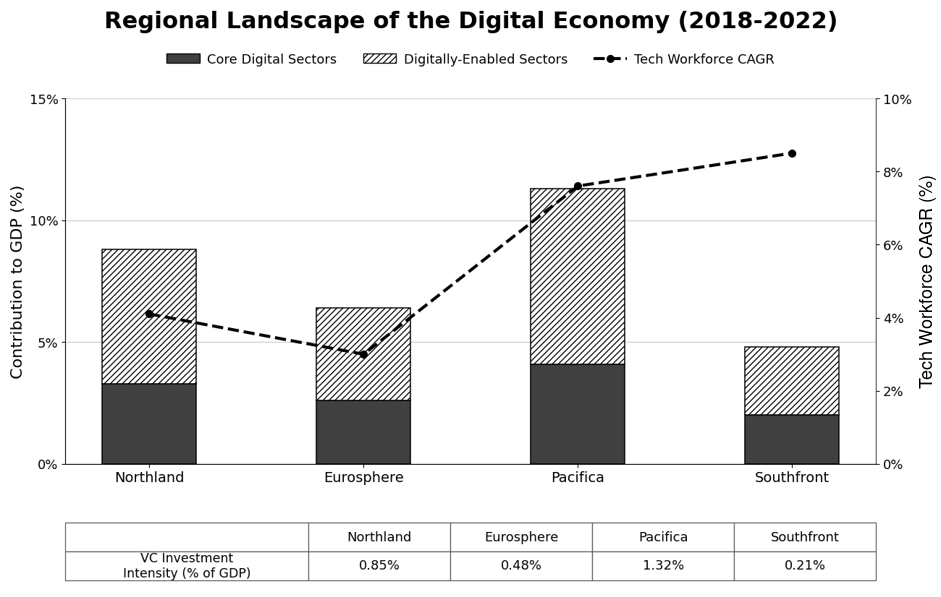
The chart and table below compare four major regions in terms of the digital economy’s contribution to GDP, venture capital investment as a percentage of GDP, and the compound annual growth rate of the tech workforce between 2018 and 2022.

Summarise the information by selecting and reporting the main features, and make comparisons where relevant.
Academic Writing Task 1 Static Mixed Chart practice image
BAND 9

Part 1 · Band 9 Sample Answer

The chart compares four regions between 2018 and 2022 by showing the shares of GDP generated by core digital and digitally enabled sectors, together with the compound annual growth of their technology workforces. The table adds venture-capital investment as a proportion of regional GDP.

Overall, Pacifica had the largest digital economy and the greatest intensity of venture funding, while digitally enabled activity contributed more than core industries in every region. Workforce expansion followed a different ranking: Southfront recorded the fastest growth despite having the smallest digital contribution and lowest investment rate.

In Pacifica, digital activity accounted for approximately 11.3% of GDP, comprising just over 4% from core sectors and around 7.2% from digitally enabled ones. Northland ranked second with a total close to 9%, of which roughly 3.3% came from the core and 5.5% from enabled industries. The corresponding total in Eurosphere was about 6.4%, split into approximately 2.6% and 3.8%. Southfront’s figures were the lowest, at around 2% for core digital sectors and 2.8% for the enabled segment, producing a combined share of just under 5%.

Venture-capital data broadly reflected this order. Investment represented 1.32% of GDP in Pacifica and 0.85% in Northland, compared with 0.48% in Eurosphere and only 0.21% in Southfront. By contrast, Southfront’s technology workforce grew at roughly 8.5% annually, ahead of Pacifica at nearly 8%. Northland’s rate was just above 4%, while Eurosphere had the slowest expansion, at around 3%.

BAND 8

Part 1 · Band 8 Sample Answer

The chart presents the contribution of two parts of the digital economy to GDP in four regions and shows the annual growth rate of the technology workforce from 2018 to 2022. The table compares venture-capital investment as a percentage of GDP.

Overall, Pacifica recorded the highest digital-economy share and venture-capital intensity. Southfront was lowest on both measures, but had the most rapidly growing technology workforce. In all four regions, digitally enabled sectors made a larger contribution to GDP than core digital industries.

Pacifica’s digital economy represented just over 11% of GDP. Core sectors supplied approximately 4.1%, while digitally enabled activity contributed about 7.2%. Northland followed with a combined figure of almost 9%, divided into roughly 3.3% from core industries and 5.5% from enabled sectors. Eurosphere’s total was lower, at around 6.4%, including 2.6% and 3.8% respectively. Southfront had the smallest overall share, at just under 5%, with core and enabled contributions of approximately 2% and 2.8%.

Pacifica also attracted the most venture capital relative to its economy, at 1.32% of GDP. Northland ranked second at 0.85%, followed by Eurosphere at 0.48%, while Southfront received only 0.21%.

The pattern for workforce growth was notably different. Southfront achieved the highest compound annual rate, at approximately 8.5%, despite its low investment and digital output. Pacifica was close behind at nearly 8%. Northland’s technology workforce grew by just over 4% annually, whereas Eurosphere recorded the lowest rate, at about 3%.

BAND 7

Part 1 · Band 7 Sample Answer

The chart compares the contribution of core digital sectors and digitally enabled sectors to GDP in four regions between 2018 and 2022. It also shows technology workforce growth, while the table gives venture-capital investment as a share of GDP.

Overall, Pacifica had the largest digital economy and the highest level of venture-capital investment. Southfront had the lowest figures in these areas, although its technology workforce grew the fastest. Digitally enabled sectors contributed more than core digital sectors in every region.

Pacifica’s two digital sectors together made up slightly more than 11% of GDP. Around 4.1% came from core sectors and approximately 7.2% from digitally enabled industries. Northland had the second-highest total, at nearly 9%, including about 3.3% from core digital activity and 5.5% from the enabled sector.

The figures were lower in Eurosphere and Southfront. Eurosphere’s total contribution was around 6.4%, with about 2.6% from the core and 3.8% from enabled industries. In Southfront, these two shares were approximately 2% and 2.8%, giving a total of just under 5%.

Venture-capital investment was equal to 1.32% of GDP in Pacifica, compared with 0.85% in Northland and 0.48% in Eurosphere. Southfront had the lowest figure, at 0.21%. However, its workforce growth rate was highest at roughly 8.5%, followed by Pacifica at nearly 8%. Northland recorded just over 4%, while Eurosphere was last at approximately 3%.

Academic Writing Task 2

Task 2 · Discuss Both Views and Give Your Opinion

Task 2 Prompt

You should spend about 40 minutes on this task. Write at least 250 words.

Write about the following topic:

Generative artificial intelligence (AI) systems can produce text, computer code, images and other forms of media. Some people believe that these tools make creative work more accessible and can significantly improve productivity. Others worry that they may weaken human skills, reduce demand for creative professionals and make human-created work less valuable.

Discuss both views and give your own opinion.

Give reasons for your answer and include any relevant examples from your own knowledge or experience.

BAND 9

Part 2 · Band 9 Sample Answer

Generative artificial intelligence has lowered the technical threshold for producing polished text, software and visual media. Advocates see a broadening of creative opportunity and a major productivity gain, whereas critics fear deskilling, job displacement and declining respect for human work. I believe these systems are beneficial when they extend human capability, but harmful when organisations use them to replace judgement, training and fair employment.

The accessibility argument is persuasive. Someone with a strong idea but limited drawing ability can create a visual prototype, while a small organisation can draft routine publicity or software without hiring a specialist for every minor task. AI can also generate alternatives and handle repetitive stages of production, leaving professionals more time for research, experimentation and refinement. It does not supply a meaningful creative purpose, but makes it cheaper and faster to test how that purpose might be expressed. People previously excluded by cost, disability or lack of formal training may therefore participate more fully.

However, convenience can become dependency. Writing, coding and design skills develop through organising ideas, diagnosing mistakes and revising weak attempts. Learners who delegate these stages may produce acceptable results without acquiring the judgement needed to recognise when a system is wrong or unimaginative. Generated material can sound convincing while being inaccurate or unsuitable for a particular audience. Human supervision becomes weaker precisely when it is most necessary.

Employment concerns are equally credible. Firms may remove junior creative roles because AI can perform basic drafting, although such positions allow beginners to become experienced professionals. A flood of inexpensive content could also reduce fees and make distinctive work harder to find. Yet abundance does not necessarily make human creativity worthless. Audiences may still value intention, lived experience, accountable authorship and a relationship with the creator. Routine production is likely to become cheaper, while original direction, trusted expertise and careful editing continue to command value.

Society should therefore shape adoption rather than choose between enthusiasm and prohibition. Schools should assess the reasoning and revision behind a finished product. Employers should retain human accountability, train workers to verify generated material and disclose AI involvement where authenticity matters. Creative professionals also need workable rules concerning permission and compensation when their work contributes to commercial systems.

In conclusion, generative AI can democratise creation and remove unproductive labour. Nevertheless, productivity should mean better human outcomes, not simply fewer paid creators. Used transparently as an assistant, AI can expand creativity; used mainly to cut expertise and responsibility, it will diminish it.

BAND 8

Part 2 · Band 8 Sample Answer

Generative AI can assist with activities ranging from writing and illustration to computer programming. Supporters argue that it allows more people to create and helps professionals work faster. Critics are concerned about declining skills, lost employment and reduced respect for human-made work. In my opinion, the advantages are greater, but only when AI remains a supporting tool and people are responsible for the final result.

One major benefit is that creative production becomes easier to enter. A person may have an excellent story or business idea without advanced drawing, editing or coding skills. AI can help turn that idea into a draft or prototype which can then be improved. This is valuable for small businesses, independent creators and people unable to afford specialist help.

AI can also raise productivity among trained professionals. A programmer might use it to produce routine code, while a designer could request several early concepts before selecting one to develop. Writers may use it to organise notes or identify unclear sentences. By reducing repetitive work, these people can concentrate on decisions requiring experience, such as understanding a client, choosing an appropriate tone or checking whether a product serves its purpose.

On the other hand, regular dependence may weaken basic abilities. Students who ask AI to write every paragraph or solve every coding problem miss the practice through which judgement develops. They may also fail to notice inaccurate output. Employment is another genuine concern. Companies might replace junior writers, illustrators or programmers to lower costs, reducing current opportunities and the supply of experienced professionals in the future.

Human-created work may also struggle in a market filled with instant, inexpensive media, and customers may refuse to pay previous prices for routine content. However, work with a recognisable personal vision may become more important because people value the experience, intention and responsibility behind it. AI is therefore more likely to reduce the value of predictable production than eliminate demand for all human creativity.

Education and employment practices must adapt. Students should explain and revise AI-assisted work, while employers should train staff to check outputs instead of assuming they are correct. Disclosure is appropriate when customers care whether a work was made by a person, and workers whose tasks change should have access to retraining.

Overall, generative AI can widen participation and make creative work more efficient, but careless use could damage skills and careers. Keeping humans in control of important decisions offers a better path than either banning the technology or allowing cost reduction to become its only purpose.

BAND 7

Part 2 · Band 7 Sample Answer

Generative AI can create writing, pictures, computer code and other media within a short time. Some people see it as a useful tool that makes people more creative and productive. Others believe it could weaken human ability and damage creative careers. I think AI offers more benefits than disadvantages, provided that it assists people instead of replacing human thought and responsibility.

The first advantage is accessibility. Many people have ideas but lack the technical skills or money needed to present them professionally. For example, someone starting a small business might use AI to produce an early logo design or draft a simple website. This allows the person to test an idea before paying specialists to improve the final product.

Productivity is another benefit. Writers can use AI to organise notes, programmers can ask it to suggest basic code, and designers can produce several possible layouts quickly. The technology can complete repetitive early work and give professionals more time for difficult decisions. A small team may therefore finish a project faster without reducing its quality, provided that people check and improve the result.

However, overuse can weaken skills. A student who always asks AI to write an essay may never learn to develop an argument or recognise poor writing. Similarly, a new programmer who copies generated code without understanding it may be unable to fix errors. AI can create the appearance of ability without the knowledge needed to use its output safely.

Creative employment may also suffer. Businesses could decide that generated images or articles are good enough and hire fewer writers, artists and programmers, especially for basic work. This would make it harder for beginners to enter these careers. Since AI produces large amounts of content cheaply, customers may begin to expect all creative work to cost very little.

Nevertheless, many people value human experience and personal meaning. A novel based on a writer’s life or a picture created with a clear purpose may remain more valuable than an automatic result. The greatest risk is therefore to routine work rather than every form of creativity.

Schools and workplaces should teach people to use AI critically. Users should check facts, revise the output and remain responsible for mistakes. Organisations should also be honest when media are mainly AI-generated and provide training for workers whose jobs are changing.

In conclusion, generative AI can make creation more accessible and efficient, but it should not replace learning or professional judgement. Responsible use can preserve human skills while allowing society to benefit from the technology.

FREE PRACTICE RESOURCES

Download the IELTS Practice PDF Pack.

Get Listening, Reading, and Writing practice materials for self-study. Use a computer to download the 1.9GB pack.

Download PDF Pack
Chat History
My Notes