ACADEMIC WRITING SAMPLE ANSWERS

Academic Writing Sample Answers Practice 12 Test 01

This original practice page includes Task 1 (Dynamic Mixed Chart) and Task 2 (Discuss Both Views and Give Your Opinion), with Band 9, Band 8, and Band 7 sample answers for IELTS preparation.
Academic Writing Task 1

Task 1 · Dynamic Mixed Chart

Task 1 Prompt

You should spend about 20 minutes on this task. Write at least 150 words.

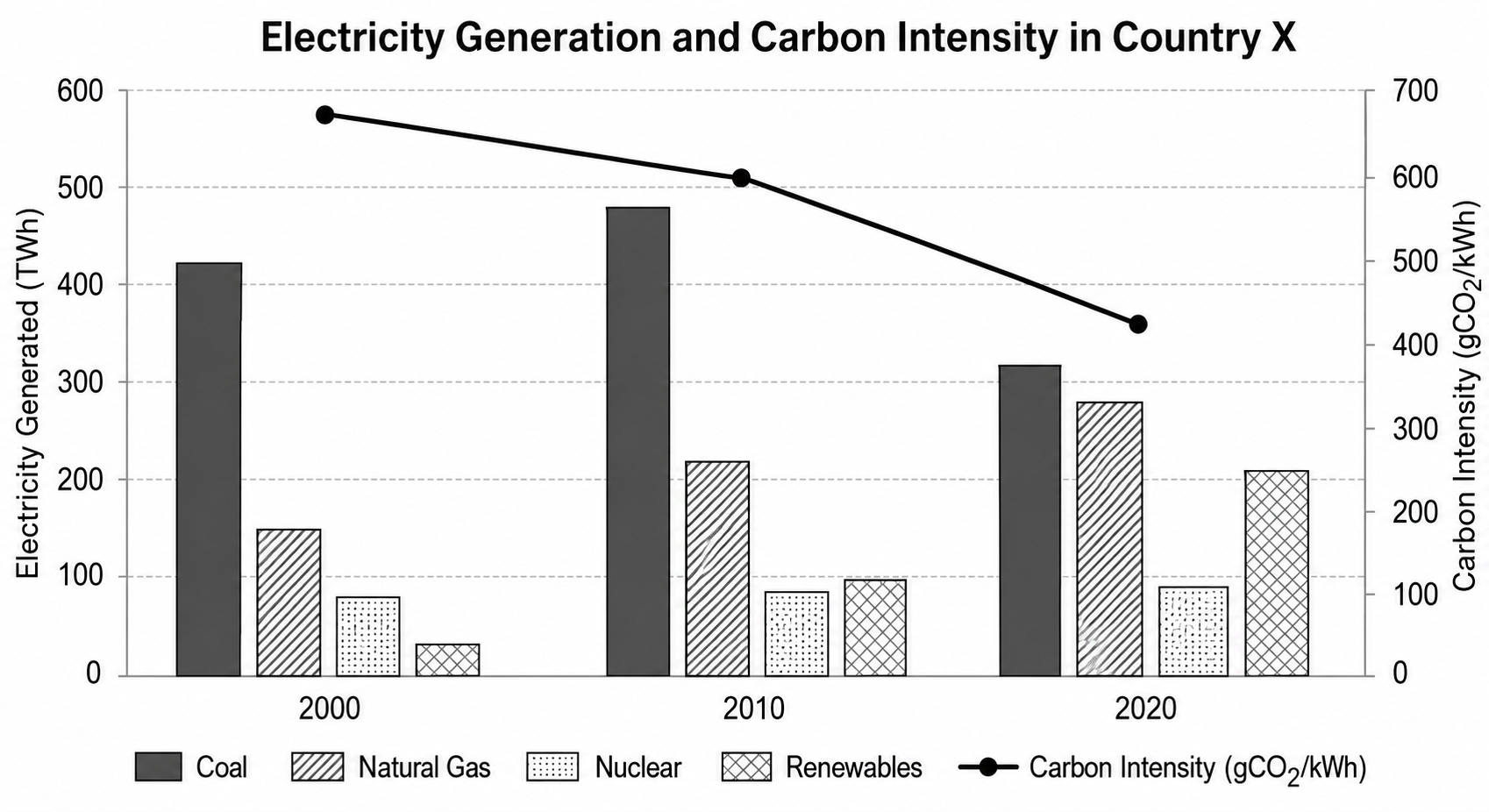
The charts below show the amount of electricity generated (in terawatt-hours) by different energy sources in Country X for the years 2000, 2010, and 2020, and the associated carbon intensity per unit of electricity produced.

Summarise the information by selecting and reporting the main features, and make comparisons where relevant.
Academic Writing Task 1 Dynamic Mixed Chart practice image
BAND 9

Part 1 · Band 9 Sample Answer

The bar and line charts compare electricity output from coal, natural gas, nuclear power and renewables in Country X in 2000, 2010 and 2020, while also showing the average carbon intensity of the electricity produced.

Overall, coal remained the largest source throughout, although its output fell considerably after reaching a peak in 2010. By contrast, natural gas and especially renewables became increasingly important, whereas nuclear generation changed very little. At the same time, total generation increased and carbon intensity declined, with the sharper reduction occurring in the final decade.

In 2000, coal generated approximately 420 TWh, almost three times the 150 TWh supplied by natural gas. Nuclear power contributed about 80 TWh, while renewables were marginal at only 30 TWh. Coal production subsequently rose to roughly 480 TWh in 2010, and gas output increased by 70 TWh to 220 TWh. Nuclear energy edged up to around 85 TWh, while renewable generation more than tripled to just under 100 TWh.

The pattern shifted markedly by 2020. Coal output dropped to about 320 TWh, narrowing its lead over natural gas, which had climbed to 280 TWh. Renewables recorded the most substantial long-term expansion, reaching approximately 210 TWh, seven times their initial figure, while nuclear power remained broadly stable at around 90 TWh. Meanwhile, carbon intensity decreased from roughly 670 gCO₂/kWh in 2000 to 600 in 2010, before falling much more steeply to about 420 gCO₂/kWh in 2020.

BAND 8

Part 1 · Band 8 Sample Answer

The charts illustrate how much electricity Country X produced from four energy sources in 2000, 2010 and 2020. They also provide information about the carbon intensity of electricity generation in each of these years.

Overall, coal generated more power than any other source in all three years, but its dominance weakened by 2020. Natural gas and renewables both expanded, with the latter experiencing the fastest growth, while nuclear output was largely unchanged. Carbon intensity followed a downward trend despite an overall rise in electricity production.

Coal supplied about 420 TWh in 2000, compared with 150 TWh from natural gas. The figures for nuclear power and renewables were much lower, at approximately 80 and 30 TWh respectively. By 2010, coal generation had risen to a high of around 480 TWh, while gas increased to 220 TWh. Renewable output also grew substantially to almost 100 TWh, overtaking nuclear power, which stood at just over 80 TWh.

By 2020, coal production had fallen sharply to roughly 320 TWh. In contrast, natural gas continued to rise and reached 280 TWh, leaving only a relatively small difference between the two fossil fuels. Renewables more than doubled from their 2010 level to around 210 TWh, whereas nuclear power increased only slightly to about 90 TWh. Carbon intensity fell from approximately 670 gCO₂/kWh in 2000 to 600 gCO₂/kWh ten years later, and then declined more noticeably to about 420 gCO₂/kWh in 2020.

BAND 7

Part 1 · Band 7 Sample Answer

The bar chart compares the amount of electricity generated from coal, natural gas, nuclear power and renewable sources in Country X in three years. The line shows the carbon intensity of the electricity supply.

Overall, coal was the main source of electricity in every year, although its output was lower in 2020 than in the two earlier years. Natural gas and renewable energy became more important over time, while the nuclear figure changed only slightly. Carbon intensity decreased throughout the period.

In 2000, coal produced about 420 TWh of electricity. This was far higher than the amounts generated from natural gas and nuclear power, at 150 TWh and around 80 TWh respectively. Renewables made the smallest contribution, producing only about 30 TWh. In 2010, coal output increased to approximately 480 TWh, its highest level on the chart. Natural gas also rose to 220 TWh, while renewable production reached nearly 100 TWh and moved above nuclear power.

The situation was different in 2020. Electricity from coal fell to around 320 TWh, while the natural-gas figure grew to 280 TWh. Renewable output continued to increase strongly and reached about 210 TWh, but nuclear generation remained close to 90 TWh. The carbon intensity of electricity production declined from roughly 670 gCO₂/kWh in 2000 to 600 gCO₂/kWh in 2010. It then fell more rapidly, reaching approximately 420 gCO₂/kWh by 2020.

Academic Writing Task 2

Task 2 · Discuss Both Views and Give Your Opinion

Task 2 Prompt

You should spend about 40 minutes on this task. Write at least 250 words.

Write about the following topic:

Artificial intelligence is now capable of creating original art, music, and literature. Some people see this as a positive development that enhances creativity, while others view it as a threat to human artists and the value of human-made art.

Discuss both views and give your own opinion.

Give reasons for your answer and include any relevant examples from your own knowledge or experience.

BAND 9

Part 2 · Band 9 Sample Answer

Artificial intelligence can now generate convincing images, compositions and prose in seconds. To some, this represents a welcome expansion of the creative toolkit; to others, it threatens both artists’ livelihoods and the cultural significance of work made by people. I believe the technology can enrich creativity, but only if its development is accompanied by fair rules on consent, attribution and commercial use.

The optimistic view rests partly on accessibility. Someone without formal training or expensive equipment can turn an idea into a visual draft, soundtrack or story and then refine it. This may allow people who previously saw themselves only as audiences to participate in artistic production. AI can also assist established creators without replacing their judgement. A filmmaker, for example, might rapidly test several colour schemes or musical moods before selecting and reworking one. Used in this manner, the system removes repetitive labour and makes experimentation cheaper, leaving the artist with more time for interpretation, selection and revision. New technology has repeatedly changed artistic practice, and photography and digital editing ultimately created new forms rather than ending creativity.

Nevertheless, the concerns are substantial. Generative systems are often trained on enormous collections of existing work, sometimes without meaningful permission from the people who produced it. A company may therefore imitate a living illustrator’s recognisable style and sell the result at a fraction of the cost, while the original artist receives neither payment nor credit. In industries where clients mainly require adequate, inexpensive content, this could reduce entry-level employment and make it harder for new professionals to develop their craft. Moreover, an endless supply of polished material may cause audiences to treat individual works as disposable. Although human-made art would not lose its emotional meaning automatically, its market value and visibility could certainly be weakened.

In my view, AI-generated art is positive when it extends human agency rather than concealing or exploiting human contribution. Training data should be licensed where appropriate, creators should be able to refuse the use of their work, and commercial AI content should be labelled clearly. Education should also teach people to use these systems critically instead of accepting their first output as a finished product.

In conclusion, artificial intelligence can democratise artistic expression and provide professionals with powerful ways to experiment. However, without safeguards, it may transfer income and recognition from creators to technology companies. Its overall value will therefore depend less on the software itself than on the conditions under which it is trained and used.

BAND 8

Part 2 · Band 8 Sample Answer

The growing ability of artificial intelligence to produce pictures, songs and written works has caused disagreement about its cultural impact. Supporters argue that it gives more people opportunities to be creative, whereas critics fear that professional artists and human-made work will suffer. In my opinion, AI is a useful creative tool, but its benefits will outweigh its disadvantages only if artists are protected from unfair imitation and loss of income.

On the positive side, AI can lower the practical barriers to creative activity. People may have strong ideas but lack the technical skill to draw, compose music or write fluently. A generative program can help them create an initial version that they can adjust according to their own aims. Professionals can benefit as well. Musicians can explore different arrangements, while designers can produce several early concepts before developing the most promising one themselves. This speeds up experimentation and may lead to combinations that a creator would not otherwise have considered. It can also reduce routine work, allowing artists to concentrate on the message, emotion and overall direction of a project.

However, there are valid reasons to see this development as a threat. Businesses may choose cheap AI content instead of employing illustrators, writers or composers, especially for ordinary commercial assignments. The loss of such work matters because many artists depend on these smaller jobs while building their experience and reputation. There is also a question of fairness when AI systems learn from copyrighted material without the creator’s permission. If a program can produce images that closely resemble a particular artist’s work, customers may obtain an imitation without supporting the person whose skills made that style valuable. Furthermore, the huge quantity of instantly generated content could make audiences less willing to spend time or money on individual works.

I nevertheless believe that human creativity will remain important. Art is valued not only for its appearance but also for the intention, experience and personal story behind it. The sensible response is therefore regulation rather than rejection. Artists should have control over whether their work is used for training, commercial users should disclose AI-generated material, and payment systems should reward creators whose work contributes to these tools.

In conclusion, AI can broaden participation and help artists work more efficiently, but it can also reduce employment and enable unfair copying. With clear protections and honest labelling, it is more likely to support human creativity than replace it.

BAND 7

Part 2 · Band 7 Sample Answer

Artificial intelligence is increasingly able to create images, music and stories that appear original. Some people welcome this because it makes creative work easier and provides new possibilities. Others are concerned that it may replace artists and reduce respect for art produced by humans. I believe AI can have a positive effect, although rules are needed to protect creative workers.

There are several reasons why AI may improve creativity. First, it allows people with limited technical skills to express their ideas. For example, a person who cannot draw well may use a program to create a basic image and then change its colours, objects or style. This does not necessarily remove human input because the user still chooses the subject and decides which result is suitable. Second, professional artists can use AI to save time. A designer could generate a range of rough ideas before selecting one and developing it in detail. As a result, creators may be able to test more possibilities and spend less time on simple, repetitive tasks.

On the other hand, AI creates serious problems for human artists. Companies may decide that generated pictures or music are good enough for advertisements and other everyday purposes. They could therefore stop hiring people in order to reduce their costs. This would be especially harmful to young artists, who often need small projects to earn money and gain experience. Another concern is that AI programs may be trained on existing paintings, books or songs without permission. They can sometimes copy the clear features of an artist’s style, even though that artist is not paid. Finally, if enormous amounts of art can be produced immediately, individual works may receive less attention and appear less valuable.

In my view, these risks do not mean that the technology should be banned. Human art has a personal background and communicates real experiences, which an automated system does not possess. However, governments and technology companies should make AI use fairer. Artists should be allowed to prevent their work from being used as training material, and organisations should clearly label content made mainly by AI. Clients should also avoid presenting generated work as the creation of a human professional.

In conclusion, artificial intelligence can help both ordinary people and trained artists become more creative and efficient. Nevertheless, it must be used honestly and with proper protection for artists, so that it supports human creativity instead of damaging the people who produce original work.

FREE PRACTICE RESOURCES

Download the IELTS Practice PDF Pack.

Get Listening, Reading, and Writing practice materials for self-study. Use a computer to download the 1.9GB pack.

Download PDF Pack
Chat History
My Notes