Task 1 · Process Diagram
You should spend about 20 minutes on this task. Write at least 150 words.
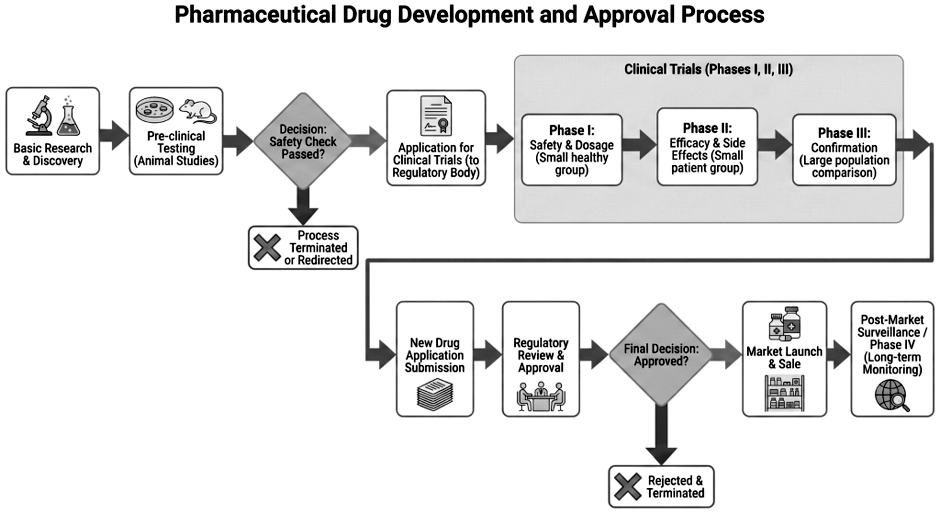
The diagram below illustrates the process by which a new medicine is developed, tested and approved for public use, followed by monitoring after it enters the market.
Summarise the information by selecting and reporting the main features.
Want to see your estimated band score?
Check your writing scorePart 1 · Band 9 Sample Answer
The diagram traces the development of a pharmaceutical medicine from the earliest research activities to regulatory approval and long-term observation after commercial release.
Overall, the procedure consists of discovery, pre-clinical assessment, three progressively larger clinical trials, and a formal approval stage. There are two decisive checkpoints at which an unsuccessful medicine may leave the process, while a product that clears both can enter the market but remains subject to continuing surveillance.
Initially, basic research and discovery produce a potential medicine, which is then examined in pre-clinical animal studies. The results are used for an initial safety decision. If the safety check is not passed, development is either terminated or redirected. By contrast, a successful candidate proceeds to an application to the regulatory body for permission to begin clinical trials.
Testing on humans is divided into three phases. Phase I establishes safety and dosage in a small group of healthy participants. Phase II uses a small patient group to evaluate efficacy and side effects, after which Phase III confirms the findings through comparison across a large population. Once these trials have been completed, a new drug application is submitted for regulatory review and approval.
A final decision then determines the outcome. Rejected applications are terminated, whereas approved medicines can be launched and sold. Following release, post-market surveillance, also described as Phase IV, provides long-term monitoring of the medicine in public use.
Part 1 · Band 8 Sample Answer
The diagram shows the stages involved in creating, testing and approving a new pharmaceutical product, as well as the monitoring that takes place after it is sold.
Overall, a medicine passes through research, animal testing, human trials and regulatory assessment before it can reach the market. The process contains two important decisions: failure at the first safety check leads to termination or redirection, while rejection at the final stage ends the application. Approved drugs continue to be monitored after launch.
The procedure begins with basic research and discovery. A promising product then undergoes pre-clinical testing on animals, followed by a decision about whether it has passed a safety check. An unsuccessful result causes the process to stop or move in another direction. If the medicine passes, an application to conduct clinical trials is made to the regulatory body.
There are three clinical phases. Phase I examines safety and dosage using a small group of healthy people. Phase II focuses on efficacy and side effects in a small group of patients. Phase III then confirms the results by making comparisons within a much larger population.
After the trials, the developer submits a new drug application. This is examined through regulatory review, leading to the final approval decision. A rejected medicine is terminated, whereas an approved one proceeds to market launch and sale. The final stage is post-market surveillance, or Phase IV, during which its long-term performance is monitored.
Part 1 · Band 7 Sample Answer
The diagram describes how a new medicine is researched, tested and approved before public sale, and how it is monitored afterwards.
Overall, the process starts with basic scientific research and ends with long-term monitoring after the medicine reaches the market. Before launch, the product must pass animal studies, three stages of human trials and regulatory review. It can be stopped at either of the two decision points if it does not meet the required conditions.
First, a possible new medicine is identified through basic research and discovery. It is then tested on animals during the pre-clinical stage. A safety check is carried out next. If the product fails this check, the work is terminated or redirected. If it passes, the developer applies to the regulatory body for permission to start clinical trials.
The clinical testing stage has three phases. Phase I tests safety and dosage on a small group of healthy people. Phase II studies whether the medicine is effective and records side effects in a small patient group. Phase III uses a large population to confirm the results and compare performance.
Next, a new drug application is submitted and reviewed by the regulator. A final decision is then made. Rejection causes the process to end, while approval allows the medicine to be launched and sold. Finally, post-market surveillance, known as Phase IV, monitors the medicine over the long term.