ACADEMIC WRITING SAMPLE ANSWERS

Academic Writing Sample Answers Practice 13 Test 02

This original practice page includes Task 1 (Dynamic Mixed Chart) and Task 2 (Advantages and Disadvantages Essay), with Band 9, Band 8, and Band 7 sample answers for IELTS preparation.
Academic Writing Task 1

Task 1 · Dynamic Mixed Chart

Task 1 Prompt

You should spend about 20 minutes on this task. Write at least 150 words.

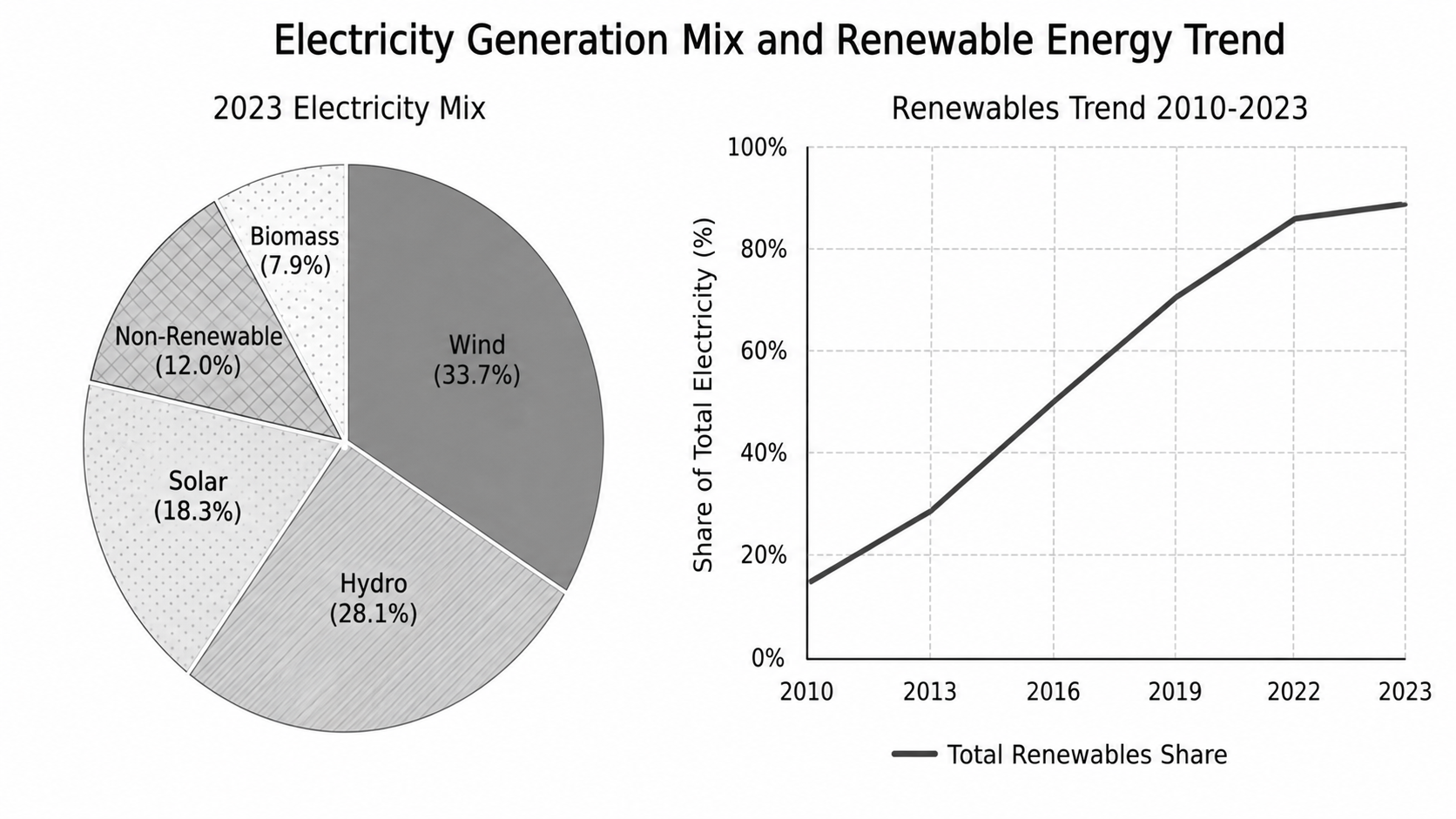
The pie chart and line graph below show the electricity generation mix in a European country in 2023 and the change in the total share of electricity generated from renewable sources between 2010 and 2023.

Summarise the information by selecting and reporting the main features, and make comparisons where relevant.
Academic Writing Task 1 Dynamic Mixed Chart practice image
BAND 9

Part 1 · Band 9 Sample Answer

The graphics compare the composition of electricity generation in a European nation in 2023 and trace the combined contribution of renewable sources from 2010 to 2023.

Overall, renewables dominated the electricity system by the end of the period, accounting for 88% of generation in 2023. Wind was the largest individual source, followed by hydro, while biomass made the smallest renewable contribution. The total renewable share increased continuously across the period, although its expansion slowed markedly after 2022.

In the 2023 mix, wind supplied 33.7% of all electricity, making it approximately 5.6 percentage points more important than hydro, at 28.1%. Together, these two technologies generated 61.8% of the total. Solar contributed a further 18.3%, whereas biomass represented only 7.9%. The four renewable categories therefore added up to exactly 88%, leaving non-renewable generation with the remaining 12%.

The line graph shows that renewable electricity initially accounted for about 15% of output in 2010. This figure almost doubled to roughly 29% by 2013 and then climbed particularly strongly, reaching 50% in 2016 and approximately 70% three years later. By 2022, the proportion had risen to around 86%. Growth was much more limited in the final year, when the share edged up by only about 2 percentage points to 88%. Across the full thirteen-year period, renewables consequently gained approximately 73 percentage points and became the overwhelmingly predominant basis of electricity production.

BAND 8

Part 1 · Band 8 Sample Answer

The pie chart presents the percentage breakdown of electricity production by source in a European country in 2023, while the line graph shows how the overall renewable share changed between 2010 and 2023.

Overall, renewable energy supplied the great majority of electricity in 2023, with wind and hydro together producing well over half of the national total. The share generated from renewables rose throughout the period, increasing most noticeably between 2013 and 2022 before growth became slower in the final year.

Wind was the leading source in 2023, at 33.7%, followed by hydro with 28.1%. Their combined contribution was 61.8%. Solar ranked third and represented 18.3% of generation, more than twice the proportion supplied by biomass, at 7.9%. These four renewable sources jointly accounted for 88% of all electricity, compared with just 12% from non-renewable sources.

Turning to the longer-term trend, renewables made up approximately 15% of total electricity in 2010. Their share rose to just under 30% in 2013 and reached 50% by 2016. It then continued to grow strongly, standing at around 70% in 2019 and roughly 86% in 2022. The upward movement was comparatively small between 2022 and 2023, when the figure increased by about 2 percentage points to 88%. Overall, the renewable share grew by around 73 percentage points, meaning that it was nearly six times its initial level by the end of the period.

BAND 7

Part 1 · Band 7 Sample Answer

The pie chart shows how electricity was generated from five sources in a European country in 2023. The line graph gives the total percentage of electricity from renewable energy between 2010 and 2023.

Overall, renewable sources were responsible for 88% of electricity generation in 2023, while non-renewable energy accounted for only 12%. Wind was the largest source in the mix, and the total renewable share increased steadily over the whole period. However, the increase between 2022 and 2023 was quite small.

In 2023, wind produced 33.7% of the country’s electricity and hydro supplied 28.1%. Together, they made up 61.8% of the total. Solar was the third-largest source, with a share of 18.3%. Biomass contributed 7.9%, making it the smallest renewable category. When these four sources are combined, their total of 88% matches the final figure shown on the line graph.

Renewables provided only about 15% of total electricity in 2010. The figure then increased to approximately 29% in 2013 before reaching 50% in 2016. Growth continued over the next three years, taking the proportion to around 70% in 2019. By 2022, renewable energy represented about 86% of generation. It then rose slightly to 88% in 2023. This means that the overall share increased by roughly 73 percentage points during the thirteen years.

Academic Writing Task 2

Task 2 · Advantages and Disadvantages Essay

Task 2 Prompt

You should spend about 40 minutes on this task. Write at least 250 words.

Write about the following topic:

The widespread adoption of remote learning, accelerated by technology, is transforming education. Some believe it offers greater flexibility and access, while others argue it leads to reduced social interaction and unequal learning outcomes.

Do the advantages of remote learning outweigh the disadvantages?

Give reasons for your answer and include any relevant examples from your own knowledge or experience.

BAND 9

Part 2 · Band 9 Sample Answer

Remote learning has moved from being a temporary substitute for the classroom to a permanent part of many education systems. It can weaken social development and intensify existing inequality, particularly when it is poorly implemented. Nevertheless, I believe its advantages outweigh its disadvantages because it removes major barriers to participation, while many of its shortcomings can be reduced through thoughtful design and public support.

Its strongest benefit is that learning is no longer tied to a particular place or rigid timetable. Students in remote areas can take courses that their local institutions do not offer, while people with disabilities, employment or caring responsibilities can study without travelling every day. Recorded lessons also allow learners to pause difficult explanations and revisit material at their own pace. At an institutional level, a single specialist course can reach students across several regions, making a wider curriculum economically possible.

The concerns, however, are substantial. Online lessons provide fewer opportunities for spontaneous conversation, friendship and face-to-face teamwork. Prolonged isolation may also reduce motivation, and subjects requiring laboratories, workshops or clinical practice cannot be fully reproduced on a screen. More seriously, students do not participate on equal terms. Reliable broadband, a quiet room and a personal computer may be routine in one household but unavailable in another. Learners with weaker independent-study skills may consequently fall behind even when they receive the same digital content.

These problems justify regulation and investment rather than the rejection of remote education. Governments and institutions can lend devices, subsidise internet access and provide local study centres. Courses can combine recorded material with live small-group seminars, individual tutoring and collaborative projects. Practical sessions and important social activities can remain in person through a hybrid model. Such measures directly address inequality and isolation, whereas a wholly classroom-based system still excludes many people who cannot attend at fixed times or locations.

Remote learning should not replace every classroom, especially for young children or highly practical training. Even so, its capacity to widen access, increase flexibility and diversify available courses is too valuable to abandon. Provided that digital provision is supported by targeted assistance and meaningful human contact, the benefits are greater than the disadvantages.

BAND 8

Part 2 · Band 8 Sample Answer

Technology has made it possible for students to attend lessons from almost anywhere, and remote learning is now common at many levels of education. Although online study can reduce personal contact and disadvantage students with limited resources, I believe its benefits are greater overall, provided that it is combined with appropriate support and some face-to-face activities.

The main advantage is flexibility. Students can learn from home, avoid long journeys and often view recorded material at a convenient time. This is particularly valuable for adults who work, parents with caring duties and people who live far from a college or university. Online delivery also expands educational choice. A learner in a small town, for example, may gain access to a specialist language or computing course that is not available locally. In addition, recorded lessons can be replayed, allowing students to review difficult points rather than losing information permanently.

Despite these strengths, remote learning creates genuine problems. Students have fewer informal conversations with classmates and teachers, which can make education feel lonely and reduce opportunities to practise communication and teamwork. Some may also become distracted or lose motivation without the routine of a physical classroom. Unequal access is another major concern. A student with fast internet, a modern computer and a quiet study space has an obvious advantage over someone sharing one device in a crowded home. These differences can produce unequal results.

However, most of these disadvantages can be limited. Schools can lend computers, help families obtain internet access and keep libraries or community study rooms open. Teachers can use live discussions, group assignments and regular individual meetings instead of relying entirely on recorded lectures. A hybrid arrangement can also preserve laboratory work, practical training and social events on campus while moving suitable academic content online.

Overall, remote learning should be treated as an additional route rather than a complete replacement for conventional education. It offers access and convenience to groups who might otherwise be excluded, and its main weaknesses can be reduced through funding and course design. For these reasons, I consider the advantages to outweigh the disadvantages.

BAND 7

Part 2 · Band 7 Sample Answer

Remote learning has become much more widely used because students can now join lessons and access materials through computers and the internet. This development offers flexibility and allows more people to study, but it can also reduce social contact and create unfair differences between learners. In my view, the advantages are greater, although online education needs proper support and should not completely replace classrooms.

One important benefit is that students can study without travelling to a school or university. This saves time and makes education available to people who live far from major towns. It also helps adults who have jobs or family responsibilities because they may be able to watch lessons at suitable times. Another advantage is access to a wider selection of courses. Students are not limited to the subjects offered by their nearest institution, and recorded classes can be watched again when a topic is difficult.

However, studying remotely can be an isolating experience. Students have fewer chances to make friends, speak informally with teachers or develop teamwork skills. Some learners also find it difficult to remain focused when they study alone at home. Furthermore, not every family can provide a good computer, reliable internet and a quiet room. Students without these resources may receive lower results even if they are capable and work hard. Online teaching is also less suitable for practical subjects that require special equipment.

These disadvantages can be reduced in several ways. Governments and schools can lend devices and provide affordable internet services to low-income students. Teachers can organise live discussions and group projects so that learners still communicate with one another. Schools can also use a mixed system in which theory lessons are delivered online but experiments, workshops and social activities take place in person.

In conclusion, remote learning gives many people greater access to education and makes study easier to fit around daily life. Reduced interaction and unequal resources are serious concerns, but they can be addressed through financial assistance and a combination of online and classroom teaching. Therefore, the benefits of remote learning outweigh its drawbacks.

FREE PRACTICE RESOURCES

Download the IELTS Practice PDF Pack.

Get Listening, Reading, and Writing practice materials for self-study. Use a computer to download the 1.9GB pack.

Download PDF Pack
Chat History
My Notes