ACADEMIC WRITING SAMPLE ANSWERS

Academic Writing Sample Answers Practice 13 Test 03

This original practice page includes Task 1 (Process Diagram) and Task 2 (Agree or Disagree Essay), with Band 9, Band 8, and Band 7 sample answers for IELTS preparation.
Academic Writing Task 1

Task 1 · Process Diagram

Task 1 Prompt

You should spend about 20 minutes on this task. Write at least 150 words.

The diagram below illustrates the steps involved in the processing and recycling of plastic waste at a municipal facility.

Summarise the information by selecting and reporting the main features.
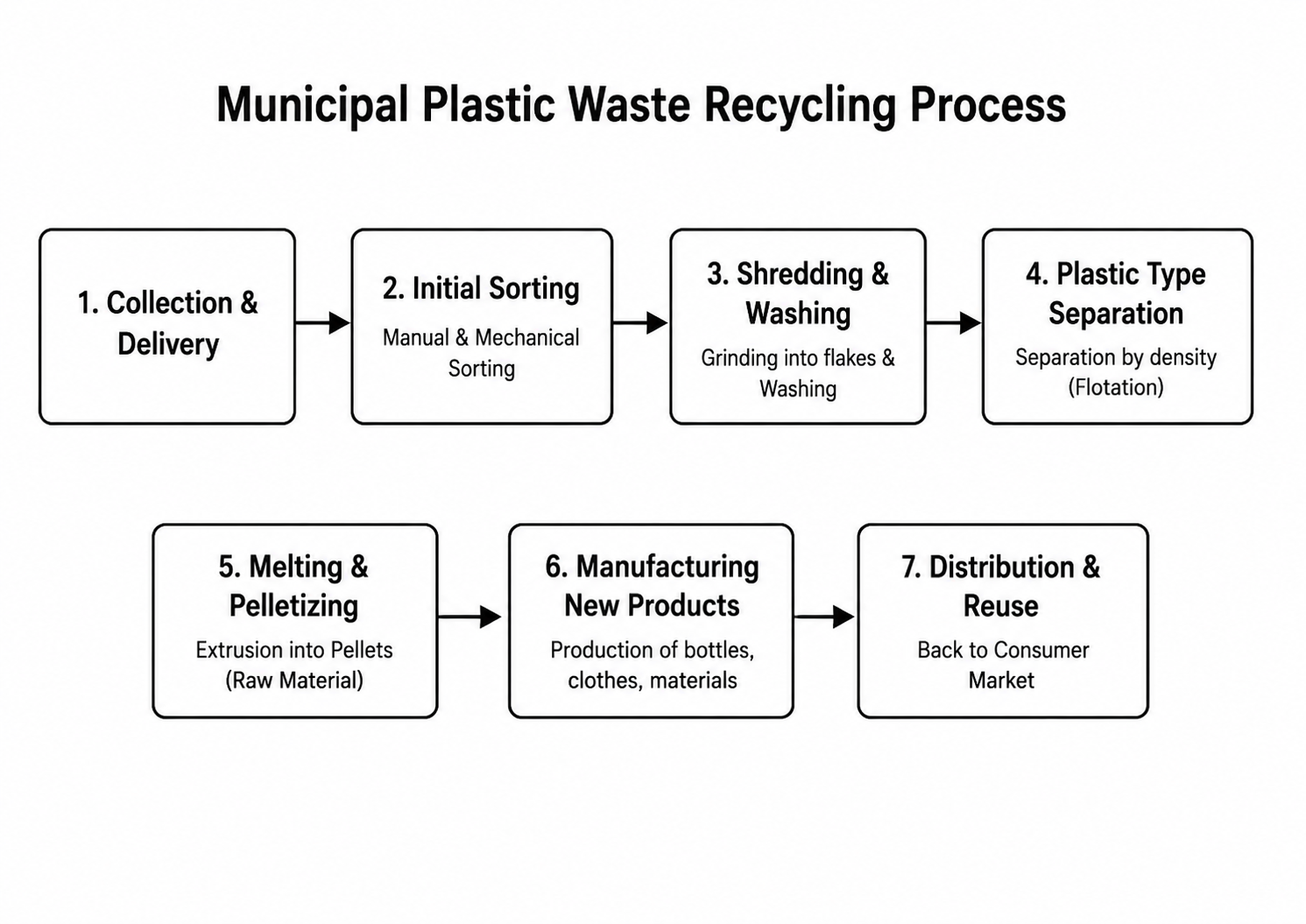
Academic Writing Task 1 Process Diagram practice image
BAND 9

Part 1 · Band 9 Sample Answer

The diagram outlines the seven-stage procedure used by a municipal facility to process discarded plastic and return it to the consumer market in new forms.

Overall, the operation is linear, beginning with the arrival of collected waste and ending with the distribution and reuse of products made from the recovered material. Broadly, the plastic is first sorted, cleaned and separated before being converted into pellets, which serve as the raw material for manufacturing.

At the initial stage, plastic waste is collected and delivered to the facility. It then undergoes preliminary sorting, for which both manual labour and mechanical equipment are employed. Once this classification has been completed, the selected plastic is shredded by being ground into flakes. These fragments are also washed during the same stage.

The clean flakes are subsequently divided according to plastic type. This is achieved through flotation, whereby differences in density allow the materials to be separated. Each appropriate plastic stream then passes to the fifth stage, where it is melted and extruded into small pellets. At this point, the waste has become usable manufacturing material rather than discarded plastic.

In the penultimate stage, the recycled pellets are used to produce a range of new goods, including bottles, clothing and other materials. These finished items are finally distributed for sale and reuse, bringing the recovered plastic back into the consumer market.

BAND 8

Part 1 · Band 8 Sample Answer

The diagram shows how plastic waste is treated and recycled in a municipal facility through a sequence of seven stages.

Overall, the process starts when waste plastic is collected and delivered, and finishes when newly manufactured goods are returned to the consumer market. Before new products can be made, the material is sorted, reduced to clean flakes, separated by type and transformed into pellets.

First, collected plastic is transported to the recycling facility. It is then sorted using a combination of manual and mechanical methods. Following this initial selection, the plastic is shredded, which involves grinding it into small flakes. These pieces are also washed so that they are clean enough for the later stages.

Next, the flakes are separated into different plastic types on the basis of density. This separation is carried out by flotation. The resulting material is then melted and pelletised: it is extruded into pellets that can be used as raw material for production.

At the manufacturing stage, the recycled pellets are converted into new products. The examples shown include plastic bottles, clothes and other materials. In the seventh and final stage, these goods are distributed and made available for reuse. They therefore return to the consumer market after the original plastic waste has passed through the complete municipal recycling procedure.

BAND 7

Part 1 · Band 7 Sample Answer

The diagram illustrates the seven steps used to process and recycle plastic waste at a municipal recycling facility.

Overall, the procedure begins with the collection and delivery of used plastic. It ends when new products are distributed back to consumers. The main parts of the process involve sorting the waste, cleaning and separating it, turning it into pellets, and using this material to manufacture new goods.

At the first stage, plastic waste is collected and delivered to the facility. It is then sorted both manually and mechanically. After this initial sorting, the selected plastic is shredded by grinding it into flakes. The flakes are also washed during this stage.

The clean pieces of plastic are next separated according to their type. This is done by flotation, which separates the materials based on their density. Once the different types have been divided, the plastic is melted. It is then extruded into pellets, which form the raw material needed for manufacturing.

In the sixth stage, manufacturers use these pellets to make new products. These can include bottles, clothes and various other materials. Finally, the completed goods are distributed and returned to the consumer market for reuse. In this way, waste plastic is changed from discarded material into useful products through a clear series of treatment and production stages.

Academic Writing Task 2

Task 2 · Agree or Disagree Essay

Task 2 Prompt

You should spend about 40 minutes on this task. Write at least 250 words.

Write about the following topic:

Some people believe that the most important factors for success in life are a person's level of intelligence and academic qualifications.

To what extent do you agree or disagree?

Give reasons for your answer and include any relevant examples from your own knowledge or experience.

BAND 9

Part 2 · Band 9 Sample Answer

Intelligence and formal education undoubtedly influence what opportunities a person can pursue. However, I largely disagree that they are the most important determinants of success. Their value depends heavily on the field concerned, whereas persistence, judgement, interpersonal ability and access to opportunity often have an equal or greater effect over an entire life.

There are strong reasons for valuing intellectual ability and qualifications. Intelligence can help people understand complex problems, learn quickly and make connections between different ideas. Academic credentials also provide evidence that someone has acquired relevant knowledge and discipline. In professions such as medicine, engineering and law, qualifications are not merely an advantage but a necessary safeguard: talent alone cannot replace systematic training. Strong educational results may therefore open doors to respected and well-paid careers.

Nevertheless, gaining entry to a career is different from succeeding within it. An exceptionally bright graduate who cannot manage setbacks, complete routine work or adapt to criticism may achieve less than a moderately gifted colleague who is dependable and persistent. Long-term achievement usually requires repeated effort after the excitement of learning has passed. This is particularly evident among business owners, skilled tradespeople and creative professionals, whose progress often depends on practical judgement and the willingness to improve through failure rather than on advanced degrees.

Success is also rarely an individual intellectual exercise. Most occupations require people to communicate clearly, earn trust, resolve disagreements and cooperate with others. A manager may understand a technical issue perfectly yet fail if unable to motivate a team. Moreover, family circumstances, financial security, professional networks and simple timing affect which opportunities are available. These influences do not make effort irrelevant, but they demonstrate why qualifications cannot explain outcomes by themselves.

Finally, success should not be limited to income or occupational status. If it includes supportive relationships, personal wellbeing and contribution to a community, emotional maturity and sound values become at least as important as academic attainment.

In conclusion, intelligence and qualifications are powerful enabling factors, especially in knowledge-intensive professions, but they are not universally the most important. Lasting success normally emerges from their interaction with perseverance, social competence, practical judgement and opportunity; without these, intellectual promise may never become meaningful achievement.

BAND 8

Part 2 · Band 8 Sample Answer

Many people associate success with being highly intelligent and obtaining strong academic credentials. These qualities can provide access to valuable opportunities, but I disagree that they are the most important factors in most cases. Personal discipline, communication skills and the ability to respond to difficulty are often more decisive in the long term.

Intelligence clearly offers certain advantages. People who understand new information quickly may perform well in complex occupations and solve problems efficiently. Qualifications are also essential for careers such as teaching, medicine and engineering because they show that a person has completed the required training. Employers frequently use degrees and certificates to select applicants, so academic achievement can make the beginning of a career considerably easier.

However, qualifications mainly help people enter a profession; they do not guarantee continued progress. Success normally requires consistent effort, including the willingness to perform ordinary tasks and continue after failure. A highly qualified employee who gives up whenever a project becomes difficult may be less successful than a colleague with average academic results but stronger determination. Adaptability is equally important because knowledge and workplace demands change. People must continue learning rather than depend permanently on what they studied at university.

Interpersonal qualities also influence outcomes. Employees need to explain ideas, cooperate with colleagues and build relationships with clients. These skills are especially important for managers and business owners, whose results depend partly on other people. Outside professional life, kindness, emotional control and responsible decision-making contribute to successful families and friendships, even though none of them is measured by an examination.

It is also necessary to recognise that people begin with unequal opportunities. Financial support, a stable home and access to useful contacts can affect whether intelligence is noticed and developed. Therefore, achievement cannot be explained only by personal ability or certificates.

Overall, intelligence and academic qualifications are important foundations, particularly in specialised careers, but they are only part of a much broader picture. I believe persistence, adaptability and the capacity to work well with others usually have greater influence on whether a person turns an initial opportunity into lasting success.

BAND 7

Part 2 · Band 7 Sample Answer

Intelligence and academic qualifications are often seen as the main signs that a person will be successful. Although both can be very useful, I disagree that they are always the most important factors. Hard work, practical skills and the ability to deal with people can matter just as much or even more.

There is no doubt that intelligent people may have an advantage in education and employment. They can often understand difficult information quickly and find solutions to complicated problems. Academic qualifications can also open the way to better job opportunities. For example, anyone wishing to become a doctor or an engineer must complete the necessary education and training. In these professions, intelligence and formal knowledge are clearly important.

However, neither quality guarantees success. A person may receive excellent grades but lack the motivation to work consistently. By comparison, someone with average academic ability may make steady progress because they are organised, patient and willing to learn from mistakes. Many goals take years to achieve, so determination is often more valuable than the ability to perform well in examinations. Practical experience can also teach lessons that are difficult to gain from books.

Communication and social skills are another major influence. Most people need to work with colleagues, understand customers or lead a team. A manager with several degrees may still fail if they cannot listen to employees or explain decisions clearly. Similarly, a business owner needs to earn the trust of customers as well as understand the product being sold.

Furthermore, success has different meanings. Some people measure it through income and career position, while others value a happy family, good health or useful work in their community. Academic qualifications may help with employment, but they do not automatically create strong relationships or personal satisfaction.

In conclusion, intelligence and education can give people knowledge and opportunities, especially in specialised careers. Nevertheless, I do not consider them the most important factors in every life. Persistence, practical judgement, communication skills and personal values are also essential, and success usually results from a combination of these qualities.

FREE PRACTICE RESOURCES

Download the IELTS Practice PDF Pack.

Get Listening, Reading, and Writing practice materials for self-study. Use a computer to download the 1.9GB pack.

Download PDF Pack
Chat History
My Notes