Task 1 · Static Mixed Chart
You should spend about 20 minutes on this task. Write at least 150 words.
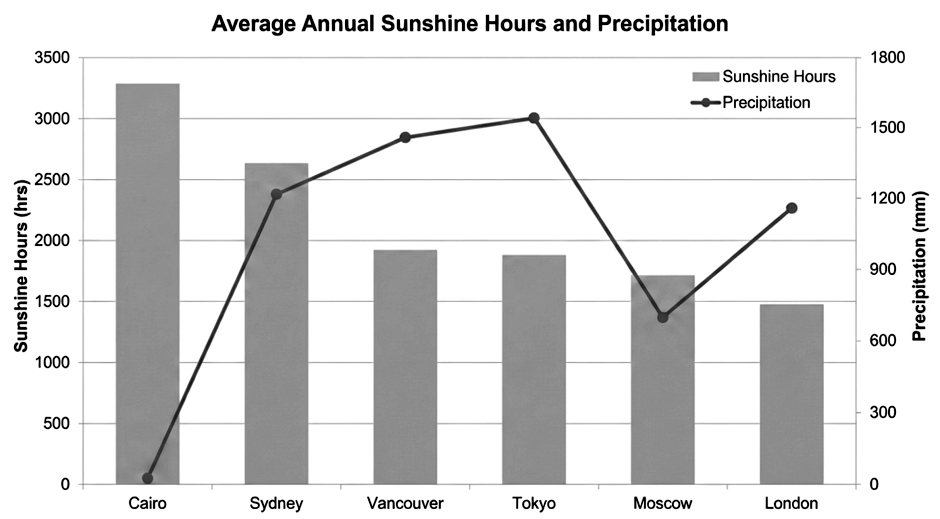
The bar chart and line graph below show the average annual hours of sunshine and the average annual precipitation in six selected cities around the world.
Summarise the information by selecting and reporting the main features, and make comparisons where relevant.
Want to see your estimated band score?
Check your writing scorePart 1 · Band 9 Sample Answer
The bar chart compares average yearly sunshine totals in six international cities, while the line graph presents their average annual precipitation.
Overall, Cairo was by far the sunniest and driest location, whereas London received the least sunshine. Tokyo recorded the greatest precipitation, closely followed by Vancouver. Although the less sunny cities generally had higher rainfall than Cairo, there was no consistent inverse relationship between the two measures, as illustrated particularly by Moscow.
Cairo enjoyed approximately 3,300 hours of sunshine annually, around 700 more than Sydney, the second-ranked city at roughly 2,600 hours. The remaining four locations all received fewer than 2,000 hours. Vancouver and Tokyo were similar, at about 1,900 hours each, although the former was marginally sunnier. Moscow registered approximately 1,700 hours, while London had the lowest total, at just under 1,500.
The precipitation figures followed a markedly different ranking. Cairo received almost no rain, with an annual total of only around 25 millimetres. This contrasted sharply with Sydney, whose figure was approximately 1,200 mm. Precipitation then rose to about 1,450 mm in Vancouver and peaked at roughly 1,550 mm in Tokyo, despite these two cities having nearly identical sunshine totals. Moscow interrupted this upward pattern: although it had the second-lowest amount of sunshine, its precipitation was only around 700 mm. Finally, London recorded approximately 1,150 mm, substantially more than Moscow but slightly less than Sydney.
Part 1 · Band 8 Sample Answer
The charts provide information about the average number of sunshine hours and the average amount of precipitation recorded annually in six cities worldwide.
Overall, Cairo had considerably more sunshine than any other city and almost no precipitation. At the other extreme, London recorded the fewest sunshine hours, while Tokyo was the wettest location. The ranking for precipitation did not simply reverse the ranking for sunshine, since Moscow was relatively dry despite receiving little sun.
Annual sunshine in Cairo stood at around 3,300 hours. Sydney ranked second with approximately 2,600 hours, about 700 fewer than Cairo. There was then a sizeable fall to Vancouver and Tokyo, which both received close to 1,900 hours, with Vancouver’s figure being slightly higher. Moscow had roughly 1,700 hours of sunshine, and London recorded the lowest total at about 1,500 hours.
Regarding precipitation, Cairo’s annual figure was negligible, at only around 25 mm. Sydney received approximately 1,200 mm, while the totals for Vancouver and Tokyo were higher, at roughly 1,450 mm and 1,550 mm respectively. Tokyo therefore had the greatest precipitation among the six cities. The figure then fell sharply to about 700 mm in Moscow before rising again to approximately 1,150 mm in London. Thus, London received about 450 mm more precipitation than Moscow even though it had around 200 fewer hours of sunshine. Vancouver and Tokyo, meanwhile, were very similar in sunshine but differed by roughly 100 mm in precipitation.
Part 1 · Band 7 Sample Answer
The bar chart shows the average annual hours of sunshine in six cities, and the line graph compares their average yearly precipitation in millimetres.
Overall, Cairo was the sunniest city and had by far the lowest level of precipitation. London received the least sunshine, whereas Tokyo recorded the highest amount of precipitation. In general, most cities with fewer sunshine hours had much more precipitation than Cairo, although Moscow was an exception.
Cairo had approximately 3,300 hours of sunshine per year, making it clearly higher than Sydney at around 2,600 hours. Vancouver and Tokyo each received close to 1,900 hours, with the figure for Vancouver being slightly greater. Sunshine was lower in Moscow, at roughly 1,700 hours, and London had the smallest total of about 1,500 hours.
There were large differences in precipitation. Cairo recorded almost none, at only around 25 mm annually. By comparison, the figure for Sydney was approximately 1,200 mm. Precipitation was even higher in Vancouver, at about 1,450 mm, and reached its highest point of roughly 1,550 mm in Tokyo. However, Moscow received only around 700 mm despite having relatively few hours of sunshine. Finally, London’s annual precipitation stood at approximately 1,150 mm. This was lower than the totals for Sydney, Vancouver and Tokyo but considerably higher than those for Cairo and Moscow.