Task 1 · Dynamic Table
You should spend about 20 minutes on this task. Write at least 150 words.
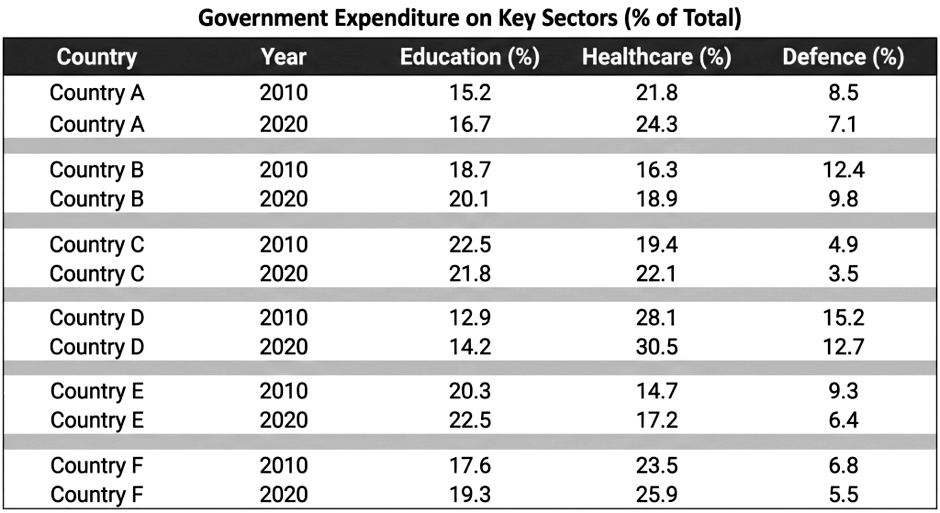
The table below shows the changes in the proportion of government expenditure on three key sectors across six countries from 2010 to 2020.
Summarise the information by selecting and reporting the main features, and make comparisons where relevant.
Want to see your estimated band score?
Check your writing scorePart 1 · Band 9 Sample Answer
The table compares the percentages of government spending allocated to education, healthcare and defence in six countries in 2010 and 2020.
Overall, expenditure shifted away from defence over the decade: its share fell in every country, while healthcare rose universally. Education also gained a larger proportion in all cases except Country C. Healthcare remained the largest sector in Countries A, D and F, whereas education generally led in B, C and E.
Country D consistently devoted the highest share to healthcare, increasing it from 28.1% to 30.5%. Countries A and F followed, rising from 21.8% to 24.3% and from 23.5% to 25.9% respectively. Elsewhere, healthcare grew from 16.3% to 18.9% in B, from 19.4% to 22.1% in C, and from 14.7% to 17.2% in E. Increases across this sector were notably similar, ranging from 2.4 to 2.7 percentage points.
Education showed more varied movement. Country C had the highest share in 2010, at 22.5%, but this slipped to 21.8%, allowing healthcare to become marginally larger there by 2020. Country E, by contrast, recorded the strongest rise, from 20.3% to a table-high 22.5% in 2020. Education also increased moderately in A, B, D and F, reaching 16.7%, 20.1%, 14.2% and 19.3% respectively.
Defence was the smallest category throughout. Country D spent the most on it in both years, despite a decline from 15.2% to 12.7%, while Country C recorded the lowest figures, falling from 4.9% to 3.5%. The steepest reduction occurred in Country E, at 2.9 percentage points.
Part 1 · Band 8 Sample Answer
The table presents the proportions of government expenditure assigned to education, healthcare and defence in six countries in 2010 and 2020.
Overall, all six governments increased the share spent on healthcare and reduced the proportion for defence. Education spending also rose in five countries, with Country C being the only exception. Healthcare received the largest allocation in Countries A, D and F, while education generally ranked first in B, C and E.
Healthcare expenditure increased by similar amounts across the countries. Country D had the highest figures, rising from 28.1% to 30.5%. Countries F and A followed, with their shares growing from 23.5% to 25.9% and from 21.8% to 24.3%. Country C recorded an increase from 19.4% to 22.1%, while B and E reached 18.9% and 17.2% respectively in 2020.
For education, Country C began with the largest allocation of 22.5%, but this declined slightly to 21.8%. Country E moved in the opposite direction, increasing from 20.3% to 22.5%, the highest level in 2020. The other four countries experienced rises of between 1.3 and 1.7 percentage points. Nevertheless, Country D continued to spend the smallest proportion on education, at 14.2% in 2020.
Defence accounted for the lowest share in every country. The largest allocation was in Country D, although it fell from 15.2% to 12.7%. Country B also dropped from 12.4% to 9.8%, while Country C reduced its already low share from 4.9% to 3.5%. The greatest fall was seen in Country E, from 9.3% to 6.4%.
Part 1 · Band 7 Sample Answer
The table shows how much of total government expenditure was spent on education, healthcare and defence in six countries in 2010 and 2020.
Overall, the percentage for healthcare increased in every country, while defence spending fell everywhere. Education also rose in all countries apart from Country C. Healthcare was the biggest category in Countries A, D and F, whereas education received the largest share in B and E. In Country C, education was highest in 2010, but healthcare became slightly higher by 2020.
Country D spent the largest proportion on healthcare in both years, with an increase from 28.1% to 30.5%. Healthcare also rose from 23.5% to 25.9% in Country F and from 21.8% to 24.3% in Country A. The figures for Countries B, C and E reached 18.9%, 22.1% and 17.2% respectively in 2020.
In education, Country C recorded the highest figure in 2010 at 22.5%, although this fell to 21.8% ten years later. Country E showed the greatest increase, from 20.3% to 22.5%. The proportions also grew in Countries A, B, D and F, reaching 16.7%, 20.1%, 14.2% and 19.3%. Country D had the lowest education spending in both years.
Defence was the smallest sector in all six countries. Country D had the highest defence share, but this decreased from 15.2% to 12.7%. Country B’s figure also fell, from 12.4% to 9.8%. Country C spent the least on this sector, at 4.9% in 2010 and 3.5% in 2020. Country E experienced the largest drop, of 2.9 percentage points.