Task 1 · Process Diagram
You should spend about 20 minutes on this task. Write at least 150 words.
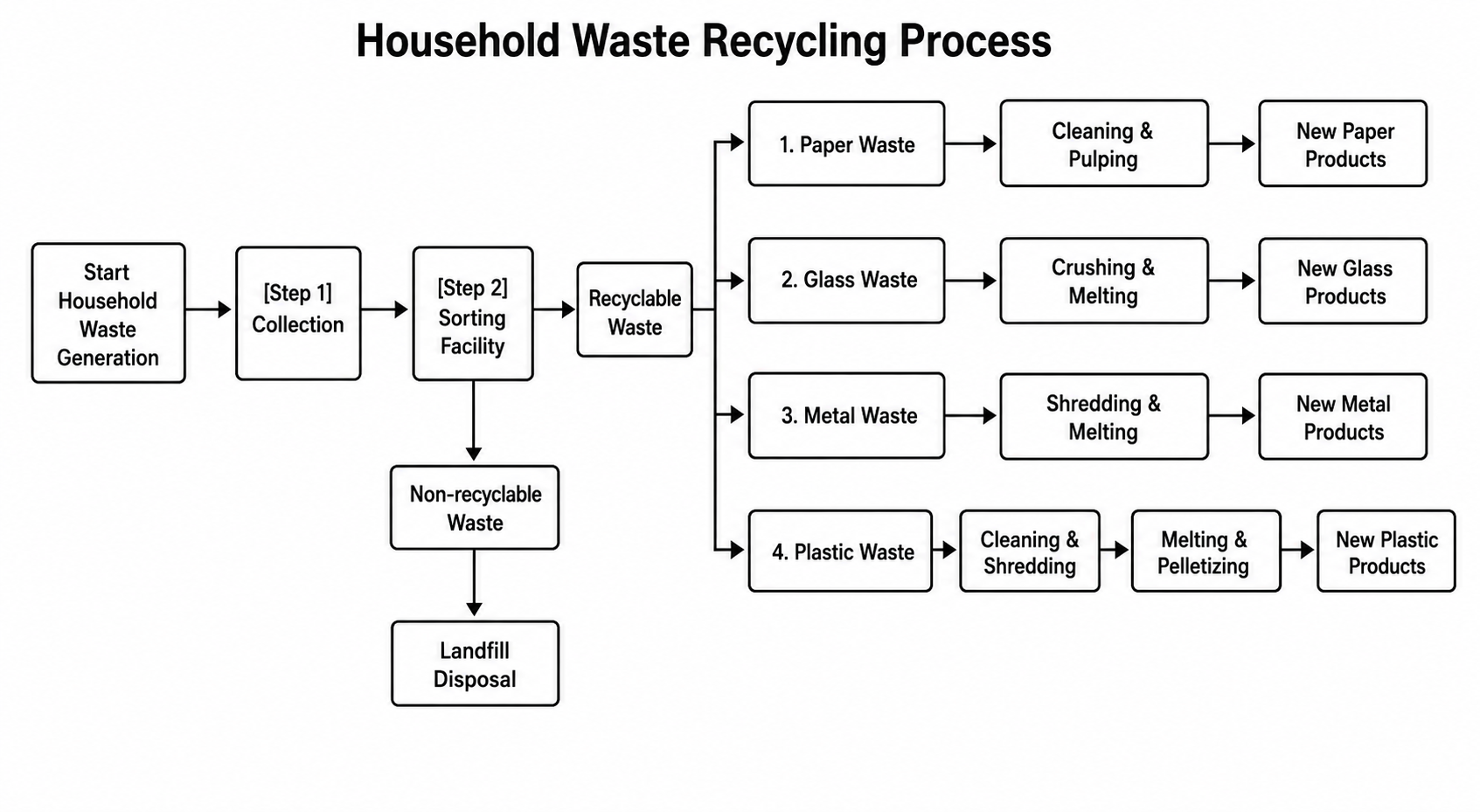
The diagram below shows the process by which household waste is recycled.
Summarise the information by selecting and reporting the main features, and make comparisons where relevant.
Want to see your estimated band score?
Check your writing scorePart 1 · Band 9 Sample Answer
The diagram illustrates how waste produced by households is collected, separated and either recycled into new goods or sent for final disposal.
Overall, the process begins with the generation and collection of domestic refuse, after which sorting creates two distinct outcomes. Material that cannot be recycled is deposited in landfill, whereas recyclable waste is divided into four streams: paper, glass, metal and plastic. Each recoverable material undergoes a dedicated treatment before becoming a new product, with plastic requiring the most separate processing stages.
Initially, household waste is generated and then gathered during the collection stage. It is subsequently transported to a sorting facility, where recyclable items are separated from the remainder. The non-recyclable portion leaves the recovery process at this point and is taken directly to landfill for disposal. By contrast, suitable material continues along one of four parallel recycling routes according to its composition.
Paper waste is cleaned and converted into pulp, from which new paper products are manufactured. Glass follows a different route: it is crushed and melted before being made into new glass goods. Similarly, discarded metal is shredded and melted to produce new metal products. The plastic stream involves an additional stage compared with the other three. After being cleaned and shredded, plastic is melted and formed into pellets, which are then used to create new plastic products. Thus, all four recyclable streams share the same broad endpoint despite differences in their treatment.
Part 1 · Band 8 Sample Answer
The diagram outlines the stages involved in recycling waste generated by households, from its initial collection to the production of new items or its disposal in landfill.
Overall, household refuse is first collected and sorted into recyclable and non-recyclable material. Waste that is unsuitable for recovery is sent to landfill, while the recyclable portion is separated into paper, glass, metal and plastic. These four materials are processed differently, although every recycling route ends with the manufacture of new products. Plastic has a slightly longer route than the other materials.
At the beginning of the process, households generate waste, which is then removed through a collection system. The collected refuse is delivered to a sorting facility. Here, non-recyclable waste is identified and diverted to landfill disposal, bringing that branch of the process to an end. The remaining recyclable waste is classified into four material groups before further treatment takes place.
In the first route, paper is cleaned and pulped, after which it is made into new paper products. Glass waste is crushed and melted to create new glass goods. Metal is treated in a similar general way, although it is shredded rather than crushed before melting and production of new metal items. Plastic needs two main processing phases: cleaning and shredding are followed by melting and pelletising. The resulting material is finally manufactured into new plastic products.
Part 1 · Band 7 Sample Answer
The diagram shows how household waste is dealt with through a recycling process, beginning with waste generation and ending with either new products or landfill disposal.
Overall, the collected waste is sorted into recyclable and non-recyclable categories. Non-recyclable material goes to landfill, while recyclable waste is divided into four types. Paper, glass, metal and plastic all become new products after suitable treatment, but the plastic route contains one more separate stage than the others.
First, waste is produced by households and collected. It is then taken to a sorting facility, where items that can be recycled are separated from those that cannot. The non-recyclable waste is sent down a different route and disposed of in landfill. Recyclable material continues through the system and is sorted into paper, glass, metal and plastic waste.
Each type is processed in a particular way. Paper waste is cleaned and pulped before new paper products are made. Glass is crushed and melted, leading to the production of new glass products. Metal waste is also melted, but it is shredded first, and the processed material becomes new metal goods. Finally, plastic is cleaned and shredded before moving to a further stage where it is melted and turned into pellets. New plastic products are then produced. Therefore, although the treatment methods differ, all four recycling paths convert used material into new goods.