ACADEMIC WRITING SAMPLE ANSWERS

Academic Writing Sample Answers Practice 15 Test 02

This original practice page includes Task 1 (Map) and Task 2 (Problems and Solutions Essay), with Band 9, Band 8, and Band 7 sample answers for IELTS preparation.
Academic Writing Task 1

Task 1 · Map

Task 1 Prompt

You should spend about 20 minutes on this task. Write at least 150 words.

The maps below show the changes that took place in a town centre between 2000 and 2025.

Summarise the information by selecting and reporting the main features, and make comparisons where relevant.
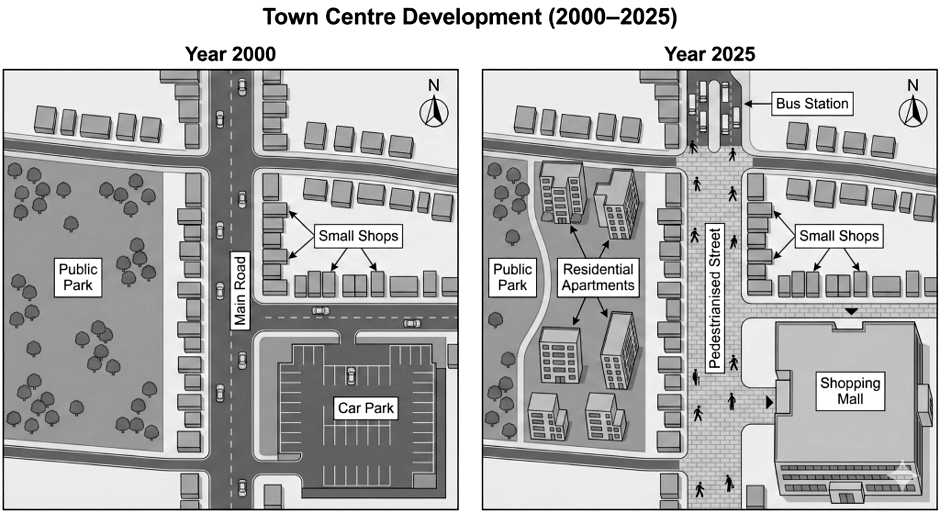
Academic Writing Task 1 Map practice image
BAND 9

Part 1 · Band 9 Sample Answer

The maps compare the layout of a town centre in 2000 with its appearance following redevelopment by 2025.

Overall, the centre became far more pedestrian-oriented and gained substantial residential and commercial facilities. The southern part of the main road was closed to traffic, a bus station was established at its northern end, and a shopping mall replaced the car park. Part of the public park also made way for apartments, although a smaller green area and many existing shops remained.

In 2000, the main road ran north–south, crossing another road near the top of the map and meeting an eastbound street farther south. Small shops lined the main road and the streets to its east. A large car park occupied the south-eastern corner, while an extensive tree-filled public park covered most land to the west.

By 2025, the main road south of the northern junction and the former eastbound street had been converted into a broad pedestrianised zone. A bus station had been constructed immediately north of the junction. The shops around the eastern block and along the western edge of the walkway were largely retained.

The shopping mall occupied the former car-park site in the south-east. Opposite it, several apartment blocks were built across the central and eastern parts of the old park. Consequently, the park was reduced to a narrower area along the western side, still extending from the northern road towards the southern boundary.

BAND 8

Part 1 · Band 8 Sample Answer

The two maps illustrate how a town centre changed over the 25 years from 2000 to 2025.

Overall, the area was transformed from a car-focused centre into one with extensive pedestrian space and public transport facilities. A shopping mall replaced the car park, while the main road became a pedestrianised street. Apartments were also constructed on part of the public park, although a smaller park and most rows of shops were preserved.

In 2000, a main road passed vertically through the centre and crossed an east–west road in the north. Farther south, another road extended towards a large car park in the south-east. Small shops stood along the main road and around the block east of it. A sizeable tree-filled public park lay to the west.

By 2025, the main road south of the northern junction had been closed to vehicles and paved for pedestrians. The road leading east was also incorporated into this zone, beside a new shopping mall on the former car-park site. A bus station was added just north of the junction, and most surrounding shops stayed in place.

West of the centre, several apartment buildings were developed in the middle and eastern portion of the former park. As a result, the park became much smaller and was limited mainly to a strip along the western side, where numerous trees remained.

BAND 7

Part 1 · Band 7 Sample Answer

The maps show the changes made to a town centre between 2000 and 2025.

Overall, the centre became more suitable for pedestrians and gained new shopping, housing and public transport facilities. A shopping mall replaced the car park, and much of the main road became a pedestrian street. The park was reduced to provide land for apartments, while most small shops remained.

In 2000, the main road ran north–south through the centre. It crossed a road near the northern end, while another road led east towards a large car park in the south-east. Small shops stood beside these roads, and a large public park filled most of the western half.

In 2025, the section of the main road below the northern junction no longer carried vehicles. It became a wide pedestrian street, and the former road towards the car park was also paved for people on foot. A bus station was built north of the junction. The rows of shops beside the central area were largely unchanged.

The former car park was occupied by a large shopping mall. Across the pedestrian street, several apartment blocks had been constructed on the eastern and central parts of the old park. This left a smaller area of parkland along the western side, where groups of trees were retained.

Academic Writing Task 2

Task 2 · Problems and Solutions Essay

Task 2 Prompt

You should spend about 40 minutes on this task. Write at least 250 words.

Write about the following topic:

In many countries, people are working longer hours and taking fewer holidays.

What problems does this cause for individuals and society?

What measures could be taken to address these problems?

Give reasons for your answer and include any relevant examples from your own knowledge or experience.

BAND 9

Part 2 · Band 9 Sample Answer

In many economies, extended working weeks and infrequent holidays have become normal rather than exceptional. Although this pattern may appear to increase output, its human and social costs are considerable. It damages health and relationships, while ultimately weakening the productivity and cohesion on which economies depend. Addressing it requires both enforceable labour protections and changes to workplace incentives.

At an individual level, sustained overwork leaves insufficient time for sleep, exercise and mental recovery. Fatigue can develop into chronic stress or burnout, reducing concentration and increasing the likelihood of mistakes and accidents. Personal relationships also suffer when workers repeatedly miss family meals, social events or opportunities to care for relatives. Holidays are especially important because a few free evenings cannot provide the deeper recovery or shared experiences offered by an uninterrupted break. In severe cases, people may remain employed yet become progressively less healthy, motivated and effective.

These effects accumulate across society. Exhausted employees can provide poorer service, make unsafe decisions and take more sickness absence, creating costs for employers and public healthcare systems. Families in which adults have little time for children or older relatives may require additional external support. Community participation can also decline because workers are unavailable for volunteering, local organisations or civic life. Moreover, a culture that rewards constant availability can exclude carers and people with health limitations, wasting capable workers and reinforcing inequality.

Governments should therefore establish meaningful limits on working time, guarantee paid annual leave and ensure that employees can actually use their entitlement. Rules must cover indirect pressures as well as formal schedules; a legal right to disconnect from routine messages outside working hours would help prevent unpaid work from invading private life. Labour inspectors and accessible complaint procedures are necessary, since protections that exist only on paper will not change behaviour.

Employers also have a central role. They should set realistic workloads, recruit enough staff and evaluate performance by results rather than visible hours. Managers ought to plan holiday cover so that taking leave does not burden colleagues or damage promotion prospects. Flexible schedules can help workers meet caring responsibilities, but they should not become a means of making staff permanently reachable.

In conclusion, excessive work and inadequate holidays harm physical health, emotional wellbeing, families and the wider functioning of society. Enforced minimum standards, combined with responsible staffing and a workplace culture that respects genuine time off, would protect employees without sacrificing sustainable economic performance.

BAND 8

Part 2 · Band 8 Sample Answer

People in many nations now spend more time at work and take less annual leave than before. This trend creates serious difficulties not only for employees but also for families, employers and public services. The most effective response would combine stronger government regulation with practical changes in the way organisations manage their staff.

The clearest problem for individuals is damage to physical and mental health. Long working days often reduce the time available for sleep, exercise and relaxation. Without regular holidays, stress can continue for months without a proper period of recovery, eventually leading to exhaustion and loss of motivation. Family life may also be affected. Parents who arrive home late have fewer opportunities to support their children, while friendships and partnerships can weaken when work repeatedly takes priority. As concentration falls, overworked people may also make more errors or face a greater risk of accidents.

Society experiences the combined effect of these personal problems. Businesses may initially gain from longer schedules, but tired staff are often less productive and more likely to take sick leave or resign. This creates recruitment costs and reduces the experience available within organisations. Public healthcare services may face additional pressure from stress-related illness. Furthermore, when citizens have little free time, they are less able to care for relatives, volunteer locally or participate in community activities. Society can therefore become less healthy and less connected.

Several measures could improve the situation. Governments should enforce maximum working hours, minimum rest periods and a reasonable amount of paid holiday. Employees should also be protected from punishment when they use their leave. Where digital communication has extended the working day, a right to ignore non-urgent work messages during personal time could create a clearer boundary between employment and home life.

Employers should examine why excessive hours are necessary. If the cause is a staff shortage or an unrealistic workload, they should recruit more workers, redistribute tasks or revise deadlines. Managers can set a good example by taking their own holidays and avoiding unnecessary evening emails. Performance should be judged mainly by the quality of completed work rather than the number of hours someone remains at a desk.

In conclusion, longer hours and fewer holidays can cause poor health, damaged relationships and weaker social participation, while also reducing long-term organisational performance. Effective laws and better management practices are both required to ensure that work remains productive without taking over people’s lives.

BAND 7

Part 2 · Band 7 Sample Answer

Working long hours and taking very few holidays has become common in many countries. This situation may help a company complete more work in the short term, but it causes a range of problems for workers and society. Governments and employers should both take action to give people enough time to rest.

One major problem is the effect on individual health. People who work late may not sleep properly, exercise regularly or prepare healthy meals. If this continues, they can become physically tired and mentally stressed. A lack of holidays also means that workers do not have a longer period in which to recover. Their family relationships may suffer because they miss time with their partners, children or older relatives. Tired employees are also less able to concentrate, so they may make mistakes at work or while travelling.

There are wider consequences for society. Stress and exhaustion can lead to more sickness absence and greater demand for healthcare. Companies may lose experienced workers if employees resign because they cannot manage the pressure. In addition, people with almost no free time are less likely to help neighbours, join local groups or care for family members. Although longer hours seem productive, the quality of work can fall when employees are constantly tired. This means that the economic benefit may not last.

Governments can address these problems by setting and enforcing limits on weekly working hours. They should also require employers to provide paid annual leave and make sure workers are allowed to take it. Clear rules about rest breaks and messages outside working hours would prevent companies from extending the working day informally. Workers must have a safe way to report employers that ignore these standards.

Employers should also improve their own practices. They can hire enough staff, share work fairly and set deadlines that can be met during normal hours. Managers should encourage employees to use their holidays rather than making them feel guilty for being absent. Flexible working arrangements may help parents and carers, provided that flexibility does not mean being available all day.

In conclusion, overwork harms health, family relationships, workplace performance and community life. Stronger employment rules, realistic workloads and genuine respect for holidays would allow people to remain productive while still having a healthy life outside work.

FREE PRACTICE RESOURCES

Download the IELTS Practice PDF Pack.

Get Listening, Reading, and Writing practice materials for self-study. Use a computer to download the 1.9GB pack.

Download PDF Pack
Chat History
My Notes