Task 1 · Static Table
You should spend about 20 minutes on this task. Write at least 150 words.
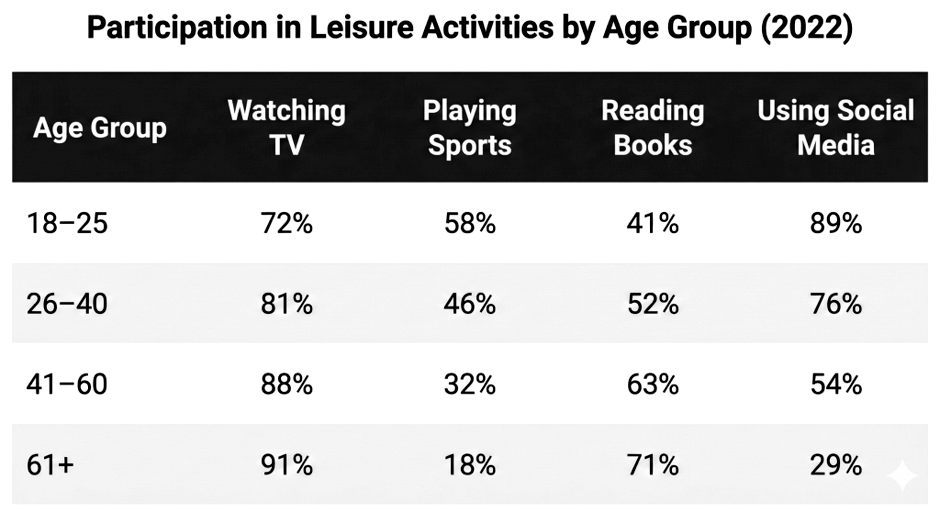
The table below shows the percentages of adults in four age groups who participated in different leisure activities in one country in 2022.
Summarise the information by selecting and reporting the main features, and make comparisons where relevant.
Want to see your estimated band score?
Check your writing scorePart 1 · Band 9 Sample Answer
The table compares the proportions of adults in four age categories who engaged in four leisure activities in a particular country in 2022.
Overall, participation followed two contrasting age-related patterns. Watching television and reading became progressively more common in older groups, whereas both playing sports and using social media declined with age. Television recorded the highest figure among adults aged 26 and above, while social media was dominant among the youngest participants.
Television participation rose steadily from 72% among 18–25-year-olds to 81% for those aged 26–40 and 88% in the 41–60 category, before reaching a table-wide high of 91% among people aged at least 61. Reading followed a similar upward pattern, increasing from 41% to 52%, 63% and 71% across the four successive groups. The gap between the two activities therefore narrowed from 31 percentage points in the youngest group to 20 in the oldest.
By contrast, the sports figure fell consistently with age, from 58% to 46%, 32% and finally 18%. Social media use declined even more sharply: its respective rates were 89%, 76%, 54% and 29%, producing a 60-point difference between the youngest and oldest adults. It was the leading pursuit among 18–25-year-olds, ahead of television by 17 points, but had already been overtaken by TV in the next group. Among those aged 61 or above, social media and sports were less than half as common as reading, making the age divide particularly pronounced for these two activities.
Part 1 · Band 8 Sample Answer
The table presents the percentages of adults from four age groups who took part in watching television, playing sports, reading books and using social media in one country during 2022.
Overall, older adults were more likely to watch television and read, while younger people showed greater participation in sports and social media. Watching TV was the leading activity in every group except those aged 18–25, for whom social media was clearly the most popular choice.
In the youngest category, 89% used social media, compared with 72% who watched television. Playing sports attracted 58%, whereas reading had the lowest rate in this group, at 41%. Among 26–40-year-olds, television rose to 81% and became slightly more common than social media at 76%. The reading figure increased to 52%, while sports participation declined to 46%.
The differences were larger among older adults. In the 41–60 age group, television remained well ahead at 88%, followed by reading at 63%. Social media participation decreased to 54%, and only 32% played sports. For the oldest group, the figures for television and reading reached 91% and 71% respectively. By contrast, social media fell to 29%, and sport was least common at 18%.
From the youngest to the oldest group, social media use experienced the largest overall fall, amounting to 60 percentage points. Sports participation also dropped substantially, by 40 points. Meanwhile, reading rose by 30 points, which was a greater increase than the 19-point growth in television viewing.
Part 1 · Band 7 Sample Answer
The table shows the percentages of adults in four different age groups who participated in four leisure activities in one country in 2022.
Overall, watching television and reading books were more common among older people, while playing sports and using social media were more popular among younger adults. Television had the highest participation rate in three age groups, but social media was the leading activity for those aged 18–25.
In the youngest group, 89% used social media and 72% watched television. Smaller proportions played sports and read books, at 58% and 41% respectively. Among adults aged 26–40, television was the most common activity at 81%, just above social media at 76%. Reading was reported by 52% of this group, compared with 46% who participated in sports.
For people aged 41–60, the percentage watching television increased to 88%, while reading reached 63%. Social media use was lower at 54%, and sport accounted for only 32%. The oldest adults showed the highest rates of television viewing and reading, at 91% and 71%. However, only 29% used social media and 18% played sports.
The biggest difference between the youngest and oldest groups was in social media use, which fell by 60 percentage points. Sports participation declined by 40 points. In comparison, reading increased by 30 points across the age groups, and watching television rose more moderately by 19 points.