ACADEMIC WRITING SAMPLE ANSWERS

Academic Writing Sample Answers Practice 15 Test 04

This original practice page includes Task 1 (Dynamic Multiple-Line Graph) and Task 2 (Advantages and Disadvantages Essay), with Band 9, Band 8, and Band 7 sample answers for IELTS preparation.
Academic Writing Task 1

Task 1 · Dynamic Multiple-Line Graph

Task 1 Prompt

You should spend about 20 minutes on this task. Write at least 150 words.

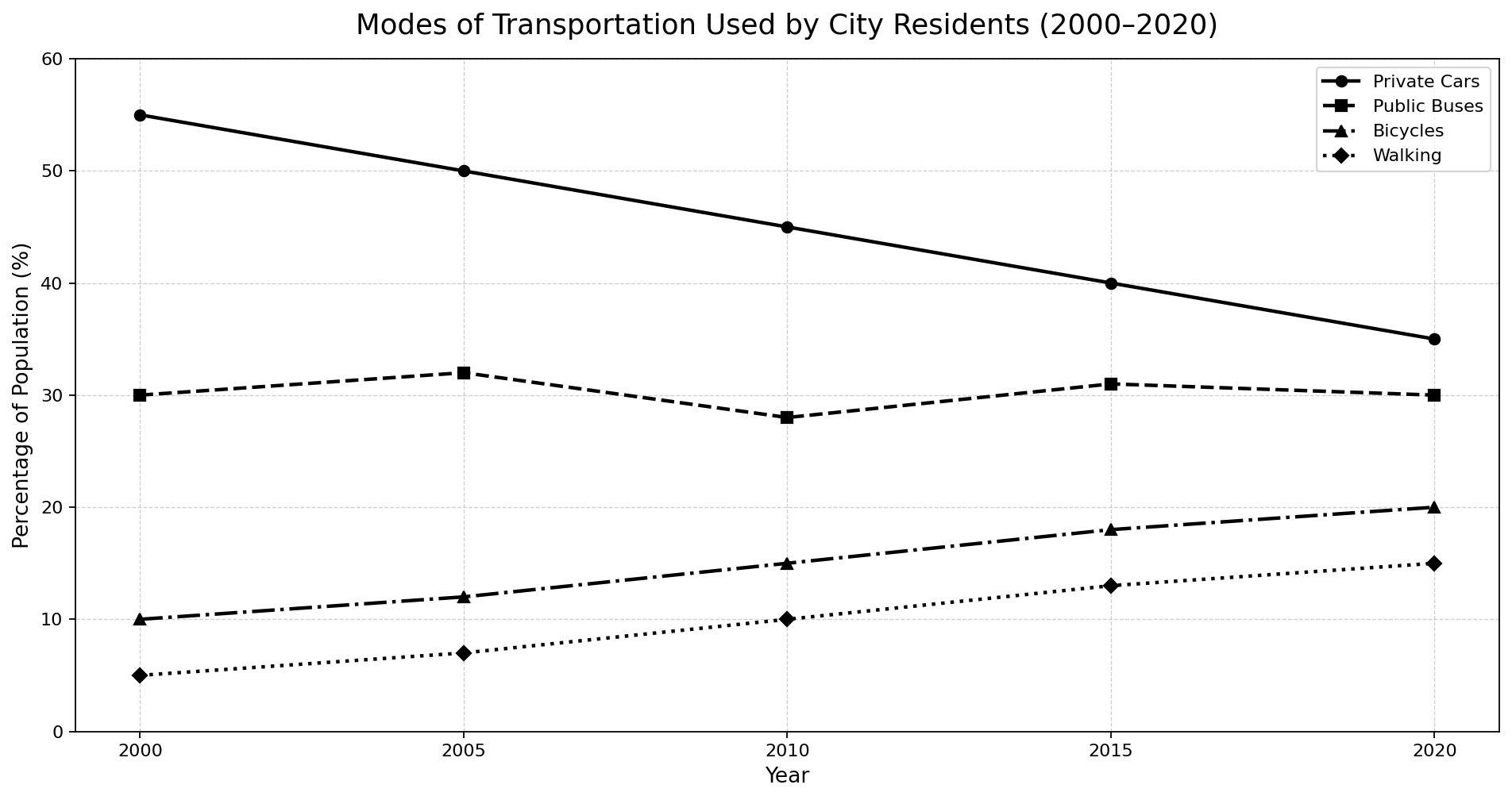
The line graph below shows the percentage of the population using different forms of transportation in a city between 2000 and 2020.

Summarise the information by selecting and reporting the main features, and make comparisons where relevant.
Academic Writing Task 1 Dynamic Multiple-Line Graph practice image
BAND 9

Part 1 · Band 9 Sample Answer

The line graph compares the proportions of residents in a city who used private cars, public buses, bicycles and walking at five-year intervals from 2000 to 2020.

Overall, private cars remained the most widely used form of transport throughout the period, despite a substantial and uninterrupted decline. Bus use fluctuated within a narrow range and ended at its initial level, whereas both cycling and walking became steadily more prevalent. Consequently, the differences between car use and the other modes, particularly buses, narrowed considerably.

In 2000, 55% of the population used private cars, 25 percentage points more than the figure for public buses. Car use then fell by exactly five points during each five-year interval, reaching 50% in 2005, 45% in 2010 and 40% in 2015 before finishing at 35%. By contrast, bus use edged up from 30% to a peak of 32% in 2005. It subsequently dropped to its low of 28% in 2010, recovered to 31% five years later and returned to 30% in 2020. The gap between these two motorised modes therefore contracted from 25 points to only five.

The two active forms of travel followed parallel upward trajectories. Bicycle use doubled from 10% in 2000 to 20% in 2020, rising successively to 12%, 15% and 18% in the intervening years. Walking also gained ten percentage points overall, tripling from 5% to 15%, with intermediate figures of 7%, 10% and 13%. Although walking remained the least common option in every year, it stayed consistently five points below cycling.

BAND 8

Part 1 · Band 8 Sample Answer

The graph illustrates the percentages of people in a city using four modes of transportation between 2000 and 2020, with figures given every five years.

Overall, private cars were used by the largest proportion of residents in every year, but their popularity declined steadily. Public bus use changed only slightly and showed no overall growth, while the percentages for cycling and walking rose continuously. By 2020, the four figures were therefore much closer together than they had been in 2000.

At the start of the period, private cars were used by 55% of the population, compared with 30% for buses. The car figure then decreased regularly to 50% in 2005 and 45% in 2010. It continued falling to 40% in 2015 and reached 35% by 2020, representing an overall reduction of 20 percentage points.

Bus use followed a less consistent pattern. It increased slightly from 30% to 32% in 2005, before falling to 28% in 2010. The percentage then recovered to 31% in 2015 and ended at 30%, the same as its starting point. As a result, the difference between cars and buses fell sharply from 25 points to five.

Cycling rose from 10% in 2000 to 12% in 2005, 15% in 2010 and 18% in 2015, finally reaching 20%. Walking remained less common but experienced similar growth, increasing from 5% to 7%, 10%, 13% and 15%. Both modes consequently gained ten percentage points, with bicycles consistently five points ahead of walking.

BAND 7

Part 1 · Band 7 Sample Answer

The line graph shows the percentages of city residents who used private cars, public buses, bicycles and walking between 2000 and 2020.

Overall, private cars were the most common form of transport during the whole period, although their use fell steadily. Bus use changed several times but finished at the same level at which it began. In comparison, cycling and walking both became more popular, while walking remained the least widely used mode.

In 2000, 55% of residents used private cars. This figure fell to 50% in 2005 and 45% in 2010. The decline continued over the following decade, with car use reaching 40% in 2015 and 35% in 2020. Public bus use started at 30% and rose slightly to 32% in 2005. It then dropped to 28% in 2010, before recovering to 31% and finally returning to 30%.

The percentage using bicycles increased at every point shown. It rose from 10% in 2000 to 12% in 2005, and then reached 15% in 2010. Further growth took the figure to 18% in 2015 and 20% at the end of the period. Walking followed the same general pattern, rising from 5% to 7%, 10%, 13% and 15% respectively.

Therefore, car use declined by 20 percentage points overall, while both cycling and walking increased by ten points. The difference between private cars and buses also became much smaller, falling from 25 points in 2000 to only five in 2020.

Academic Writing Task 2

Task 2 · Advantages and Disadvantages Essay

Task 2 Prompt

You should spend about 40 minutes on this task. Write at least 250 words.

Write about the following topic:

Many people believe that international tourism creates understanding between countries, while others argue that it causes more problems than benefits.

Do the advantages of international tourism outweigh the disadvantages?

Give reasons for your answer and include any relevant examples from your own knowledge or experience.

BAND 9

Part 2 · Band 9 Sample Answer

International tourism is credited with bringing societies closer together, yet it is also associated with environmental damage, overcrowding and cultural disruption. In my view, its advantages do outweigh its disadvantages, but this judgement is conditional: the benefits arise most reliably when governments manage visitor numbers and ensure that local communities share the rewards.

Travel can promote international understanding in ways that second-hand information cannot. Visitors encounter ordinary people, customs and social conditions that may contradict simplistic images of a country. Equally, residents who interact with travellers can discover that foreigners are more varied than political rhetoric or media stereotypes suggest. A brief holiday will not automatically create deep cultural knowledge, and some tourists remain within isolated resorts. Nevertheless, respectful contact in homestays, local restaurants, museums or guided tours can encourage curiosity and reduce prejudice. Repeated across millions of individual encounters, this is a meaningful diplomatic benefit even if it is difficult to quantify.

Tourism also directs income towards places that may have limited alternatives. It supports accommodation, transport and attractions, but its effects extend to farmers, craftspeople and small businesses supplying the visitor economy. Revenue from entrance fees can finance the protection of historic buildings, wildlife and landscapes that might otherwise receive little funding. Furthermore, tourism is not restricted to major industrial centres, so it can create opportunities in rural or coastal regions from which residents might otherwise have to migrate.

The disadvantages, however, are substantial. Flights and cruise ships generate emissions, while heavy visitor demand can strain water supplies, housing, waste systems and public spaces. In popular destinations, short-term rentals may displace residents and seasonal employment may be insecure. Cultural exchange can also become superficial or disrespectful when traditions are reduced to commercial performances. If most revenue flows to foreign-owned operators, local people may endure these pressures without receiving a fair economic return.

These harms justify regulation rather than the rejection of international tourism. Authorities can limit access to fragile sites, regulate holiday accommodation, charge conservation fees and invest the proceeds in infrastructure. Supporting locally owned enterprises and requiring decent employment standards would retain more value within host communities. Better rail connections and longer, less frequent trips could also reduce the environmental cost per day of travel.

In conclusion, international tourism can damage destinations when growth is treated as an end in itself. Even so, the combination of cultural contact, regional employment and funding for heritage gives it greater potential benefits. With firm environmental and social safeguards, its advantages outweigh its disadvantages; without them, the balance can easily reverse.

BAND 8

Part 2 · Band 8 Sample Answer

The growth of international tourism has allowed more people to experience foreign cultures, but it has also created pressure on host communities and the environment. I believe the advantages are greater overall because tourism encourages contact between nationalities and provides important economic opportunities. However, these gains depend on effective regulation.

One major advantage is greater cultural understanding. Travellers can learn directly about local customs, food, history and everyday life instead of depending entirely on news reports or stereotypes. Local residents also have opportunities to meet people from different backgrounds. Although a short visit cannot provide complete knowledge of another society, friendly conversations and shared experiences can make foreign cultures seem less distant. This may not solve political disagreements, but it can encourage greater openness and respect between ordinary people.

International tourism also creates employment and business income. Hotels, restaurants, tour companies and transport services hire local workers, while visitors spend money in shops and markets. This can be particularly valuable in areas with attractive scenery or historic sites but few large industries. Tourism revenue may also pay for the restoration of monuments and the protection of natural areas. When local businesses participate fully, the benefits can spread through the community rather than going to a single employer.

On the other hand, popular destinations can suffer from overcrowding, pollution and rising living costs. Large numbers of visitors create waste and place pressure on water, roads and public transport. Demand for holiday accommodation can increase rents and make central neighbourhoods less affordable for residents. Tourism jobs may be seasonal or poorly paid, and some visitors behave without respect for local customs. In addition, frequent air travel contributes to environmental problems beyond the destination itself.

These disadvantages can be reduced through sensible policies. Governments can restrict visitor numbers at vulnerable locations, control short-term rentals and use tourist taxes to improve public services and conservation. They should also support locally owned accommodation and tour providers so that more income remains in the region. Clear information and penalties for damaging behaviour can encourage visitors to treat communities and natural sites responsibly.

In conclusion, tourism can create serious difficulties if destinations pursue unlimited growth. Nevertheless, its contribution to cultural exchange, employment and heritage protection is more significant in my view. Provided that authorities control its environmental and social effects, the advantages of international tourism outweigh the disadvantages.

BAND 7

Part 2 · Band 7 Sample Answer

International tourism has become an important activity in many countries. Some people believe it improves understanding between nations, while others focus on problems such as pollution and overcrowding. In my opinion, the advantages outweigh the disadvantages because tourism supports cultural exchange and local economies, although governments must manage it carefully.

The first benefit is that people can learn about other cultures through direct experience. Tourists may visit historical places, try local food and speak to residents. This can correct false ideas that they had before travelling and help them respect different ways of life. People in the host country can also learn about the backgrounds of their visitors. A holiday does not always create a deep understanding of another nation, but positive contact can still reduce prejudice and make people more open-minded.

Tourism also brings economic benefits. Visitors spend money on hotels, transport, restaurants, guides and souvenirs. This creates jobs and gives small businesses more customers. It can be especially useful in rural areas where there are few other employment opportunities. Money from tourism can also be used to maintain museums, historic buildings and national parks. Therefore, both individuals and public attractions may benefit from international visitors.

However, there are clear disadvantages. Too many tourists can make town centres, beaches and natural sites crowded. They produce additional waste and use local water and transport services. In some places, homes are changed into holiday accommodation, which can raise rents for local families. Tourism also causes emissions because many visitors travel by air. Finally, disrespectful behaviour can offend residents rather than create cultural understanding.

Governments can reduce these problems in several ways. They can limit entry to fragile attractions, regulate holiday rentals and charge visitors a fee that pays for cleaning and conservation. They should encourage tourists to use local businesses so that communities receive more of the income. Providing clear rules about behaviour can also protect cultural and natural sites.

In conclusion, poorly controlled tourism can harm the environment and make life more difficult for residents. Even so, it creates valuable jobs and allows people from different countries to understand one another better. With effective limits and responsible behaviour, these advantages are greater than the disadvantages.

FREE PRACTICE RESOURCES

Download the IELTS Practice PDF Pack.

Get Listening, Reading, and Writing practice materials for self-study. Use a computer to download the 1.9GB pack.

Download PDF Pack
Chat History
My Notes