ACADEMIC WRITING SAMPLE ANSWERS

Academic Writing Sample Answers Practice 16 Test 04

This original practice page includes Task 1 (Static Grouped Bar Chart) and Task 2 (Advantages and Disadvantages Essay), with Band 9, Band 8, and Band 7 sample answers for IELTS preparation.
Academic Writing Task 1

Task 1 · Static Grouped Bar Chart

Task 1 Prompt

You should spend about 20 minutes on this task. Write at least 150 words.

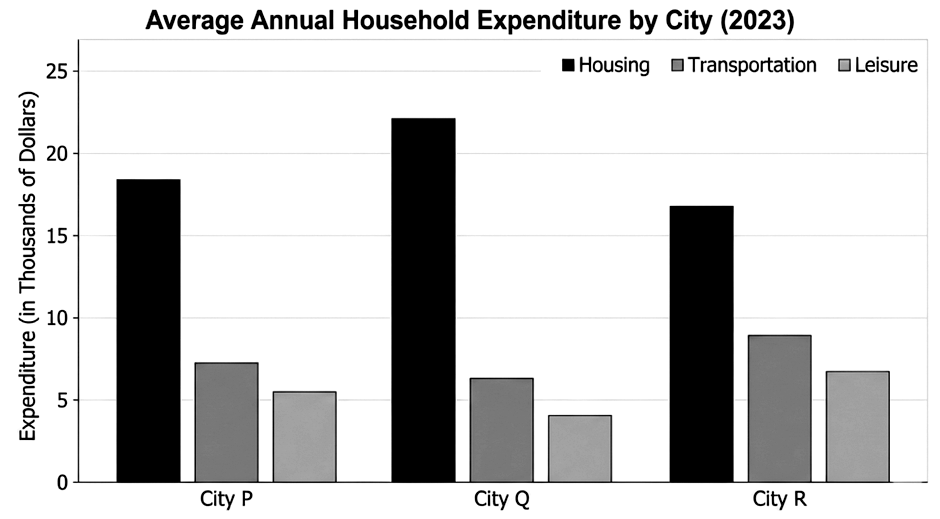
The bar chart below shows the average annual expenditure per household (in thousands of dollars) on three categories in three different cities in 2023.

Summarise the information by selecting and reporting the main features, and make comparisons where relevant.
Academic Writing Task 1 Static Grouped Bar Chart practice image
BAND 9

Part 1 · Band 9 Sample Answer

The bar chart compares average household spending on housing, transportation and leisure across Cities P, Q and R in 2023, with the figures expressed in thousands of dollars per year.

Overall, housing was by a considerable margin the largest expense in every city. City Q recorded the highest housing expenditure but the lowest leisure figure, whereas households in City R spent the most on both transportation and leisure. Despite these contrasting patterns, total spending across the three categories was remarkably similar in all three places.

In City P, annual housing costs averaged approximately $18,500 per household. This was more than twice the amount allocated to transportation, at just over $7,000, while leisure expenditure was lower again, at around $5,500. The three categories therefore totalled a little above $31,000.

Housing expenditure peaked in City Q at roughly $22,000, exceeding the corresponding figures for Cities P and R by about $3,500 and $5,000 respectively. However, its transportation spending, at approximately $6,300, was the lowest among the three cities, as was its leisure budget of $4,000. City R showed the opposite pattern: although it had the smallest housing figure, at just under $17,000, it led the other cities in transportation and leisure expenditure, at about $9,000 and $6,700. Consequently, the combined total in both Cities Q and R was around $32,000, only marginally above that of City P.

BAND 8

Part 1 · Band 8 Sample Answer

The chart illustrates how much an average household in three cities spent annually on housing, transportation and leisure in 2023. All amounts are shown in thousands of dollars.

Overall, housing represented the greatest expense in each location, although the highest figure was found in City Q. By contrast, City R had the largest budgets for transportation and leisure. The combined expenditure in each city was fairly similar because lower housing costs were generally balanced by higher spending in the other categories.

Households in City P spent about $18,500 per year on housing. Their transportation expenditure was much lower, at a little over $7,000, while approximately $5,500 was used for leisure. This gave City P a total of roughly $31,000 across the three areas.

City Q had the highest housing cost, at around $22,000. However, average spending there was only about $6,300 on transportation and $4,000 on leisure, the lowest leisure figure on the chart. In City R, housing expenditure stood at just under $17,000, making it the smallest of the three housing amounts. Nevertheless, this city ranked first for the remaining categories: households spent approximately $9,000 on transportation and nearly $7,000 on leisure. As a result, total expenditure in Cities Q and R was slightly above $32,000, compared with the somewhat lower overall amount in City P.

BAND 7

Part 1 · Band 7 Sample Answer

The bar chart shows the average amount that households in Cities P, Q and R spent on three types of expenses in 2023. The figures are given in thousands of dollars per year.

Overall, housing was the largest category in all three cities. City Q spent the most on housing, while City R had the highest figures for transportation and leisure. Total expenditure was quite close across the cities despite these differences.

In City P, the average household spent approximately $18,500 on housing. Transportation accounted for just over $7,000, and leisure spending was lower at around $5,500. Housing was therefore more than twice as expensive as either of the other two categories.

The housing figure for City Q was the highest on the chart, at about $22,000. In comparison, transportation spending was roughly $6,300 and only $4,000 was spent on leisure. The pattern was different in City R. Its housing expenditure, at just under $17,000, was the lowest among the cities. However, households there spent about $9,000 on transportation and close to $7,000 on leisure, both of which were the highest figures in their categories. Overall spending in Cities Q and R was a little above $32,000, while the total for City P was just over $31,000.

Academic Writing Task 2

Task 2 · Advantages and Disadvantages Essay

Task 2 Prompt

You should spend about 40 minutes on this task. Write at least 250 words.

Write about the following topic:

Nowadays, many people get the news from social media platforms rather than traditional newspapers or television.

Do the advantages of this trend outweigh the disadvantages?

Give reasons for your answer and include any relevant examples from your own knowledge or experience.

BAND 9

Part 2 · Band 9 Sample Answer

Social media has transformed news from a scheduled product into a continuous stream selected by users and algorithms. This brings gains in speed, reach and participation. However, I do not believe these advantages outweigh the disadvantages, because the same systems that distribute valuable reporting also reward unverified and emotionally provocative material, often without making the distinction clear.

The advantage is accessibility. A person with a phone can receive updates immediately rather than waiting for a newspaper or television bulletin, which is particularly useful during elections, transport disruption or natural disasters. Social platforms also allow established news organisations to reach people who would never buy a printed paper. In addition, eyewitnesses and local communities can draw attention to events that large broadcasters have overlooked. Users may compare accounts from different countries, follow specialist reporters and encounter perspectives excluded from traditional editorial agendas. These platforms broaden both the audience for news and the range of voices producing it.

Nevertheless, removing the traditional gatekeeper also removes many checks. A professional report normally passes through editing, source verification and legal review; an anonymous post can reach millions before anyone establishes whether it is true. Corrections rarely travel as widely as the original dramatic claim. Moreover, platforms commonly recommend material according to its ability to hold attention rather than its public importance or accuracy. This encourages sensational headlines, short clips without context and content that confirms existing beliefs. Users can consequently feel well informed while repeatedly seeing only one interpretation of an issue.

There are broader consequences as well. When audiences consume journalism through social feeds, the advertising income and subscriptions needed to finance original reporting may decline, even though platforms continue circulating that work. The result can be more commentary about a shrinking supply of carefully investigated facts. Constant exposure to alarming fragments of information may also create anxiety and fatigue, prompting people either to disengage entirely or to accept simple explanations for complicated events.

These harms are not inevitable. Platforms could label provenance more clearly, reduce incentives for repeat offenders and give users greater control over recommendation systems. Schools can teach people to check authors, dates and supporting evidence. Even so, these safeguards are not yet strong enough to offset the structural preference for speed and engagement.

In conclusion, social media makes news faster, more accessible and more inclusive, but it also weakens verification, fragments public understanding and threatens the production of reliable journalism. Until trustworthy information is rewarded at least as strongly as viral content, the disadvantages of this shift remain greater.

BAND 8

Part 2 · Band 8 Sample Answer

More people now discover current events through social media instead of relying on newspapers or television. This change makes news easier to access and allows information to spread rapidly. Nevertheless, I believe its disadvantages are greater overall because unreliable content and personalised feeds can seriously reduce the quality of public understanding.

One important benefit is convenience. Social media users can see breaking news wherever they are and receive updates throughout the day without purchasing a newspaper or watching a scheduled programme. This is helpful when information changes quickly, such as during severe weather or a public transport emergency. Social platforms can also present a wider variety of viewpoints. Local residents can share direct accounts, independent journalists can reach large audiences, and readers can follow news from other countries. Traditional organisations also benefit by using these networks to attract younger audiences to their reporting.

However, social media makes it extremely easy to publish false or misleading claims. Posts are often shared because they are surprising or emotional, not because their evidence has been checked. Many users read only a headline, photograph or short video and may not investigate its original source. Even when an inaccurate story is corrected, the correction may receive far less attention. By contrast, reputable newspapers and broadcasters employ editors and are publicly responsible for serious mistakes, although they are not perfect.

Another problem is the way platforms select content. Recommendation systems learn what keeps each person interested and then provide more similar material. This can create an echo chamber in which users rarely encounter strong evidence from another side. It may also give extreme opinions more visibility than balanced explanations because conflict attracts attention. Furthermore, if people expect all news to be free on social media, professional outlets may lose income needed to employ reporters and conduct lengthy investigations.

In my view, these problems outweigh the benefits, but abandoning social media is neither realistic nor necessary. Users should follow identifiable news organisations, compare several sources and open full reports instead of reacting to short posts. Platforms should respond more quickly to deliberately deceptive accounts and make the source of news content obvious.

In conclusion, social media offers immediate and varied access to current events, which is a major advantage. Yet the risks of misinformation, narrow information bubbles and weakened professional journalism have a deeper effect on society. For now, therefore, this trend is more harmful than beneficial.

BAND 7

Part 2 · Band 7 Sample Answer

Today, social media has become a common source of news, while fewer people depend mainly on newspapers and television. Receiving news in this way is fast and convenient, but it also increases the risk of false information. In my opinion, the disadvantages outweigh the advantages.

The main benefit of social media is that news can reach people almost immediately. Users can check events on their phones at any time and do not need to wait for a television broadcast or the next newspaper. This can be valuable during emergencies, when road closures, storms or safety warnings need to be communicated quickly. Social media also gives people access to many sources. They can follow local reporters, international organisations and witnesses to an event instead of receiving information from only one newspaper or television channel. In addition, most social platforms are free to use, so news is available to a large audience.

Despite these benefits, information on social media is not always reliable. Almost anyone can publish a post, even if they have no evidence or professional knowledge. False stories can spread quickly when people share them without reading the full article or checking where they came from. Photographs and videos can also be presented without the context needed to understand them. Traditional news companies can make errors too, but they normally have editors and clear procedures for correcting mistakes.

A further disadvantage is that users may see only news that matches their existing opinions. Platforms recommend content based on what a person has previously watched or liked. Over time, this can prevent people from considering different views and may make political or social disagreements worse. Social media posts are also usually short, so complicated subjects may be reduced to simple and emotional messages. Finally, declining newspaper and television audiences could reduce the money available for professional reporting.

People can lower these risks by following trusted news providers and comparing reports from several sources. Platforms should also identify original publishers clearly and limit accounts that repeatedly spread false information. However, these steps require both effort and good judgement from users.

To conclude, obtaining news through social media is quick, affordable and convenient. However, unreliable posts, limited viewpoints and the possible decline of professional journalism are more serious. Therefore, I believe this change currently creates more disadvantages than advantages.

FREE PRACTICE RESOURCES

Download the IELTS Practice PDF Pack.

Get Listening, Reading, and Writing practice materials for self-study. Use a computer to download the 1.9GB pack.

Download PDF Pack
Chat History
My Notes