ACADEMIC WRITING SAMPLE ANSWERS

Academic Writing Sample Answers Practice 17 Test 03

This original practice page includes Task 1 (Static Pie Chart) and Task 2 (Agree or Disagree Essay), with Band 9, Band 8, and Band 7 sample answers for IELTS preparation.
Academic Writing Task 1

Task 1 · Static Pie Chart

Task 1 Prompt

You should spend about 20 minutes on this task. Write at least 150 words.

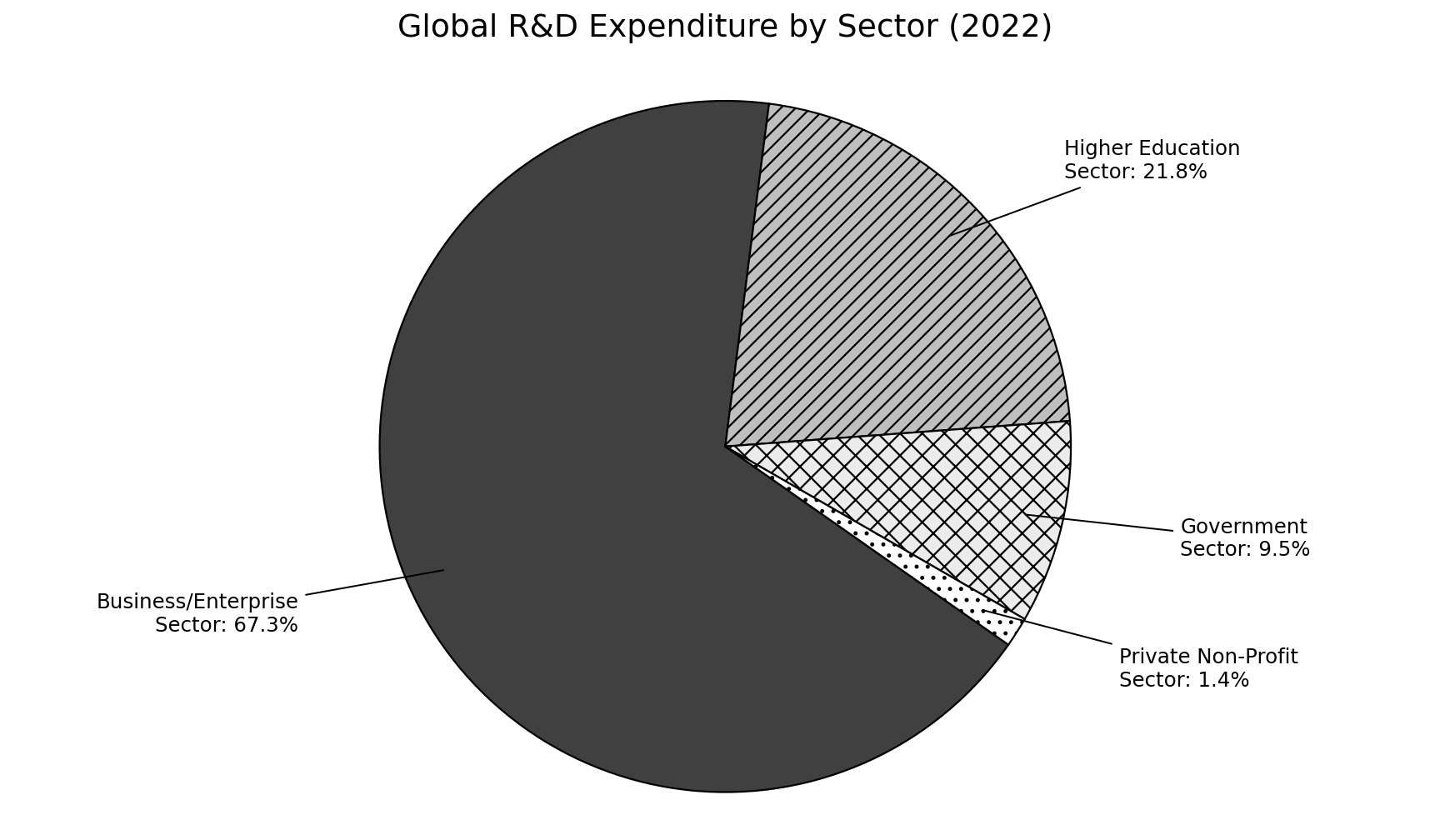
The pie chart below shows the distribution of global research and development (R&D) expenditure by sector in 2022.

Summarise the information by selecting and reporting the main features, and make comparisons where relevant.
Academic Writing Task 1 Static Pie Chart practice image
BAND 9

Part 1 · Band 9 Sample Answer

The pie chart illustrates how worldwide expenditure on research and development was divided among the business, higher education, government and private non-profit sectors in 2022.

Overall, R&D spending was overwhelmingly concentrated in business and enterprise, which alone accounted for more than two-thirds of the global total. Higher education ranked a distant second, while government represented less than one-tenth. The private non-profit sector made only a negligible contribution.

More precisely, businesses and enterprises were responsible for 67.3% of all expenditure. This proportion was just over three times the 21.8% attributed to higher education, producing a substantial difference of 45.5 percentage points between the two leading sectors. Together, they comprised 89.1% of global R&D spending, leaving only slightly more than one-tenth for the remaining categories.

The government sector contributed 9.5%, a figure 12.3 percentage points below that of higher education. Private non-profit organisations, by comparison, accounted for merely 1.4%, making their share less than one-sixth of government expenditure and by far the smallest on the chart. Combined, government and private non-profit spending amounted to 10.9%. Notably, the higher education share was exactly double this combined figure, while business expenditure was marginally more than twice the total allocated to all three other sectors.

BAND 8

Part 1 · Band 8 Sample Answer

The chart presents the percentage distribution of global research and development expenditure across four sectors in 2022.

Overall, the business and enterprise sector dominated R&D spending, providing over two-thirds of the total. Higher education was the second-largest contributor, although its share was considerably smaller. Government and private non-profit organisations together accounted for only a relatively small proportion, with the latter contributing the least.

Business and enterprise represented 67.3% of worldwide expenditure on research and development. This was more than three times the proportion recorded for higher education, at 21.8%. The difference between these two sectors was 45.5 percentage points. Taken together, the two largest categories were responsible for 89.1% of total spending.

The government sector accounted for a further 9.5%, which was less than half the percentage contributed by higher education. Its share was nevertheless much greater than that of private non-profit organisations, whose figure was only 1.4%. Government expenditure was therefore almost seven times the private non-profit proportion. The two smallest sectors jointly made up 10.9% of the global total. This combined figure was exactly half the share of higher education and remained far below that of business and enterprise.

BAND 7

Part 1 · Band 7 Sample Answer

The pie chart shows the proportions of worldwide research and development spending provided by four different sectors in 2022.

Overall, the business and enterprise sector accounted for the majority of global R&D expenditure and was clearly the largest category. Higher education was in second place, while government spending formed a much smaller share. Private non-profit organisations had by far the lowest percentage.

The business and enterprise sector made up 67.3% of all spending. In other words, more than two-thirds of the global total came from this category. Higher education contributed 21.8%, which was less than one-third of the business figure. Together, these two leading sectors were responsible for 89.1% of research and development expenditure around the world.

The government sector provided 9.5% of the total. Its proportion was 12.3 percentage points lower than the share for higher education, although it was still much higher than the private non-profit figure. Private non-profit organisations accounted for only 1.4%, meaning that their contribution was less than one-sixth of the government share. The two smaller categories together represented 10.9% of total expenditure. By comparison, the percentage for higher education alone was exactly twice as large as their combined figure, and the business share was more than six times as large.

Academic Writing Task 2

Task 2 · Agree or Disagree Essay

Task 2 Prompt

You should spend about 40 minutes on this task. Write at least 250 words.

Write about the following topic:

Many minority languages are losing speakers as younger generations adopt national or international languages. Some people believe that the decline of these languages should be accepted because using fewer languages makes communication between communities easier.

To what extent do you agree or disagree?

Give reasons for your answer and include any relevant examples from your own knowledge or experience.

BAND 9

Part 2 · Band 9 Sample Answer

As younger people shift towards nationally or internationally dominant languages, many minority languages are approaching a point from which recovery may be impossible. A shared language unquestionably facilitates mobility and communication. However, I strongly disagree that linguistic decline should simply be accepted, because acquiring a common language does not require abandoning another, while the loss of a language removes cultural and intellectual resources that cannot be fully reconstructed.

The argument for using fewer languages rests on genuine practical benefits. When citizens share a national language, they can access public services, education and employment without constant translation. An international language similarly allows researchers, businesses and travellers to communicate across borders. Parents who encourage children to use a dominant language are therefore often responding rationally to economic and social pressures rather than rejecting their heritage.

Nevertheless, convenience alone is an inadequate reason to tolerate language extinction. A language is not merely a different set of labels for identical ideas; it carries oral history, humour, social customs and ways of describing the local environment. Translations can preserve the basic content of a traditional story, but not necessarily its wordplay, rhythm or cultural associations. Moreover, when younger members can no longer understand older speakers, communication within the community itself becomes harder even if interaction with outsiders becomes easier. The supposed gain in connection can thus create a profound internal disconnection.

More importantly, the choice between mutual understanding and linguistic diversity is false. Millions of people use one language at home and another in education or employment. Schools can teach the national language to a high standard while offering minority-language classes or bilingual instruction, particularly in areas where the language remains widely used. Community broadcasting, digital keyboards, recorded archives and online lessons can make smaller languages relevant to contemporary life at a manageable cost. Such measures should support willing speakers rather than compel every descendant to achieve fluency, since forced preservation could produce resentment.

Admittedly, no government can guarantee that every language will remain in daily use indefinitely. Speakers themselves must decide how they communicate, and resources should reflect community demand. Yet accepting individual choice is different from ignoring conditions that make abandonment seem unavoidable, such as the absence of teaching materials or the belief that a minority accent limits employment.

In conclusion, common languages are valuable bridges between communities, but bridges do not require the demolition of the places they connect. I therefore strongly oppose passive acceptance of minority-language decline and favour practical, voluntary support for bilingualism.

BAND 8

Part 2 · Band 8 Sample Answer

The growing use of national and global languages has caused many smaller languages to lose speakers, particularly among the young. It is argued that this process should be accepted because communication becomes simpler when fewer languages are used. Although a common language brings clear practical advantages, I largely disagree with this view because minority languages have cultural value and can coexist with wider languages.

There are understandable reasons for younger generations to adopt a dominant language. Fluency in the national language gives people easier access to universities, public institutions and jobs outside their home region. Knowledge of an international language can further expand opportunities in business, travel and online education. Shared languages also reduce the cost and difficulty of translation. In an emergency, for instance, communication between medical staff and patients is more efficient when both can use the same language. It would therefore be unreasonable to discourage minority communities from learning languages that allow them to participate fully in society.

However, these benefits do not mean that their original languages must disappear. Languages preserve songs, stories, expressions and historical knowledge that translation cannot reproduce perfectly. Their decline may also weaken relationships between generations when children can no longer speak easily with grandparents or take part in traditional events. In addition, linguistic variety gives regions a distinct identity. If every community used only the same few languages, cultural life would become less varied, even if some forms of communication became more convenient.

In my view, bilingualism offers a better answer than accepting language loss. Children can learn a national or international language at school while continuing to use a minority language at home and in community activities. Where there is sufficient demand, schools could provide bilingual lessons, and public broadcasters could produce programmes for younger audiences in regional languages. Digital dictionaries, apps and online videos also make learning materials cheaper to create and easier to distribute. These policies should provide opportunities rather than force people to use a language against their wishes.

Preserving very small languages requires resources, and not every programme will succeed. Governments must consider the number of interested speakers and work with communities when deciding what support is appropriate. Nevertheless, allowing a language to disappear without offering reasonable assistance is an avoidable cultural loss.

In conclusion, widespread languages make communication and social participation easier, so everyone should have the chance to learn them. I nevertheless disagree that this justifies accepting the decline of minority languages. Supporting voluntary bilingualism can achieve effective communication while retaining local heritage.

BAND 7

Part 2 · Band 7 Sample Answer

Many young people are choosing to speak national or international languages instead of the minority languages used by their families. Some people think this decline should be accepted because a smaller number of languages makes communication easier. I disagree with this opinion because people can learn a common language without giving up their local one.

Using widely spoken languages certainly has important benefits. A national language allows people from different regions to study, work and use government services more easily. International languages can also help them communicate when travelling or dealing with foreign businesses. Young people may therefore have better educational and career opportunities if they speak these languages well. Furthermore, governments and companies do not need to translate every document into a very large number of languages, which can save time and money.

Despite these advantages, losing a minority language can seriously affect a community. Language is closely connected with local history, music, stories and customs. Although some of this material can be translated, particular jokes, meanings and expressions may be lost. The decline of a language can also create distance between generations. For example, grandparents may speak their traditional language confidently, while their grandchildren can only hold a simple conversation in it. As a result, younger people may find it harder to understand family stories and participate fully in local traditions.

I believe the most sensible approach is to encourage people to become bilingual. Schools should teach the main national language so that every student can take part in the wider society. At the same time, minority languages can be offered as subjects or used in some lessons where enough families want this. Local radio, cultural events and online learning materials can also make the language more attractive and useful to children. Nobody should be forced to speak it, but those who wish to learn should have a realistic opportunity to do so.

Of course, supporting small languages costs money, and some may continue to lose speakers even with assistance. This does not mean that society should make no effort. Communities and governments can choose affordable measures based on local interest rather than treating every language in exactly the same way.

In conclusion, common languages improve communication and provide valuable opportunities. However, accepting the disappearance of minority languages is unnecessary. Bilingual education and community support can preserve much of this cultural heritage without preventing communication between different groups.

FREE PRACTICE RESOURCES

Download the IELTS Practice PDF Pack.

Get Listening, Reading, and Writing practice materials for self-study. Use a computer to download the 1.9GB pack.

Download PDF Pack
Chat History
My Notes