Task 1 · Static Grouped Bar Chart
You should spend about 20 minutes on this task. Write at least 150 words.
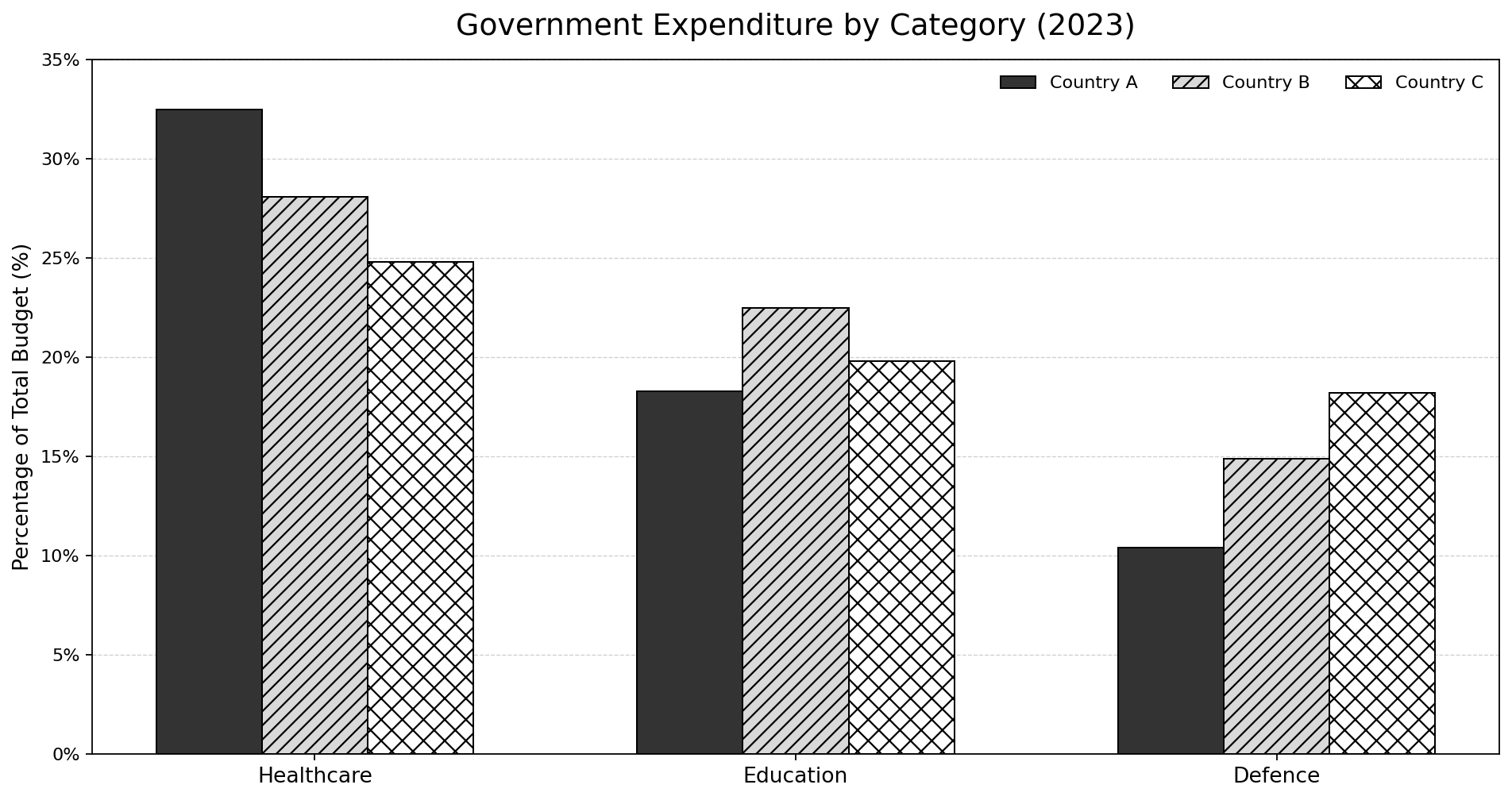
The bar chart below compares the expenditure of three countries on three key areas as a percentage of their total government budgets in 2023.
Summarise the information by selecting and reporting the main features, and make comparisons where relevant.
Want to see your estimated band score?
Check your writing scorePart 1 · Band 9 Sample Answer
The bar chart compares the proportions of total government spending allocated to healthcare, education and defence in Countries A, B and C in 2023.
Overall, healthcare received the largest budget share in all three countries, whereas defence attracted the smallest. Country A prioritised healthcare most strongly but assigned the lowest proportions to the other two fields. By contrast, Country B led spending on education, while Country C devoted the greatest share to defence and distributed its expenditure more evenly across the three areas.
Approximately 32.5% of Country A’s budget went to healthcare, compared with about 28% in Country B and just under 25% in Country C. Thus, the figure for A exceeded that for C by nearly eight percentage points. Within Country A itself, healthcare spending was almost three times its defence allocation of slightly over 10%, while education represented roughly 18%.
The ranking was different for education. Country B recorded the highest proportion, at around 22.5%, followed by Country C at just under 20%; Country A had the lowest figure, at a little over 18%. Defence spending showed the reverse of the pattern seen in healthcare, rising across the countries from approximately 10.5% in A to almost 15% in B and just above 18% in C. As a result, the gap between healthcare and defence was widest in Country A, at about 22 percentage points, but narrowed to roughly six or seven points in Country C.
Part 1 · Band 8 Sample Answer
The chart illustrates the percentages of government budgets spent on healthcare, education and defence in three countries during 2023.
Overall, healthcare accounted for the greatest proportion of expenditure in every country, while defence received the smallest share. Country A spent the most on healthcare but the least on education and defence. Country B had the highest education figure, whereas Country C allocated the largest percentage to defence.
For healthcare, Country A devoted approximately 32.5% of its total budget to this area. The corresponding proportion was lower in Country B, at about 28%, and fell further to just under 25% in Country C. Healthcare therefore took around eight percentage points more of the budget in A than in C. Education spending displayed a different order: Country B led at roughly 22.5%, followed by C at nearly 20% and A at just over 18%.
Defence represented about 10.5% of Country A’s expenditure, the lowest individual figure shown on the chart. Country B assigned close to 15% to this category, while the share in Country C was higher, at approximately 18%. Within Country A, the proportion for healthcare was more than 20 percentage points above that for defence. The difference was smaller in B, at around 13 points, and narrowest in C, where healthcare exceeded defence by only about six or seven points.
Part 1 · Band 7 Sample Answer
The bar chart shows the percentages of the total government budget spent on healthcare, education and defence in Countries A, B and C in 2023.
Overall, all three governments spent the largest share on healthcare and the smallest on defence. However, Country A had the highest healthcare figure, Country B spent the most on education, and Country C had the greatest proportion for defence.
Country A allocated around 32.5% of its budget to healthcare. This was higher than the figures for Country B and Country C, at approximately 28% and 25% respectively. In Country A, education accounted for just over 18%, while only about 10.5% was used for defence. The difference between its healthcare and defence shares was therefore roughly 22 percentage points.
Country B spent about 22.5% on education, which was the highest education figure among the three nations. Its healthcare proportion was 28%, while defence made up almost 15% of its budget. In Country C, the three percentages were closer together. Healthcare still ranked first at just under 25%, followed by education at approximately 20%. Defence represented about 18%, which was only around two percentage points lower than education. Country C’s defence share was therefore much higher than Country A’s, although its healthcare allocation was the lowest of the three countries.