Task 1 · Static Grouped Bar Chart
You should spend about 20 minutes on this task. Write at least 150 words.
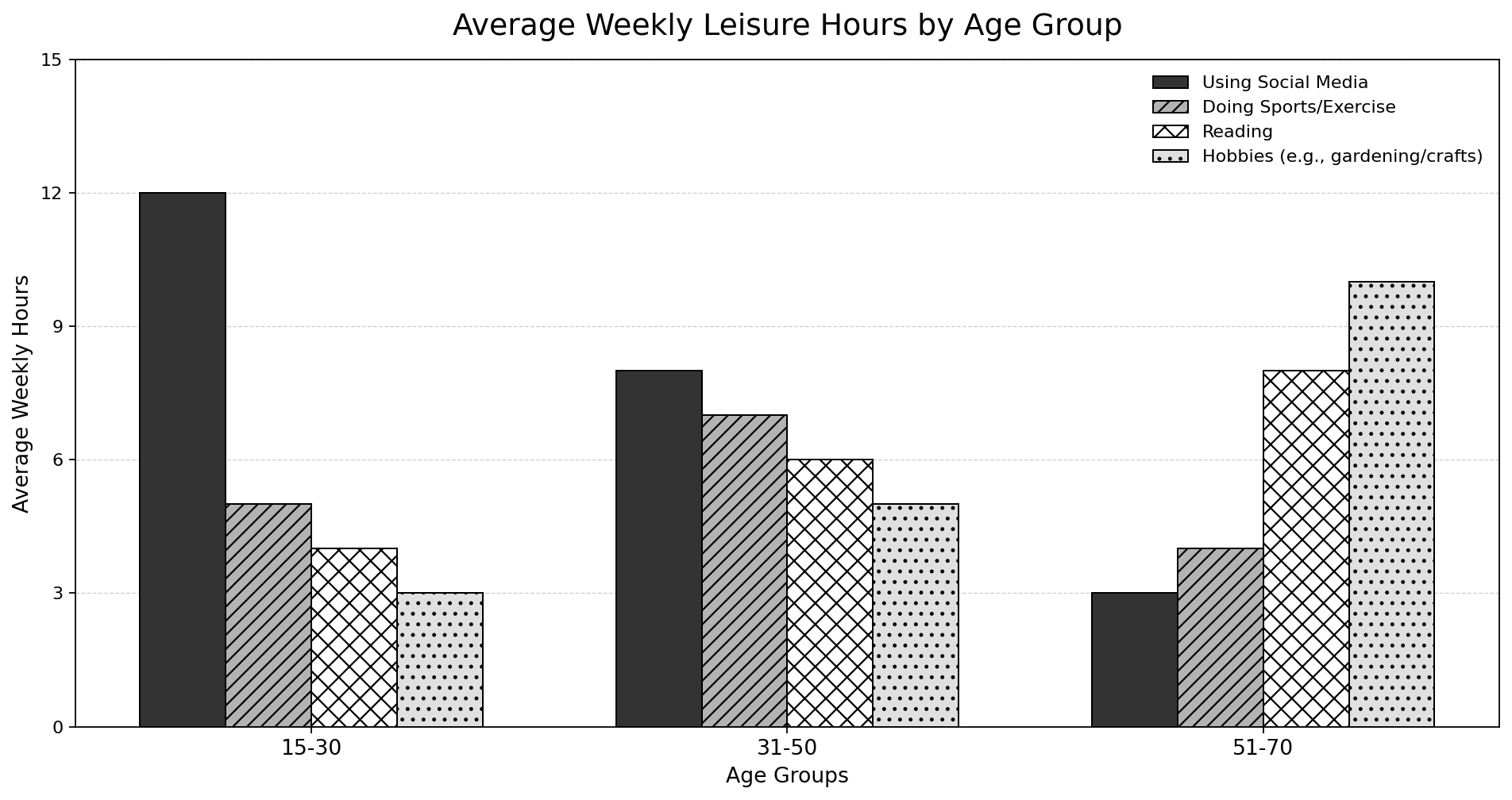
The bar chart below shows the average weekly hours spent on four different leisure activities by three age groups in a particular country.
Summarise the information by selecting and reporting the main features, and make comparisons where relevant.
Want to see your estimated band score?
Check your writing scorePart 1 · Band 9 Sample Answer
The bar chart compares the average amount of time that people in three age brackets in a particular country devote each week to social media, sport or exercise, reading and hobbies.
Overall, leisure preferences change markedly with age. Social media dominates the free time of the youngest group but becomes progressively less popular among older people, whereas reading and hobbies show the opposite pattern. The 31–50 group distributes its time most evenly across the four activities, and exercise is the only category to peak among this middle group.
People aged 15–30 spend 12 hours per week using social media, by far the highest figure in this age group and more than double the five hours allocated to sport and exercise. Reading accounts for four hours, while hobbies receive the least time, at three hours.
Among 31–50-year-olds, social-media use declines to eight hours, although it remains their leading activity. Exercise follows closely at seven hours, and this group spends six hours reading and five on hobbies, leaving a gap of only three hours between the highest and lowest figures. The pattern is reversed among those aged 51–70: hobbies rank first at ten hours and reading second at eight. By contrast, exercise occupies four hours and social media just three. Thus, compared with the youngest group, the oldest people spend seven additional hours on hobbies but nine fewer hours on social media.
Part 1 · Band 8 Sample Answer
The chart illustrates how many hours per week, on average, three age groups in one country spend on four leisure pursuits: social media, exercise, reading and hobbies.
Overall, the amount of time devoted to social media falls sharply as age increases, while the figures for reading and hobbies generally rise. The middle age group has a relatively balanced leisure profile, whereas the youngest and oldest groups each show a clear preference for one activity.
For people aged 15–30, social media is easily the most time-consuming pursuit, at 12 hours weekly. This is well above the five hours spent doing sports or exercise. Reading takes up four hours, and hobbies such as gardening and crafts account for only three, the lowest value for this group.
The figures are closer together among 31–50-year-olds. They spend eight hours on social media and seven on exercise, followed by reading at six hours and hobbies at five. Exercise therefore reaches its highest level in this group, despite remaining slightly less popular than social media.
The oldest group, aged 51–70, displays a very different pattern. Hobbies lead at ten hours per week, with reading also comparatively high at eight hours. Exercise and social media are much less prominent, at four and three hours respectively. Social-media use consequently drops by nine hours from the youngest to the oldest group, while time spent on hobbies increases by seven hours.
Part 1 · Band 7 Sample Answer
The bar chart shows the average number of weekly hours that three age groups in a country spend using social media, exercising, reading and doing hobbies.
Overall, younger people spend much more time on social media, while older people prefer reading and hobbies. The figures for the 31–50 age group are more evenly distributed than those for the other two groups. Exercise is most popular among middle-aged people.
Those aged 15–30 use social media for 12 hours per week. This is considerably higher than the figures for all their other activities. They spend five hours doing sports or exercise and four hours reading, while hobbies receive the smallest amount of time, at three hours.
In the 31–50 group, social media remains the leading activity at eight hours, but exercise is only one hour lower, at seven. Reading takes six hours per week, followed by hobbies at five hours. Therefore, the difference between all four activities is fairly small for this age group.
Among people aged 51–70, hobbies become the most common leisure activity, occupying ten hours weekly. Reading is second at eight hours. In comparison, these older people spend only four hours on exercise and three hours on social media. The oldest group therefore spends the same amount of time on social media as the youngest group spends on hobbies, showing a clear change in interests with age.