ACADEMIC WRITING SAMPLE ANSWERS

Academic Writing Sample Answers Practice 18 Test 02

This original practice page includes Task 1 (Dynamic Multiple-Line Graph) and Task 2 (Problems and Solutions Essay), with Band 9, Band 8, and Band 7 sample answers for IELTS preparation.
Academic Writing Task 1

Task 1 · Dynamic Multiple-Line Graph

Task 1 Prompt

You should spend about 20 minutes on this task. Write at least 150 words.

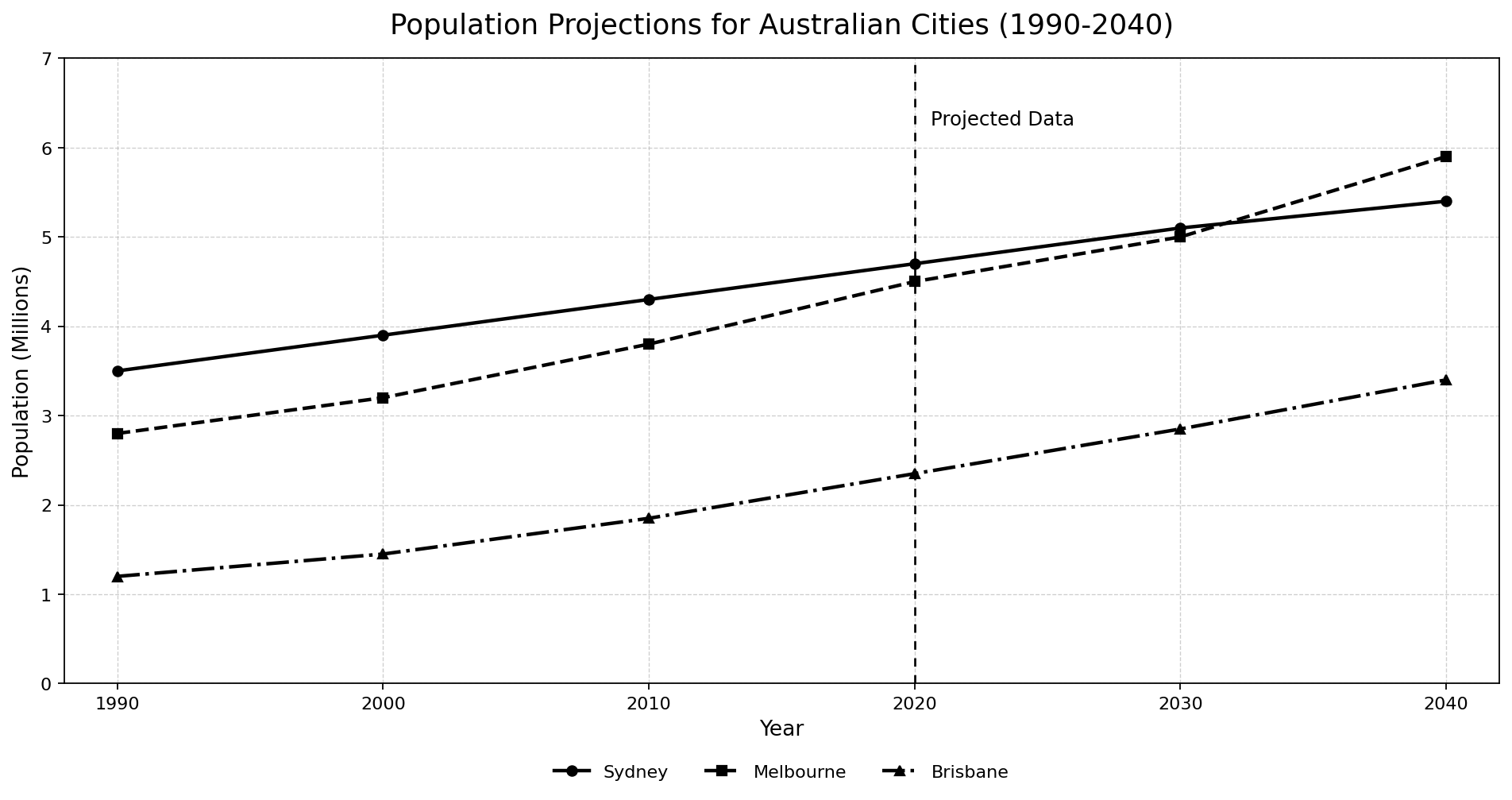
The line graph below shows the past and projected population figures (in millions) for three major Australian cities from 1990 to 2040.

Summarise the information by selecting and reporting the main features, and make comparisons where relevant.
Academic Writing Task 1 Dynamic Multiple-Line Graph practice image
BAND 9

Part 1 · Band 9 Sample Answer

The line graph compares changes in the populations of Sydney, Melbourne and Brisbane between 1990 and 2020, together with projections for the following two decades. Figures are given in millions.

Overall, all three cities grew throughout the historical period and are expected to continue doing so. Sydney was the most populous city at every recorded point and is forecast to remain narrowly ahead in 2030. However, Melbourne grows more rapidly and is projected to take first place by 2040, while Brisbane remains considerably smaller despite substantial expansion.

In 1990, Sydney had approximately 3.5 million residents, compared with 2.8 million in Melbourne and 1.2 million in Brisbane. Sydney’s population then rose steadily to 3.9 million in 2000 and 4.3 million in 2010. Over the same years, Melbourne increased to 3.2 million and then 3.8 million, reducing its deficit behind Sydney from 700,000 to about 500,000. Brisbane experienced a gradual rise to roughly 1.5 million in 2000 and just under 1.9 million a decade later. By 2020, the three totals had reached around 4.7 million, 4.5 million and 2.35 million respectively.

The gap between the two largest cities is predicted to narrow further by 2030, when Sydney is expected to contain 5.1 million people and Melbourne 5 million. Thereafter, Melbourne should overtake Sydney and climb to 5.9 million in 2040, half a million above Sydney’s projected 5.4 million. Brisbane, meanwhile, is forecast to rise consistently to about 2.85 million in 2030 and 3.4 million at the end of the period.

BAND 8

Part 1 · Band 8 Sample Answer

The graph presents the populations of three large Australian cities from 1990 to 2040, measured in millions. The figures up to 2020 show past changes, while those for 2030 and 2040 are projections.

Overall, the population of every city rises across the period. Sydney is the largest city from 1990 until at least 2030, but Melbourne is expected to grow faster and become the most populous by 2040. Brisbane has the lowest figures throughout, although its population also increases considerably.

Sydney begins with 3.5 million inhabitants in 1990 and grows steadily to 3.9 million in 2000 and 4.3 million in 2010. Its population reaches approximately 4.7 million by 2020. Melbourne follows a similar upward pattern, rising from 2.8 million to 3.2 million and then 3.8 million over the first three dates. By 2020, it stands at 4.5 million, leaving a difference of only around 200,000 between the two cities. Brisbane starts much lower, at 1.2 million, before increasing to about 1.5 million in 2000, 1.85 million in 2010 and 2.35 million in 2020.

Looking ahead, Sydney and Melbourne are predicted to reach 5.1 million and 5 million respectively in 2030. Melbourne is then forecast to experience stronger growth, reaching 5.9 million in 2040 and moving ahead of Sydney, whose population is expected to be 5.4 million. Brisbane should continue its steady increase to roughly 2.85 million in 2030 and 3.4 million by 2040, remaining two million below Sydney at the end of the period.

BAND 7

Part 1 · Band 7 Sample Answer

The line graph shows the past and predicted populations of Sydney, Melbourne and Brisbane between 1990 and 2040. Population numbers are presented in millions, and the data after 2020 are forecasts.

Overall, all three cities show continuous population growth. Sydney has the highest population for most of the period, while Brisbane remains the smallest city. However, Melbourne is expected to pass Sydney before 2040 and finish with the largest population.

In 1990, about 3.5 million people lived in Sydney. This figure rose to 3.9 million in 2000 and 4.3 million in 2010 before reaching approximately 4.7 million in 2020. Melbourne also grew steadily, from 2.8 million in 1990 to 3.2 million in 2000. It then increased more quickly to 3.8 million in 2010 and 4.5 million by 2020. Therefore, the population gap between Sydney and Melbourne became much smaller.

Brisbane had a considerably lower starting point of 1.2 million. Its population increased to around 1.5 million in 2000 and just under 1.9 million in 2010. By 2020, it had reached roughly 2.35 million, which was still only about half the figure for Sydney.

In 2030, Sydney is forecast to have 5.1 million residents, slightly more than Melbourne at 5 million. By 2040, Melbourne is predicted to rise to 5.9 million and overtake Sydney, which should reach 5.4 million. Brisbane is also expected to continue growing, reaching about 2.85 million in 2030 and 3.4 million in 2040.

Academic Writing Task 2

Task 2 · Problems and Solutions Essay

Task 2 Prompt

You should spend about 40 minutes on this task. Write at least 250 words.

Write about the following topic:

In many cities, the level of crime is increasing rapidly.

What are the main reasons for this, and what measures can be taken to tackle this problem?

Give reasons for your answer and include any relevant examples from your own knowledge or experience.

BAND 9

Part 2 · Band 9 Sample Answer

Rapidly rising urban crime is rarely the product of a single cause. It usually reflects a combination of economic exclusion, weakened local institutions and criminal opportunities that develop faster than a city’s ability to control them. Effective policy must therefore prevent people from entering crime while also improving the likelihood that offenders are identified and rehabilitated.

One important cause is severe inequality combined with insecure employment and housing. Poverty does not automatically lead to offending, but neighbourhoods with few legitimate opportunities can leave young people especially vulnerable to recruitment by gangs or drug networks. Rapid urban expansion can intensify this problem. When populations grow faster than schools, youth services, transport and public spaces can be provided, community ties become weaker and neglected areas offer more opportunities for robbery and violence. Crime may rise further where residents distrust the police, since victims and witnesses become reluctant to report offences. In addition, online marketplaces, encrypted communication and digital payment systems have enabled fraud and illegal trade to operate across an entire city without requiring offenders to meet their victims.

The first response should be targeted prevention rather than broad promises to eliminate poverty. Municipal authorities can identify districts with high school dropout rates, unstable housing and youth unemployment, then concentrate mentoring, vocational training, addiction treatment and family support there. Partnerships with local employers could offer apprenticeships leading to genuine jobs rather than short courses with no clear outcome. Better street lighting, reliable late-night transport and the active use of abandoned buildings can also reduce opportunities for crime and make residents more willing to occupy public areas.

Prevention must be supported by fair and capable law enforcement. Police should focus resources on repeat offenders, violent groups and specific locations where harm is concentrated, while maintaining safeguards against discriminatory treatment. Community officers who develop long-term relationships with residents can improve reporting and provide intelligence that surveillance alone cannot obtain. Cities also need trained digital investigators and efficient courts so that cybercrime and conventional offences produce timely consequences. Finally, prisons should provide education, mental-health care and assistance with employment after release; otherwise, punishment may simply return people to the circumstances that encouraged their offending.

In conclusion, urban crime grows when exclusion and weak services coincide with low risks for offenders. A combination of focused social investment, trusted policing, effective justice and rehabilitation is more likely to reverse the trend than either harsher punishment or welfare spending in isolation.

BAND 8

Part 2 · Band 8 Sample Answer

A sharp increase in crime can seriously reduce the quality of urban life and weaken trust among residents. In many cities, this rise is caused mainly by economic pressure, poor support for young people and weaknesses in policing. Tackling it requires a balance between preventing crime and enforcing the law effectively.

A major reason is the lack of stable work and affordable housing in some urban neighbourhoods. People facing long-term unemployment may be attracted to theft, illegal trade or gang activity, particularly when they can see considerable wealth nearby but have few realistic ways to improve their own position. Young people are at greater risk when schools, sports facilities and family services are inadequate. Without safe places to spend time or adults who can guide them, some may join groups involved in violence or drug dealing. Meanwhile, fast population growth can leave police forces overstretched. If crimes are rarely solved, offenders may believe that the chance of punishment is low. Poor relations between the police and local communities make the situation worse because witnesses may refuse to provide information.

Governments should first address the conditions that make offending more likely. Funding should be directed towards the districts with the highest levels of youth unemployment and school absence. Practical training, apprenticeships and support for small local businesses can create legal sources of income. After-school programmes, counselling and drug treatment can assist people before they become involved in serious crime. City authorities can also improve lighting, repair neglected public areas and ensure that buses and railway stations are safe at night.

At the same time, police and courts must operate more effectively. More officers alone will not necessarily solve the problem; they need accurate local information and should concentrate on persistent offenders and places where repeated crimes occur. Regular contact between community officers and residents can build trust and increase reporting. Courts should deal with cases without unnecessary delays, while prisons should provide education and employment preparation to reduce reoffending after release. For offences committed online, specialist investigators are also needed because traditional street patrols cannot detect digital fraud.

In conclusion, urban crime is driven by both social disadvantage and ineffective control. Cities can reduce it by expanding genuine opportunities, supporting vulnerable young people, improving public spaces and ensuring that law enforcement is focused, trusted and fair.

BAND 7

Part 2 · Band 7 Sample Answer

Crime is rising quickly in many urban areas, creating fear and making communities less secure. The main causes include unemployment, limited support for young people and ineffective law enforcement. Governments can respond by improving social opportunities while making the police and justice system more capable.

One key reason for higher crime is economic difficulty. When people cannot find stable employment or afford basic living costs, some may turn to theft or illegal business to earn money. Large differences between rich and poor areas can add to feelings of frustration. However, financial hardship is not the only cause. In some neighbourhoods, young people have few safe activities after school and may be influenced by gangs. Drug and alcohol problems can also lead to violence and property crime.

Another reason is that services often fail to keep pace with urban growth. A rapidly expanding population can place heavy pressure on schools, social workers and police. If officers cannot investigate offences properly, criminals may feel that they are unlikely to be caught. Residents may also avoid reporting crimes when they do not trust the police or fear revenge from local offenders. As a result, criminal groups can continue operating with little resistance.

Several practical measures could improve the situation. Governments should create vocational courses and apprenticeship opportunities that lead to real jobs, especially in poorer districts. Schools and community centres can provide sports, mentoring and counselling for young people who might otherwise join gangs. Treatment should also be available for people whose offending is connected to drug dependence. Improving street lighting, public transport and neglected parks can make public spaces safer.

Better prevention must be combined with effective policing. Officers should work closely with local residents and focus on areas where repeated offences occur. This approach can provide useful information and improve public trust. Courts should process cases promptly, and serious offenders must face appropriate penalties. At the same time, prisoners need education, skills training and help finding work after release, since these services can reduce the risk of further crime.

In conclusion, increasing urban crime results from social pressures, weak services and a low chance of detection. Providing employment and youth support, together with fair policing and rehabilitation, offers the most effective long-term response.

FREE PRACTICE RESOURCES

Download the IELTS Practice PDF Pack.

Get Listening, Reading, and Writing practice materials for self-study. Use a computer to download the 1.9GB pack.

Download PDF Pack
Chat History
My Notes