Task 1 · Process Diagram
You should spend about 20 minutes on this task. Write at least 150 words.
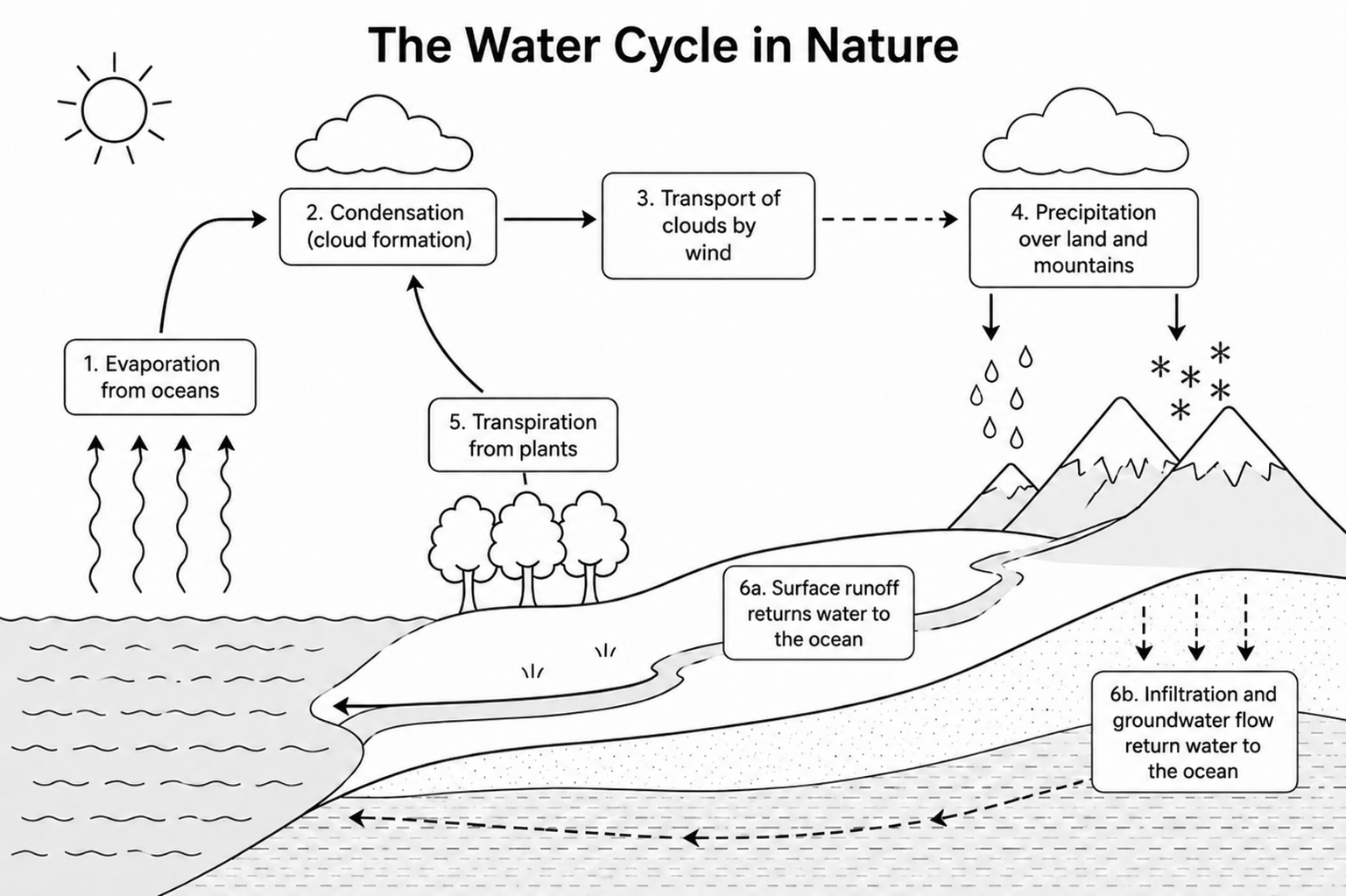
The diagram below illustrates the natural process of the water cycle.
Summarise the information by selecting and reporting the main features.
Want to see your estimated band score?
Check your writing scorePart 1 · Band 9 Sample Answer
The diagram depicts the natural circulation of water between the ocean, the atmosphere and the land, showing the principal atmospheric stages as well as two routes by which water returns to the sea.
Overall, this is a continuous cycle driven initially by the movement of water into the air. Oceanic evaporation and transpiration from plants supply moisture for cloud formation; the clouds are then carried inland and release precipitation. Finally, the resulting water reaches the ocean again either as surface runoff or through infiltration and underground flow.
At the first stage, water evaporates from the surface of the ocean and rises into the atmosphere. This water vapour then undergoes condensation, producing clouds. Plants provide an additional source of atmospheric moisture through transpiration, and the vapour released in this way also contributes to condensation. Once formed, the clouds are transported away from the ocean by wind towards the land.
The next major phase occurs when the clouds produce precipitation over inland areas and mountains. This falls in the form of both rain and snow. Water arriving on the land subsequently follows one of two return paths. Some travels across the ground as surface runoff, collecting in channels that carry it downhill and discharge it directly into the ocean. The remainder soaks into the soil through infiltration. It then enters the underground water system and flows beneath the surface towards the coast. Both routes ultimately replenish the ocean, from which evaporation can begin the cycle once more.
Part 1 · Band 8 Sample Answer
The illustration shows how water moves naturally from the ocean into the atmosphere, across the land and eventually back to the sea.
Overall, the process forms a repeated cycle. Water reaches the atmosphere through evaporation from the ocean and transpiration from plants. After clouds form and are carried over the land, precipitation occurs. The water then returns to the ocean along two main routes: surface runoff and groundwater flow.
The cycle begins when water evaporates from the ocean and rises into the air. This moisture condenses to form clouds. At the same time, plants release water vapour through transpiration, which supplies further moisture for the condensation stage. Wind then transports the clouds from above the ocean towards inland areas.
When the clouds reach the land and mountains, water falls as precipitation. The diagram indicates that this can take the form of rain or snow. After reaching the ground, part of this water flows over the surface. It enters streams or channels and travels down towards the coast, thereby returning directly to the ocean.
Another portion of the precipitation moves below ground rather than remaining on the surface. It first infiltrates the soil and then becomes part of the groundwater system. This underground water flows gradually in the direction of the ocean and eventually enters it. Once both the surface and underground flows have restored water to the sea, evaporation can occur again and the same sequence is repeated.
Part 1 · Band 7 Sample Answer
The diagram illustrates the natural water cycle, in which water travels from the ocean to the atmosphere and land before returning to the ocean.
Overall, there are several main stages in this circular process. Water first enters the atmosphere through evaporation and plant transpiration. It then forms clouds, which are moved by wind and produce precipitation. Finally, the water returns to the sea through either surface runoff or underground flow.
At the beginning of the cycle, water evaporates from the ocean and rises upwards. Condensation then takes place, causing clouds to form. Plants also release moisture into the air through transpiration. This water vapour moves upwards and joins the condensation stage. The clouds are then transported by wind from the ocean towards the land.
Once the clouds arrive over the land and mountains, precipitation occurs. Water falls to the ground as rain, while snow falls in the mountainous areas. Some of this water travels downhill across the surface. It enters a stream or river and flows back into the ocean as surface runoff.
The second return route begins when water enters the ground through infiltration. It moves down through the soil until it reaches the groundwater below. This water then flows underground towards the coast and eventually returns to the ocean. The surface runoff and groundwater flow therefore complete the cycle, allowing evaporation from the sea to start again.