Task 1 · Process Diagram
You should spend about 20 minutes on this task. Write at least 150 words.
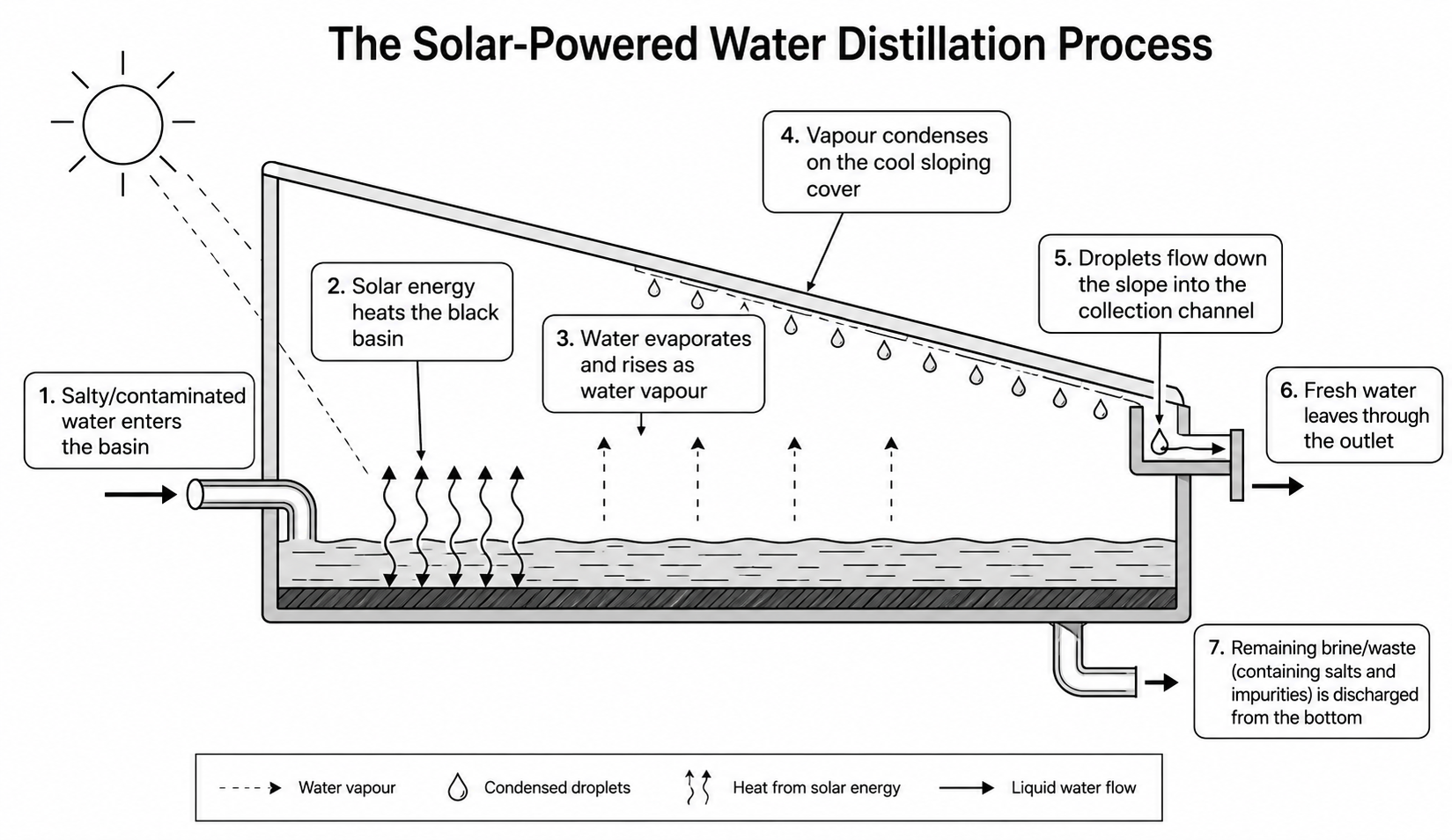
The diagram below shows how a solar-powered water distillation unit works to produce fresh water.
Summarise the information by selecting and reporting the main features.
Want to see your estimated band score?
Check your writing scorePart 1 · Band 9 Sample Answer
The diagram illustrates the operation of a solar-powered distillation unit that separates fresh water from salty or contaminated water.
Overall, the system uses sunlight to heat and evaporate the incoming water before condensing the resulting vapour on an inclined cover. The condensed liquid is collected as fresh water, whereas the salts and other impurities remain in the basin and are removed separately from the bottom. Thus, the unit produces two distinct outputs without mixing the purified water with the residual waste.
Initially, untreated water enters through a pipe on the left and collects inside a shallow basin with a black base. Solar radiation passes through the transparent sloping cover and heats this dark surface. Energy transferred from the basin to the water causes evaporation, and the water vapour then rises through the enclosed space. The salts and contaminants do not rise with the vapour and therefore remain in the basin.
When the warm vapour reaches the cooler underside of the inclined cover, it condenses into droplets. Owing to the downward slope, these droplets move towards the lower right-hand side of the unit rather than falling back into the untreated water. They enter a collection channel positioned at the edge of the cover and are directed through a separate outlet, from which fresh water leaves the apparatus.
Meanwhile, the liquid left at the base becomes brine or waste containing the separated impurities. This residue is discharged through a pipe fitted to the bottom of the basin, completing the process.
Part 1 · Band 8 Sample Answer
The illustration explains how a distillation device powered by solar energy converts salty or polluted water into fresh water.
Overall, water is purified through evaporation and condensation inside a covered basin. Sunlight supplies the heat required for the process, while the sloping cover guides the condensed water into a collection channel. Fresh water and the remaining contaminated waste leave the unit through different outlets.
First, salty or contaminated water flows into the basin through an inlet on the left. The basin has a black base, which is heated by energy from the sun. This heat raises the temperature of the water and causes it to evaporate. The water rises as vapour, but the salts and other impurities are left behind in the liquid at the bottom.
The vapour then reaches the underside of the cover above the basin. Since this surface is cool, the vapour condenses on it and forms droplets. The cover slopes downwards from left to right, so the droplets flow along its inner surface towards the lower end.
Next, the droplets enter a small collection channel on the right-hand side. The collected fresh water passes through an outlet and leaves the unit. The materials that were not carried upwards during evaporation remain inside the basin as brine or contaminated waste. At the final stage, this residual liquid is removed separately through a discharge pipe beneath the unit. The two outlets therefore keep the fresh product apart from the waste.
Part 1 · Band 7 Sample Answer
The diagram shows the stages used by a solar-powered unit to produce fresh water from salty or contaminated water.
Overall, the unit uses solar heat to evaporate water and a cool sloping cover to turn the vapour back into liquid. The fresh water is collected at one side of the device, while the salts and impurities that remain in the basin are discharged from the bottom.
First, untreated water enters the basin through a pipe on the left. The bottom of the basin is black and absorbs energy from the sun. As the basin becomes heated, the water inside it begins to evaporate. Water vapour rises towards the cover, whereas salt and other unwanted substances stay in the basin.
The vapour reaches the cooler surface on the inside of the cover and condenses. This produces small droplets of clean water. Because the cover slopes downwards towards the right, the droplets run along it in this direction. They then fall into a collection channel near the lower end of the cover.
After entering this channel, the fresh water flows out of the unit through a side outlet. Meanwhile, the substances separated from the water are left at the bottom in the form of brine or waste. This remaining liquid contains the original salts and impurities. It is finally released from the device through another pipe connected to the bottom of the basin. In this way, fresh water and contaminated waste leave through separate routes.