ACADEMIC WRITING SAMPLE ANSWERS

Academic Writing Sample Answers Practice 19 Test 03

This original practice page includes Task 1 (Dynamic Pie Chart) and Task 2 (Agree or Disagree Essay), with Band 9, Band 8, and Band 7 sample answers for IELTS preparation.
Academic Writing Task 1

Task 1 · Dynamic Pie Chart

Task 1 Prompt

You should spend about 20 minutes on this task. Write at least 150 words.

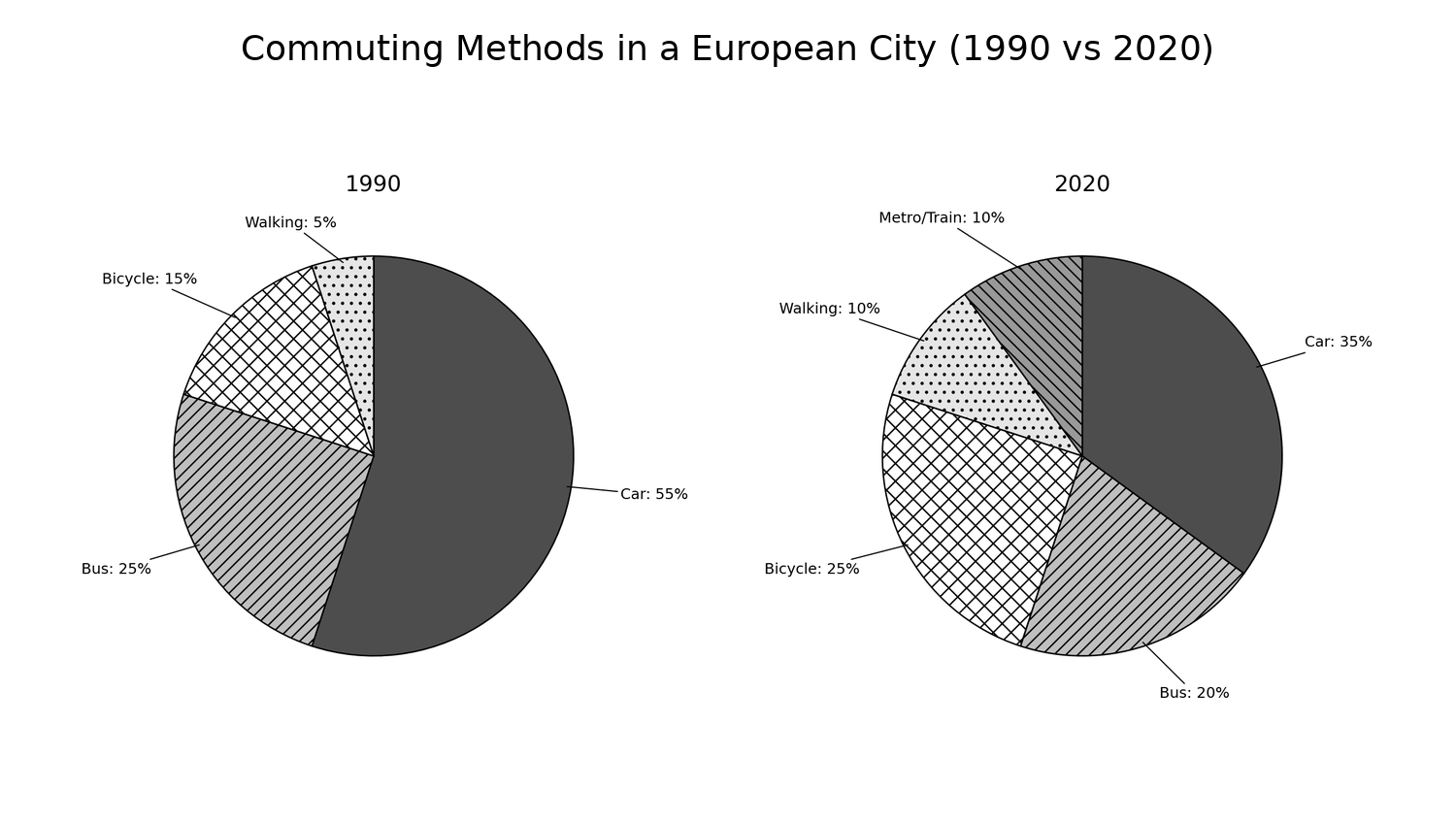
The pie charts below show the main modes of transportation used by people to commute to work in a European city in 1990 and 2020.

Summarise the information by selecting and reporting the main features, and make comparisons where relevant.
Academic Writing Task 1 Dynamic Pie Chart practice image
BAND 9

Part 1 · Band 9 Sample Answer

The two pie charts compare the proportions of commuters using the principal forms of transport in a European city in 1990 and 2020.

Overall, the car remained the single most common means of travelling to work, but its dominance diminished markedly over the 30-year period. Commuting became more diversified as cycling and walking gained popularity and metro or train travel emerged as a separate mode, whereas the share using buses declined moderately.

In 1990, a clear majority of commuters, 55%, travelled by car. The bus was a distant second at 25%, while bicycles were used by 15% of workers. Walking was by far the least common option, representing only 5%. Thus, motorised road transport accounted for four fifths of all journeys, and the combined proportion for cycling and walking was just 20%.

By 2020, the car share had fallen by 20 percentage points to 35%, although it still ranked first. Bicycle use, by contrast, rose by 10 points to 25%, overtaking the bus, whose figure slipped to 20%. Walking doubled to 10%, and metro or train services, absent from the 1990 chart, accounted for an identical proportion. Consequently, non-car modes collectively increased from 45% to 65%. Active travel by bicycle or on foot also expanded substantially, from one fifth to 35%, while the two public transport categories together represented 30% of commuting in 2020.

BAND 8

Part 1 · Band 8 Sample Answer

The pie charts illustrate how people in a European city travelled to work in 1990 and 2020, with the figures given as percentages of all commuters.

Overall, cars were the leading form of transport in both years, despite a considerable fall in their share. Meanwhile, bicycle use and walking became more common, and metro or train travel appeared as an additional mode in 2020. Bus use was the only other category to decrease.

In 1990, 55% of people commuted by car, meaning that this method was used by more than half of workers. Buses accounted for a further 25%, making them the second most popular choice. Much smaller proportions travelled actively: 15% cycled and just 5% walked. Cars and buses therefore made up 80% of commuting altogether.

Thirty years later, the proportion using cars had dropped by 20 percentage points to 35%. Although cars continued to rank first, the gap between them and other methods had narrowed. Cycling rose to 25%, an increase of 10 points, and became the second most widely used mode. In contrast, bus travel fell slightly to 20%, placing it third. The percentage walking doubled from 5% to 10%, while metro or train services also accounted for 10% in 2020. Overall, the combined share of cycling and walking climbed from 20% to 35%, showing a clear shift away from reliance on motorised road transport.

BAND 7

Part 1 · Band 7 Sample Answer

The two pie charts show the main types of transport used for journeys to work in a European city in 1990 and 2020.

Overall, the car was the most popular commuting method in both years, but the percentage using it fell significantly. Cycling and walking both became more common, while a new metro or train category appeared in 2020. The proportion travelling by bus decreased slightly.

In 1990, cars were used by 55% of commuters, which was more than all the other methods combined. Buses were the second-largest category, accounting for 25%. Bicycle users represented 15% of workers, whereas only 5% walked to work. As a result, cars and buses together were responsible for 80% of journeys in that year.

By 2020, the share of car users had fallen by 20 percentage points to 35%, although this was still the highest figure. Bicycle use increased from 15% to 25%, making it the second most common method. At the same time, the proportion commuting by bus declined from 25% to 20%. Walking doubled to 10%, and the newly shown metro or train category also made up 10%. Taken together, bicycles, walking and metro or train services accounted for 45% of journeys in 2020. The figures therefore show that commuters relied less heavily on cars and used a wider range of transport methods than they had in 1990.

Academic Writing Task 2

Task 2 · Agree or Disagree Essay

Task 2 Prompt

You should spend about 40 minutes on this task. Write at least 250 words.

Write about the following topic:

As young people increasingly communicate through digital devices, some people believe that schools should continue to place strong emphasis on reading printed texts and writing by hand.

To what extent do you agree or disagree?

Give reasons for your answer and include any relevant examples from your own knowledge or experience.

BAND 9

Part 2 · Band 9 Sample Answer

Digital communication now shapes much of young people’s academic and social lives, yet this does not make older forms of literacy obsolete. I agree to a considerable extent that schools should retain a strong emphasis on printed reading and handwriting. These practices cultivate forms of attention and physical fluency that screens and keyboards may not reliably provide, although they must sit within a broader curriculum of digital literacy.

Printed texts are particularly valuable for teaching sustained, analytical reading. A book or paper article presents a stable sequence without notifications, hyperlinks or rapidly changing media competing for attention. Students can annotate margins, compare distant passages and develop a physical sense of where information appears. None of this means that comprehension is automatically better on paper; a well-designed digital text can also support close study. However, because many pupils already spend substantial time scanning short online messages, schools provide an important counterbalance when they require learners to follow a lengthy argument or narrative in print. The objective is not loyalty to paper itself, but the patience and concentration it can help establish.

Handwriting likewise remains a foundational skill. Forming letters manually requires learners to slow down, select information and organise it within limited space. During note-taking, this can discourage the effortless transcription that sometimes occurs when students type every sentence without processing it. Handwriting is also practical when devices fail, forms must be completed, diagrams need labelling or a quick personal note is appropriate. Schools should therefore ensure that every pupil can write legibly and compose coherent work by hand, rather than treating the ability as an artistic extra.

Nevertheless, strong emphasis should not become exclusive emphasis. Digital texts can be searched, enlarged, translated and adapted for students with particular needs. Typing permits rapid revision, while online tools enable research and collaboration that are central to higher education and employment. Schools must also teach pupils to verify sources, protect privacy and communicate appropriately online. A sensible approach would use print and handwriting for selected activities, such as close reading, initial note-taking and timed composition, while using digital media where accessibility, editing or cooperation is the main goal.

In conclusion, I strongly support preserving printed reading and handwriting because they broaden rather than restrict a student’s intellectual tools. Their value is greatest when schools integrate them deliberately with, rather than position them against, capable and critical use of technology.

BAND 8

Part 2 · Band 8 Sample Answer

I largely agree that schools should continue to give substantial attention to printed reading and handwriting, even though digital communication has become normal for young people. These traditional skills can support concentration and careful thinking, but they should be taught alongside the digital abilities students will need outside school.

Reading on paper can create a calmer environment for understanding long or difficult material. When using a phone or computer, students may be interrupted by messages, advertisements or links, and they can easily move to another page. A printed novel or article removes many of these distractions and encourages the reader to follow the text for longer. It is also simple to underline key sentences and make notes beside them. Schools can therefore use printed material to build close-reading habits, especially among pupils who are accustomed to short videos and brief social media posts.

Writing by hand has a different but equally useful role. Students must form words at a controlled pace, which can give them more time to decide which ideas are important. For example, a pupil taking handwritten notes may summarise a teacher’s explanation instead of copying it word for word. Handwriting also remains necessary for completing certain forms, labelling diagrams and communicating when a suitable device is unavailable. All students should leave school able to write clearly and confidently without depending entirely on technology.

However, an education focused mainly on paper would be inadequate. Digital documents are widely used at university and in employment, and they offer important advantages. Students can edit typed work efficiently, find information quickly and collaborate with classmates from different locations. Electronic text can also be enlarged or read aloud, helping learners with visual or reading difficulties. In addition, young people need guidance on judging online sources and protecting personal information.

Schools should consequently choose the medium according to the purpose of each activity. Printed books may be preferable for extended reading, and handwriting can be used for notes or early drafts. Research projects and collaborative assignments, by contrast, often benefit from digital tools.

Overall, printed texts and handwriting deserve strong continuing support because they develop useful habits that digital communication does not always encourage. Nevertheless, a balanced curriculum should ensure that students become confident in both traditional and digital forms of literacy.

BAND 7

Part 2 · Band 7 Sample Answer

I agree to a large extent that schools should still place strong emphasis on reading printed material and writing by hand. Although computers and phones are now essential for communication, traditional reading and writing can help students concentrate and develop skills that remain useful in daily life.

Printed texts can make it easier for pupils to focus on one task. A student reading on a phone may receive messages or be tempted to open social media. A printed book does not contain these distractions, so the student may be more willing to read a long chapter carefully. Pupils can also underline important points and write comments in the margins. This is valuable when they are studying a complex story or trying to understand an argument in detail.

Handwriting should also continue to be taught and practised. Writing by hand is slower than typing, but this is not always a disadvantage. When taking notes, students often need to select the main ideas instead of copying every word. This can encourage them to think about the information. Clear handwriting is also needed for forms, short notes and situations where a computer is not available. If schools stop requiring it, some young people may become unable to express themselves clearly without a keyboard.

However, schools must not ignore digital skills. Most students will use computers in further education and at work. Typed documents can be corrected easily, and online platforms allow groups to work together. Digital texts are also helpful because users can search for a word, change the text size or use audio support. Students therefore need practice in typing, online research and safe communication as well as traditional literacy.

A balanced programme is the best solution. Schools could use printed books for extended reading and ask pupils to write some notes or essays by hand. They could use computers for research, editing and group projects where technology provides a clear benefit.

In conclusion, schools should continue to emphasise printed reading and handwriting because these activities promote concentration and independent basic skills. At the same time, they should prepare students to use digital tools confidently and responsibly rather than treating the two approaches as opposites.

FREE PRACTICE RESOURCES

Download the IELTS Practice PDF Pack.

Get Listening, Reading, and Writing practice materials for self-study. Use a computer to download the 1.9GB pack.

Download PDF Pack
Chat History
My Notes