ACADEMIC WRITING SAMPLE ANSWERS

Academic Writing Sample Answers Practice 20 Test 03

This original practice page includes Task 1 (Dynamic Multiple-Line Graph) and Task 2 (Discuss Both Views and Give Your Opinion), with Band 9, Band 8, and Band 7 sample answers for IELTS preparation.
Academic Writing Task 1

Task 1 · Dynamic Multiple-Line Graph

Task 1 Prompt

You should spend about 20 minutes on this task. Write at least 150 words.

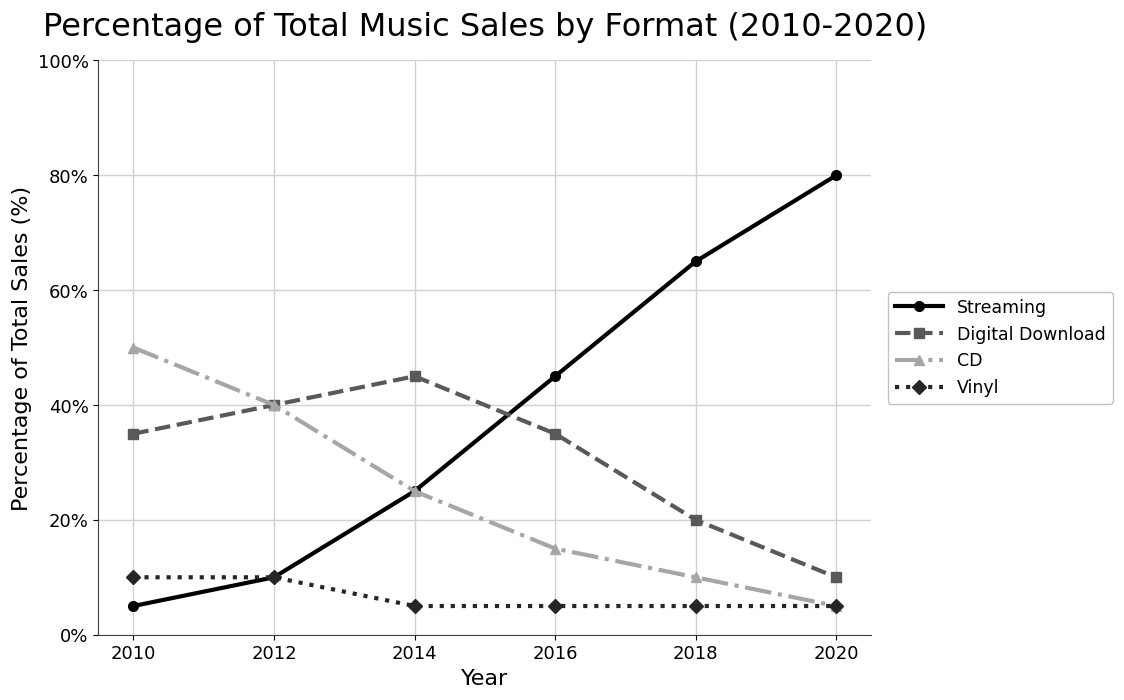
The chart below shows the percentage of total music sales by format (streaming, digital download, CD, and vinyl) in a particular country from 2010 to 2020.

Summarise the information by selecting and reporting the main features, and make comparisons where relevant.
Academic Writing Task 1 Dynamic Multiple-Line Graph practice image
BAND 9

Part 1 · Band 9 Sample Answer

The line chart illustrates how four formats accounted for total music sales in a particular country at two-year intervals between 2010 and 2020.

Overall, the market shifted decisively towards streaming, whose share rose from the smallest to by far the largest. CD sales moved in the opposite direction, while digital downloads increased initially before declining substantially. Vinyl remained a minor format throughout and changed very little compared with the other categories.

In 2010, CDs dominated the market at 50% of sales, followed by digital downloads at 35%. Vinyl represented 10%, twice the figure for streaming. By 2012, the shares of CDs and downloads had converged at 40%, while streaming had doubled to 10%, equalling vinyl. Two years later, downloads reached their peak of 45%. Over the same period, the CD proportion fell by 15 percentage points to 25%, where it was matched by streaming. Vinyl, meanwhile, declined to 5%.

The second half of the period saw streaming establish a clear lead. Its share climbed to 45% in 2016, overtaking downloads, which had retreated to 35%. Streaming then rose by a further 20 percentage points to 65% in 2018 and finished at 80% in 2020. In contrast, downloads fell to 20% and then 10% in the final two years. The CD share continued its steady decline, reaching 15% in 2016, 10% in 2018 and only 5% by 2020. Vinyl remained unchanged at 5% from 2014 onwards, ending level with CDs but five percentage points below downloads.

BAND 8

Part 1 · Band 8 Sample Answer

The graph compares the proportions of music sales made through streaming, digital downloads, CDs and vinyl in one country from 2010 to 2020.

Overall, streaming grew rapidly and became the leading sales format, while CDs experienced a continuous and considerable decline. Digital downloads first increased but then lost market share, whereas vinyl stayed at a low level for most of the period.

At the beginning, CDs accounted for half of all music sales, making them the most popular format. Digital downloads represented 35%, while vinyl and streaming stood at 10% and 5% respectively. In 2012, CDs fell to 40% and were equal to downloads, which had risen by five percentage points. Streaming also increased to 10%, the same proportion as vinyl. By 2014, downloads had reached their highest point of 45%. Both streaming and CDs accounted for 25% at this time, while vinyl had dropped to 5%.

After 2014, streaming rose sharply. It reached 45% in 2016, when it passed downloads at 35%, and then increased to 65% in 2018. By 2020, streaming made up 80% of total sales. Digital downloads followed the reverse pattern after their peak, falling to 20% in 2018 and 10% in the final year. CD sales also continued to decrease, from 15% in 2016 to 10% in 2018 and 5% in 2020. Vinyl showed no further change after 2014, remaining at 5% and eventually sharing last place with CDs.

BAND 7

Part 1 · Band 7 Sample Answer

The line graph shows the percentage of total music sales for four different formats in a country between 2010 and 2020.

Overall, streaming became much more popular over the period and was the largest category by the end. In contrast, the share of CD sales fell steadily. Digital downloads rose at first and then declined, while vinyl remained a small part of the market throughout.

In 2010, CDs had the highest share, at 50%, while digital downloads accounted for 35%. Vinyl made up 10% of sales and streaming was the smallest category at 5%. Two years later, CDs and downloads were equal at 40%. Streaming had increased to 10%, which was also the figure for vinyl. In 2014, downloads reached a peak of 45%. At the same time, streaming rose to 25% and became equal to CDs, while vinyl fell to 5%.

Streaming continued to grow quickly during the rest of the period. Its share reached 45% in 2016, compared with 35% for downloads, and then rose to 65% in 2018. It finished at 80% in 2020. Downloads decreased to 20% in 2018 and just 10% in 2020. The proportion of CD sales also continued to fall, reaching 15% in 2016, 10% in 2018 and 5% in the final year. Vinyl stayed unchanged at 5% from 2014 to 2020, when it had the same share as CDs.

Academic Writing Task 2

Task 2 · Discuss Both Views and Give Your Opinion

Task 2 Prompt

You should spend about 40 minutes on this task. Write at least 250 words.

Write about the following topic:

Some people believe that salaries should mainly reflect how much income a worker generates for an organisation. Others think that salaries should mainly reflect how important the work is to society.

Discuss both views and give your own opinion.

Give reasons for your answer and include any relevant examples from your own knowledge or experience.

BAND 9

Part 2 · Band 9 Sample Answer

Whether pay should be determined chiefly by commercial contribution or social usefulness exposes a tension between what markets reward and what communities need. Revenue generation is a defensible basis for performance-related pay, particularly in private firms. Nevertheless, I believe social importance deserves greater influence over basic salaries in essential occupations, while individual commercial results should mainly affect bonuses.

Supporters of revenue-based salaries argue that organisations can distribute only the income they earn. Employees who attract clients, develop profitable products or secure major contracts directly strengthen their employer’s capacity to invest and retain staff. Rewarding such results also creates an incentive to innovate and assume responsibility for difficult commercial decisions. A salesperson who consistently wins valuable business, for instance, can reasonably expect some connection between those results and remuneration. Measurable performance can also appear more objective than a broad judgement about social worth.

However, income generated is not always an accurate measure of an individual’s contribution. Commercial success commonly depends on teams, infrastructure and an established brand, making it difficult to assign revenue to one worker. More fundamentally, many indispensable occupations do not generate sales at all. Nurses, teachers, care workers and emergency personnel create benefits such as health, security and human development, but these outcomes are not fully expressed through market transactions. Persistently low pay in such fields can produce staff shortages, heavy workloads and declining service quality, ultimately imposing costs on the whole community.

Basing salaries mainly on social importance would therefore help essential services recruit and retain capable people. Yet this principle also has limitations. Social value is difficult to rank, and governments cannot raise every worthy occupation to the highest salary level without considering public finances, training requirements and labour supply. A purely social formula might also weaken incentives in roles where exceptional performance can be clearly demonstrated.

In my view, a mixed structure is preferable. Basic pay should reflect skills, responsibility, scarcity and social consequences, ensuring that essential workers receive secure and competitive compensation. In revenue-generating roles, transparent commissions or bonuses can then reward exceptional commercial outcomes without treating sales as the sole measure of worth. Independent pay reviews and workforce shortages could help identify socially vital jobs that markets systematically undervalue.

In conclusion, revenue-based remuneration promotes enterprise and links rewards to an organisation’s resources, but it overlooks many forms of essential contribution. Society should give greater weight to the public value of work when setting core salaries, while using variable pay to recognise genuine income generation.

BAND 8

Part 2 · Band 8 Sample Answer

People disagree over whether workers should be paid mainly according to the money they produce for their employer or according to the value of their occupation to society. Although income generation is a useful basis for rewarding performance, I believe socially essential work should receive stronger recognition in basic pay.

There are sound reasons for linking salaries to revenue. Businesses need profits to survive, invest and provide employment, so workers who increase sales or create successful products contribute directly to these goals. Higher rewards can motivate employees to improve their performance and take on greater responsibility. For example, offering a commission to a salesperson who brings in new customers gives that person a clear reason to work effectively. Commercial results can also be measured more easily than social importance, which different people may judge differently.

Nevertheless, a system focused mainly on income can undervalue essential occupations. Teachers, nurses, firefighters and care workers may not generate direct revenue, but communities depend on their services. Their work improves health, safety and future opportunities, creating benefits that cannot be shown on a company’s sales report. If these workers receive poor salaries, experienced staff may leave and fewer capable people may enter the profession. The resulting shortages can reduce the quality of services used by everyone. In this sense, paying essential workers properly is not only fair but also a practical investment in social stability.

In my opinion, salaries should combine both principles rather than applying one rule to every occupation. Core pay should take account of qualifications, responsibility, working conditions and the importance of the service provided. Governments and employers should therefore review pay in essential sectors and raise it when shortages show that compensation is insufficient. Where an employee’s individual revenue contribution can be identified reliably, part of the total reward could take the form of a bonus or commission. This preserves an incentive for strong commercial performance without suggesting that less profitable work has little value.

In conclusion, revenue generation matters because organisations must remain financially sustainable and productive employees deserve recognition. However, salary systems should place greater emphasis on social importance when setting basic pay, especially for essential workers whose contribution is valuable but not commercially measurable.

BAND 7

Part 2 · Band 7 Sample Answer

There are different opinions about whether salaries should be based mainly on the income employees produce or on the importance of their work to society. Both factors are relevant, but I believe socially important jobs should receive fair basic salaries, while revenue can be used to decide additional rewards in commercial roles.

Paying people according to the income they generate has several advantages. A business needs to earn money in order to continue operating and paying its staff. Workers who increase sales, find new customers or develop profitable products directly support the organisation. Giving them higher pay can encourage them to work harder and produce better results. It can also be easier to measure sales than to decide exactly how valuable a job is to society. For instance, a company can clearly see how much business a salesperson has gained.

On the other hand, many important workers do not produce income for an organisation. Nurses care for sick people, teachers educate children and firefighters protect the public, but their success cannot be measured through profits. These services are necessary for a safe and healthy society. If salaries in these occupations are too low, workers may leave for better-paid careers, and it may become difficult to recruit replacements. This can lead to staff shortages and poorer services for local communities.

In my view, basic salaries should consider the skills, responsibility and social value involved in a job. Essential workers need sufficient pay to make these careers attractive and to reflect the serious duties they perform. However, income generation should not be ignored. Companies can use bonuses or commissions to reward workers who achieve strong financial results, rather than making revenue the only basis for their entire salary. This approach recognises both business performance and valuable public service.

To conclude, connecting pay with income can motivate employees and help organisations succeed, but it does not recognise work that benefits society without earning a profit. A balanced system should provide fair salaries for socially important jobs and offer extra financial rewards when individual commercial results can be measured.

FREE PRACTICE RESOURCES

Download the IELTS Practice PDF Pack.

Get Listening, Reading, and Writing practice materials for self-study. Use a computer to download the 1.9GB pack.

Download PDF Pack
Chat History
My Notes