Task 1 · Process Diagram
You should spend about 20 minutes on this task. Write at least 150 words.
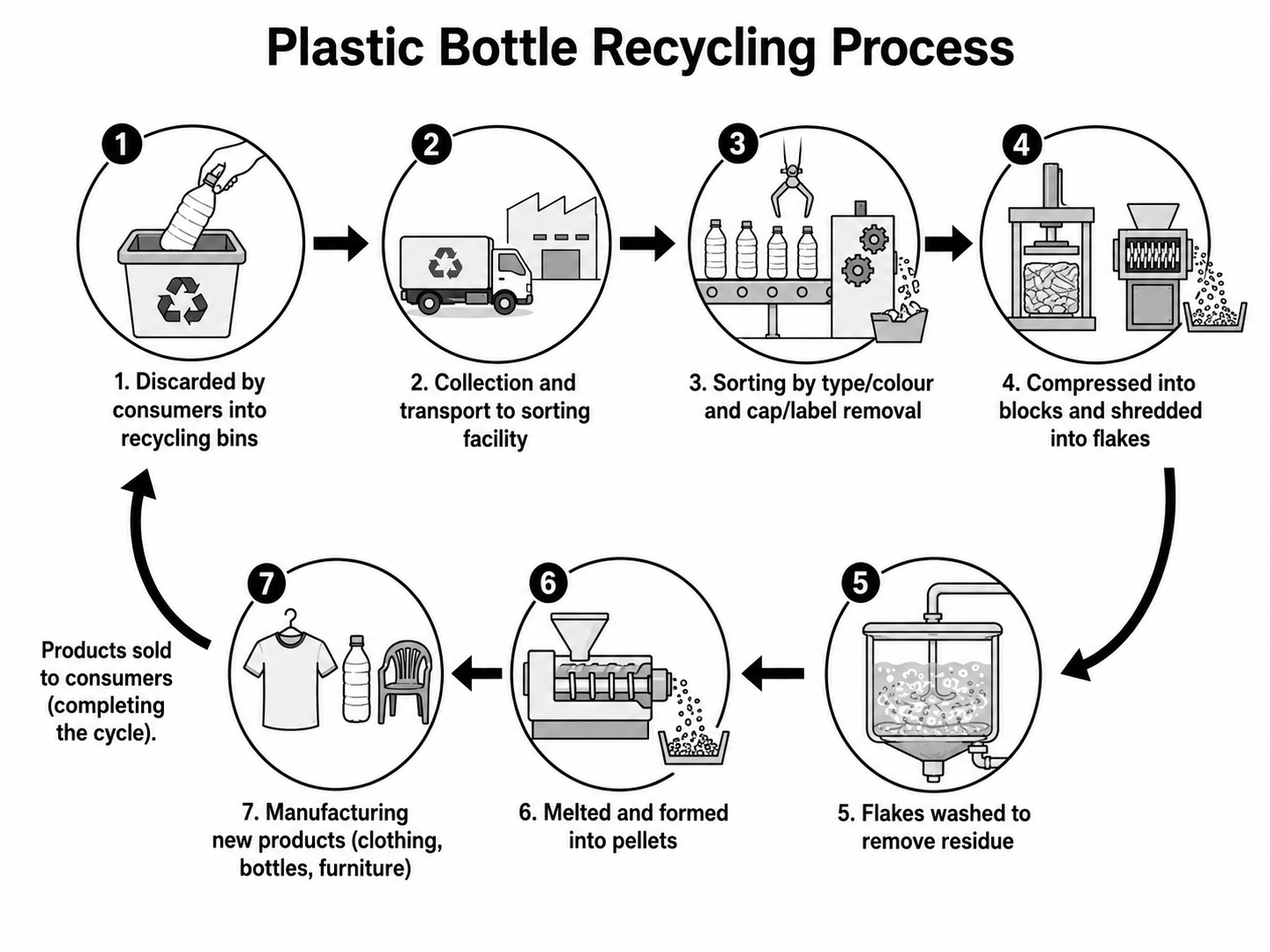
The diagram below illustrates the process of recycling plastic bottles.
Summarise the information by selecting and reporting the main features.
Want to see your estimated band score?
Check your writing scorePart 1 · Band 9 Sample Answer
The diagram outlines the seven-stage cycle through which discarded plastic bottles are collected, processed and converted into new consumer goods.
Overall, recycling begins when consumers place used bottles in designated bins and ends with the manufacture and sale of items including clothing, new bottles and furniture. The central stages comprise collection and sorting, mechanical preparation, and conversion into pellets for manufacturing. As some of the resulting goods are bottles, the process can then be repeated.
Initially, consumers dispose of empty plastic bottles in recycling containers. These are emptied by a collection vehicle, which carries the material to a sorting facility. There, the bottles pass along a conveyor and are separated according to their type and colour. Their caps and labels are also removed at this stage, leaving the plastic ready for processing.
Next, the sorted bottles are compressed into dense blocks. This compacted material is subsequently fed into a shredding machine, which reduces it to small flakes. The fragments are transferred to a washing tank, where they are cleaned to eliminate any residue. Once clean, the flakes enter another machine in which the plastic is heated until it melts and is then formed into uniform pellets.
In the final stage, these recycled pellets serve as raw material for manufacturing a range of new products. The examples shown are garments, plastic bottles and chairs or other furniture. After these items are purchased by consumers, recyclable bottles may once again be placed in the appropriate bins, thereby completing the cycle.
Part 1 · Band 8 Sample Answer
The diagram shows how used plastic bottles are recycled through a process consisting of seven main stages.
Overall, the cycle starts with consumers discarding their bottles and finishes when the recycled plastic is made into new goods and sold. Before it can be reused, the material is collected and sorted, reduced to flakes, cleaned, and finally converted into pellets. The production of new bottles allows the same cycle to begin again.
At the first stage, consumers put unwanted plastic bottles into special recycling bins. A collection truck then gathers them and transports them to a sorting facility. At this location, the bottles travel along a conveyor belt and are sorted by both type and colour. Their caps and labels are removed during the same stage.
The prepared bottles are then compressed together to form blocks. These blocks are passed through a machine that shreds the plastic into small flakes. Next, the flakes are placed in a tank and washed in order to remove any residue or other unwanted material. The clean pieces are subsequently sent into processing equipment, where they are melted and shaped into plastic pellets.
In the last part of the process, manufacturers use the pellets to produce a variety of new items. The diagram gives clothing, bottles and furniture as examples of the finished goods. These products are then supplied to consumers. When the newly manufactured bottles are no longer needed, they can be discarded in recycling bins and enter the process once more, completing the loop.
Part 1 · Band 7 Sample Answer
The diagram illustrates the process used to recycle plastic bottles and turn them into new products.
Overall, there are seven main stages in this cycle. It begins when consumers throw used bottles into recycling bins and ends with the sale of newly manufactured products. During the process, the bottles are collected, sorted, crushed, washed and changed into pellets before being used again.
First, consumers place their unwanted plastic bottles in a recycling bin. The bottles are collected by a truck and taken to a sorting facility. At the facility, they move along a conveyor belt and are separated according to their type and colour. The caps and labels are also removed from the bottles at this point.
After sorting, the bottles are pressed together into solid blocks. They are then put through a shredding machine, which breaks the plastic into small flakes. These flakes are transferred to a washing container, where any remaining residue is removed. Once they are clean, the plastic pieces enter another machine. They are melted inside this equipment and formed into pellets.
Finally, manufacturers use the recycled plastic pellets to make new goods. The products shown in the diagram include clothing, plastic bottles and furniture such as chairs. These finished items are sold to consumers. Some of them, especially the new bottles, can later be placed in recycling bins again, meaning that the process can be repeated.