ACADEMIC WRITING SAMPLE ANSWERS

Academic Writing Sample Answers Practice 4 Test 01

This original practice page includes Task 1 (Dynamic Grouped Bar Chart) and Task 2 (Discuss Both Views and Give Your Opinion), with Band 9, Band 8, and Band 7 sample answers for IELTS preparation.
Academic Writing Task 1

Task 1 · Dynamic Grouped Bar Chart

Task 1 Prompt

You should spend about 20 minutes on this task. Write at least 150 words.

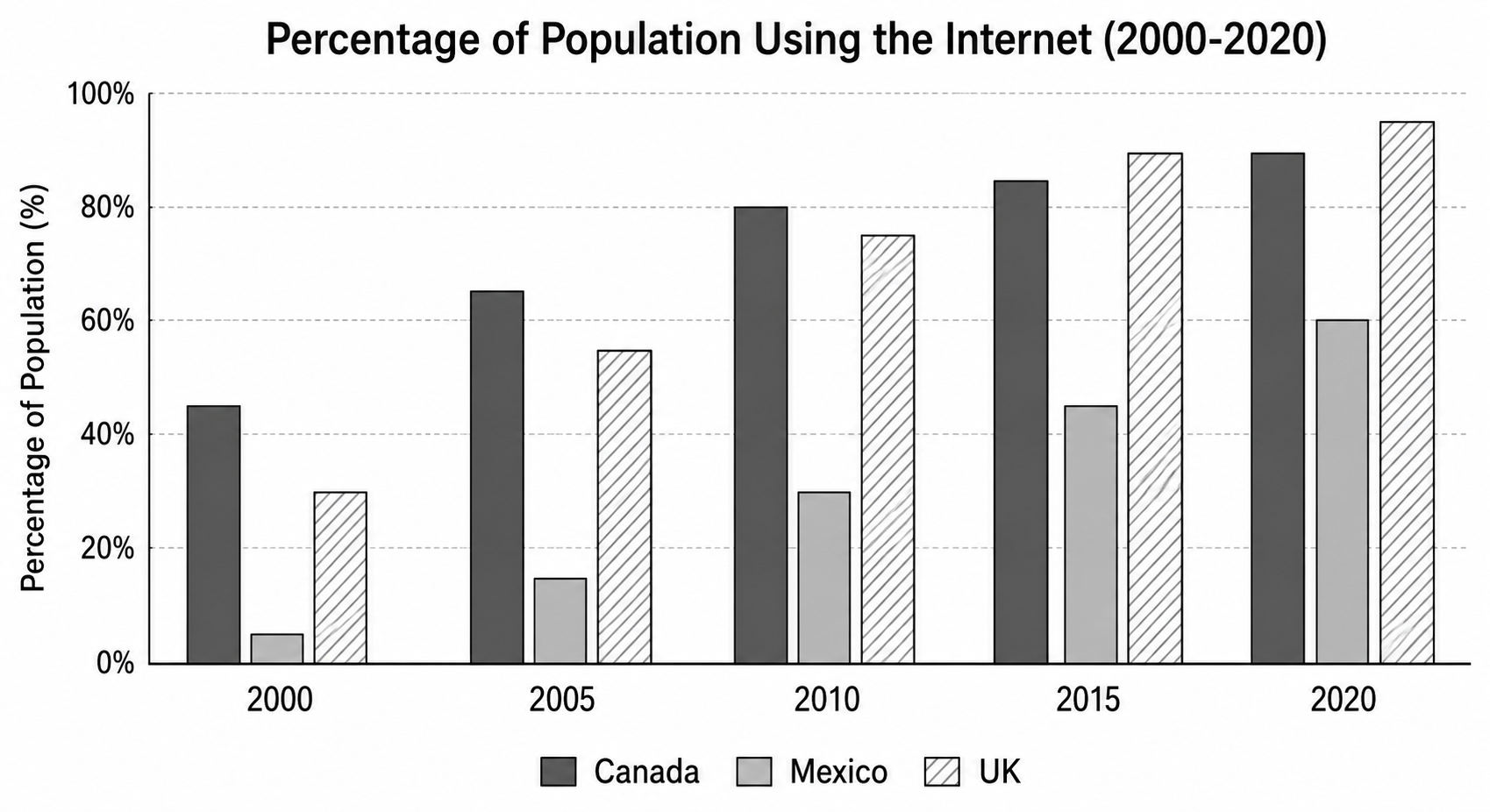
The chart below shows the percentage of the population using the internet in three different countries from 2000 to 2020.

Summarise the information by selecting and reporting the main features, and make comparisons where relevant.
Academic Writing Task 1 Dynamic Grouped Bar Chart practice image
BAND 9

Part 1 · Band 9 Sample Answer

The bar chart compares the proportions of people who used the internet in Canada, Mexico and the UK at five-year intervals between 2000 and 2020.

Overall, internet use increased substantially in all three countries. Canada had the highest proportion at the beginning of the period, but the UK overtook it by 2015 and recorded the highest figure in 2020. Mexico remained considerably behind the other two countries throughout, despite experiencing strong growth.

In 2000, approximately 45% of Canadians used the internet, compared with 30% of people in the UK. Mexico’s figure was much lower, at just 5%. By 2005, usage had risen to 65% in Canada and 55% in the UK, while the proportion in Mexico had tripled to 15%.

The upward trend continued over the following decade. In 2010, the figures for Canada and the UK reached 80% and 75% respectively, whereas internet penetration in Mexico stood at 30%. Five years later, the UK moved into first place at 90%, five percentage points above Canada. Mexico, meanwhile, reached 45%. By 2020, internet use had climbed to 95% in the UK and 90% in Canada, while Mexico ended the period at 60%.

BAND 8

Part 1 · Band 8 Sample Answer

The bar chart illustrates the percentage of the population using the internet in Canada, Mexico and the UK from 2000 to 2020, with data given at five-year intervals.

Overall, the proportion of internet users rose steadily in all three countries. Canada recorded the highest percentage during the first three years shown, whereas the UK became the leading country in 2015. Although Mexico also experienced significant growth, it had the lowest figures throughout the period.

In 2000, internet users accounted for 45% of the population in Canada. The corresponding figure for the UK was 30%, while only 5% of Mexicans used the internet. By 2005, the percentages had increased to 65% in Canada and 55% in the UK. Mexico’s rate also rose, but remained relatively low at 15%.

In 2010, internet usage reached 80% in Canada and 75% in the UK, compared with 30% in Mexico. The UK then overtook Canada in 2015, when their figures stood at 90% and 85% respectively. During the same year, Mexico reached 45%. By the end of the period, the UK had the highest level at 95%, followed by Canada at 90% and Mexico at 60%.

BAND 7

Part 1 · Band 7 Sample Answer

The bar chart shows the percentages of people who used the internet in Canada, Mexico and the UK between 2000 and 2020.

Overall, internet use increased in all three countries over the period. Canada had the highest percentage at first, but the UK became the country with the most internet users by 2015. Mexico had the lowest proportion in every year shown.

In 2000, 45% of the Canadian population used the internet, compared with 30% in the UK. Mexico had a much smaller figure of only 5%. Five years later, the percentages in Canada and the UK had risen to 65% and 55% respectively, while the figure for Mexico increased to 15%.

By 2010, internet use had reached 80% in Canada and 75% in the UK. Mexico was still far below these two countries, at 30%. In 2015, the UK rose to 90% and overtook Canada, which stood at 85%. Mexico’s figure also increased to 45%. In the final year, the UK remained in first place at 95%, followed by Canada at 90%. Mexico finished the period at 60%, which was twelve times its percentage in 2000.

Academic Writing Task 2

Task 2 · Discuss Both Views and Give Your Opinion

Task 2 Prompt

You should spend about 40 minutes on this task. Write at least 250 words.

Write about the following topic:

In some countries, the government fully funds all university tuition fees. In other countries, students must pay for their own education.

Discuss both views and give your own opinion.

Give reasons for your answer and include any relevant examples from your own knowledge or experience.

BAND 9

Part 2 · Band 9 Sample Answer

Whether university tuition should be paid entirely by the state or by individual students remains a contentious issue. Supporters of public funding regard higher education as a social investment, whereas others argue that graduates should bear the cost because they receive substantial personal benefits. Although both positions have merit, I believe governments should provide significant support without necessarily covering every student’s full tuition.

The strongest argument for fully funded university education is that it promotes equal opportunity. When fees are high, capable students from low-income households may avoid university or graduate with considerable debt. Removing this financial barrier allows admission to depend more on ability than family wealth. Society may also benefit from having more qualified doctors, engineers and teachers, especially in fields where labour shortages exist. Furthermore, graduates generally earn more and therefore contribute additional tax revenue over their working lives, enabling the state to recover part of its investment indirectly.

On the other hand, requiring students to pay can be justified on grounds of fairness and efficiency. A degree often brings higher earnings, better employment prospects and greater social mobility, all of which primarily benefit the graduate. It may therefore seem unreasonable to use taxes collected from people who did not attend university, including those on modest incomes, to finance every degree. Charging tuition can also discourage students from enrolling without a clear purpose and encourage institutions to respond more carefully to students’ expectations. Full public funding, by contrast, may place a heavy burden on government budgets and divert resources from primary education, healthcare or housing.

In my view, a shared-cost system offers the fairest solution. Governments should fully support students from disadvantaged backgrounds and subsidise courses that serve important public needs. Other students could make a reasonable contribution through income-contingent loans, repaying only after their earnings exceed a suitable threshold. This would preserve access while recognising the private value of a degree.

In conclusion, free tuition can expand opportunity and benefit the wider economy, while student contributions protect public finances and acknowledge graduates’ personal gains. A carefully designed combination of public subsidies and affordable repayments is therefore preferable to either extreme.

BAND 8

Part 2 · Band 8 Sample Answer

The cost of university education is handled differently around the world. Some governments pay all tuition fees, while elsewhere students are expected to finance their own degrees. Free higher education can improve access and produce benefits for society, but asking students to contribute may be fairer and more sustainable. In my opinion, the best approach is for the government and students to share the cost.

Those who support full government funding argue that university should be available according to academic ability rather than personal wealth. Tuition fees can prevent students from poorer families from applying, even when they have excellent grades. If the state covers these costs, more people can become qualified professionals and improve their future prospects. The country also gains from a better-educated workforce. For example, public investment in medical or engineering degrees may help address shortages of essential workers and support economic development. Graduates will later pay taxes, so some of the original expenditure returns to the government.

However, there are also convincing reasons for students to pay. University graduates usually receive direct advantages, including access to professional careers and higher salaries. It is therefore reasonable for them to contribute towards an education that increases their earning potential. Fully funding every degree would also be extremely expensive, particularly when participation in higher education is widespread. This money might otherwise be needed for hospitals, schools and other public services. In addition, completely free tuition could encourage some people to begin courses without seriously considering whether the subject is useful or suitable for them.

I believe neither side should carry the entire financial burden. Students from low-income households should receive full grants so that cost does not exclude them. Other students could pay part of their fees with loans that are repaid only when they earn a sufficient salary. Governments could also give greater subsidies to subjects that meet national needs.

In conclusion, state-funded tuition supports equality and provides social benefits, whereas student fees recognise the personal value of a university degree and reduce pressure on public budgets. A shared system with strong protection for disadvantaged students is the most balanced solution.

BAND 7

Part 2 · Band 7 Sample Answer

In some nations, university students do not have to pay tuition fees because the government covers the full cost. In others, students are responsible for paying for their degrees. Both systems have advantages, but I believe the fairest policy is to provide government assistance while asking those who can afford it to make a contribution.

There are several reasons why governments should pay university fees. First, free education gives students from different financial backgrounds an equal chance to attend university. Without this support, young people from poorer families may decide not to continue their education because they are worried about fees and debt. Second, a country benefits when more people are highly educated. Universities train doctors, teachers, engineers and other workers who provide important services. By paying their tuition, the government is investing in the future workforce and the wider economy.

Nevertheless, there are good arguments for making students pay for their own education. A university degree usually gives the individual better job opportunities and the possibility of earning a higher salary. Since graduates receive this personal benefit, it is reasonable for them to pay at least part of the cost. Free tuition for everyone can also be very expensive for the government. Public money is limited, and spending a large amount on university students may leave less funding for healthcare, primary schools or support for elderly people. In addition, students may take their studies more seriously when they are contributing financially.

In my opinion, the cost should be shared. The government should pay all or most tuition fees for students from low-income families, as well as for subjects where the country needs more skilled workers. Students from wealthier backgrounds could pay a reasonable amount themselves. Another option is to offer loans that graduates repay only after they obtain a job and reach a certain income.

To conclude, full government funding makes university more equal and benefits society, while student fees reduce pressure on taxpayers and reflect the private advantages of a degree. A mixed system can achieve both aims without preventing talented people from studying.

FREE PRACTICE RESOURCES

Download the IELTS Practice PDF Pack.

Get Listening, Reading, and Writing practice materials for self-study. Use a computer to download the 1.9GB pack.

Download PDF Pack
Chat History
My Notes