ACADEMIC WRITING SAMPLE ANSWERS

Academic Writing Sample Answers Practice 4 Test 04

This original practice page includes Task 1 (Static Bubble Chart) and Task 2 (Discuss Both Views and Give Your Opinion), with Band 9, Band 8, and Band 7 sample answers for IELTS preparation.
Academic Writing Task 1

Task 1 · Static Bubble Chart

Task 1 Prompt

You should spend about 20 minutes on this task. Write at least 150 words.

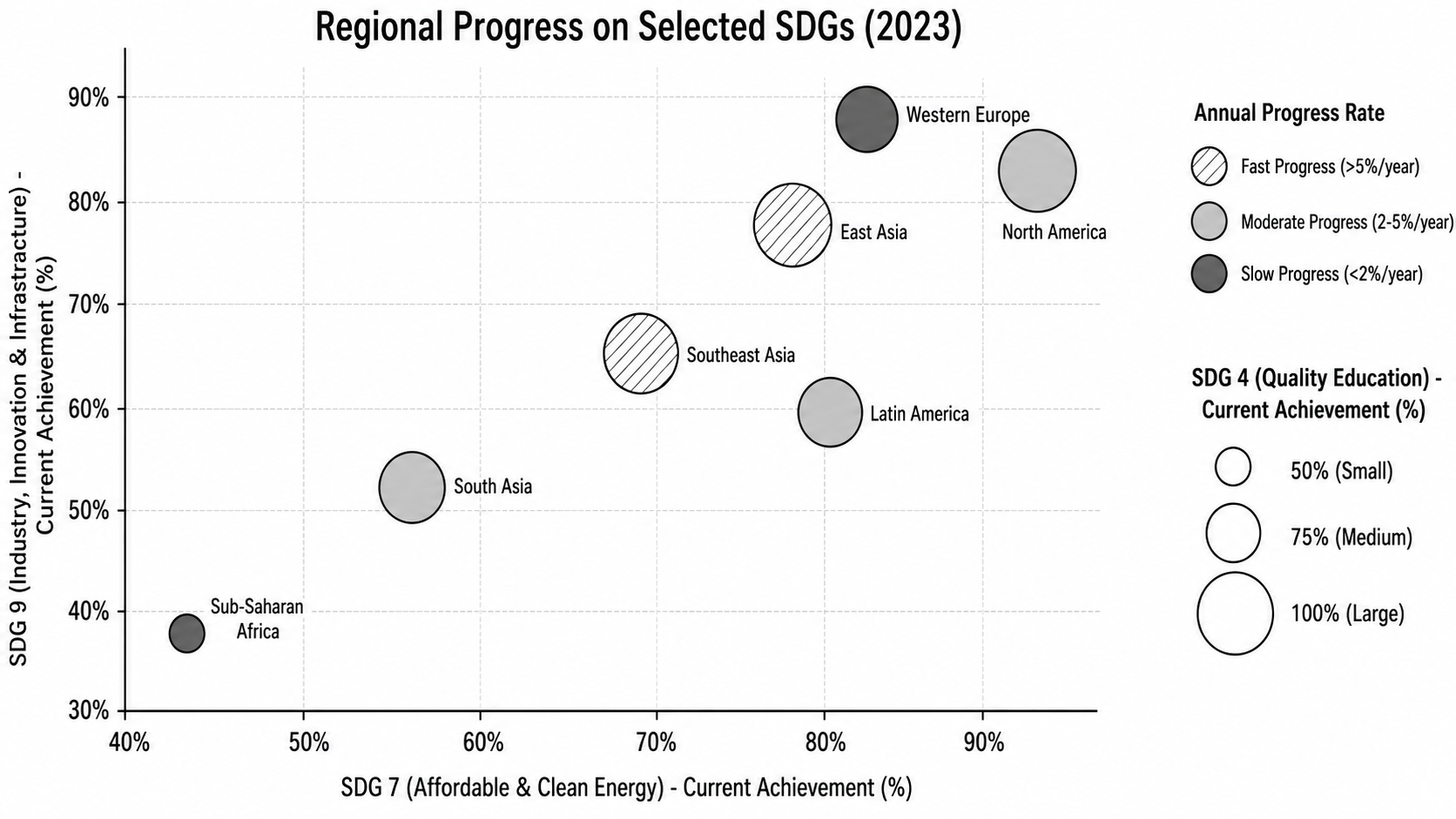
The bubble chart below compares seven regions in terms of their current achievement in SDG 7 and SDG 9 in 2023. The size of each bubble represents achievement in SDG 4, while the shading indicates the annual rate of progress.

Summarise the information by selecting and reporting the main features, and make comparisons where relevant.
Academic Writing Task 1 Static Bubble Chart practice image
BAND 9

Part 1 · Band 9 Sample Answer

The bubble chart compares seven world regions in 2023 according to their achievement in SDG 7, concerning affordable and clean energy, and SDG 9, relating to industry, innovation and infrastructure. Bubble size shows SDG 4 achievement, while the pattern or shade represents the annual pace of progress.

Overall, North America and Western Europe record the strongest current results, although both are progressing less rapidly than East and Southeast Asia. Sub-Saharan Africa ranks lowest on all three achievement measures. The largest bubbles are concentrated among North America and the two faster-growing Asian regions.

North America leads SDG 7 at approximately 93% and achieves about 83% for SDG 9. Western Europe, by contrast, has the highest SDG 9 figure, at roughly 88%, alongside an SDG 7 result of around 83%. However, North America is making only moderate progress and Western Europe slow progress. East Asia records almost identical results of about 78% on both axes, while Southeast Asia stands at approximately 69% for SDG 7 and 65% for SDG 9. Both regions are advancing at over 5% annually and have large bubbles, indicating high educational achievement.

Latin America achieves around 80% for clean energy but only 60% for industry and infrastructure, whereas South Asia scores lower, at approximately 56% and 52% respectively. Both show moderate progress and medium-sized bubbles. Sub-Saharan Africa is the clear outlier, with only about 43% achievement in SDG 7 and 38% in SDG 9. Its small, dark bubble also indicates the lowest educational result and progress below 2% per year.

BAND 8

Part 1 · Band 8 Sample Answer

The bubble chart presents the performance of seven regions in three Sustainable Development Goals in 2023. The horizontal and vertical axes show achievement in SDG 7 and SDG 9 respectively, while bubble size represents SDG 4. Different shading indicates whether annual progress is fast, moderate or slow.

Overall, North America and Western Europe have the highest current achievement levels, while Sub-Saharan Africa performs worst. East Asia and Southeast Asia are the only regions making fast progress. Larger bubbles generally appear among the better-performing regions, particularly North America and the two East Asian areas.

North America has the highest SDG 7 result, at about 93%, together with an SDG 9 score of approximately 83%. Western Europe leads SDG 9 at around 88%, while achieving roughly 83% in SDG 7. Despite these strong positions, their annual progress is moderate and slow respectively. East Asia records about 78% on both measures, and Southeast Asia achieves approximately 69% in clean energy and 65% in industry and infrastructure. Both have large, striped bubbles, showing high educational achievement and growth above 5% per year.

Latin America scores around 80% in SDG 7 but only 60% in SDG 9. South Asia has lower figures of roughly 56% and 52%. These two regions are making moderate progress and have medium-sized bubbles. Finally, Sub-Saharan Africa records just 43% for SDG 7 and 38% for SDG 9. Its bubble is both the smallest and darkly shaded, indicating low SDG 4 achievement and annual progress below 2%.

BAND 7

Part 1 · Band 7 Sample Answer

The bubble chart compares seven regions according to their achievement in SDG 7 and SDG 9 in 2023. The size of the bubbles shows achievement in quality education, or SDG 4, and the shading gives the rate of annual progress.

Overall, North America and Western Europe have the highest current figures, while Sub-Saharan Africa has the lowest. East Asia and Southeast Asia are progressing the fastest. The regions with high achievement generally have larger bubbles than those with lower results.

North America has the highest SDG 7 score at approximately 93%, and its SDG 9 figure is around 83%. Western Europe records about 83% for SDG 7 and has the highest SDG 9 result, at roughly 88%. However, North America is making moderate progress, while progress in Western Europe is slow. East Asia has similar figures of around 78% for both goals. Southeast Asia reaches about 69% in SDG 7 and 65% in SDG 9. Both Asian regions have large, striped bubbles, which show strong education results and fast annual progress.

Latin America performs better in SDG 7, at around 80%, than in SDG 9, at 60%. South Asia records lower figures of about 56% and 52% respectively. Both regions show moderate progress and medium educational achievement. Sub-Saharan Africa is last, with approximately 43% for clean energy and 38% for industry and infrastructure. It also has the smallest bubble and a slow rate of progress.

Academic Writing Task 2

Task 2 · Discuss Both Views and Give Your Opinion

Task 2 Prompt

You should spend about 40 minutes on this task. Write at least 250 words.

Write about the following topic:

Autonomous weapons can select and attack targets without direct human control. Some people believe that these weapons should be banned internationally because they create serious ethical and security risks. Others argue that they should be allowed under strict regulations requiring meaningful human control.

Discuss both these views and give your own opinion.

Give reasons for your answer and include any relevant examples from your own knowledge or experience.

BAND 9

Part 2 · Band 9 Sample Answer

The prospect of machines independently selecting and attacking targets has generated an urgent debate. Advocates of an international ban argue that delegating lethal decisions to algorithms is morally unacceptable and strategically dangerous, while others believe tightly regulated systems could be used responsibly if humans retain meaningful control. In my view, weapons capable of making the final decision to kill without human authorisation should be prohibited, although limited autonomous functions may be permitted under enforceable human-control requirements.

The case for a ban rests first on accountability. If an autonomous weapon attacks civilians because of flawed data, an unpredictable environment or a software error, responsibility may be divided among commanders, programmers, manufacturers and political leaders. This uncertainty weakens both legal accountability and the moral principle that a person should consciously justify the use of lethal force. Algorithms may also struggle to interpret surrender, fear or ambiguous civilian behaviour in the way a trained human can. Beyond individual incidents, widespread deployment could lower the political cost of starting conflicts because leaders would risk fewer soldiers. It could also trigger an arms race in which speed is prioritised over careful judgement, increasing the chance that machines escalate a confrontation before humans can intervene.

Supporters of regulated use respond that autonomy may improve precision and protect both soldiers and civilians. Machines do not act from anger, panic or a desire for revenge, and they can process sensor information rapidly. Autonomous defensive systems might intercept incoming threats in situations where human reaction is too slow. A complete ban could therefore remove technologies with legitimate protective uses and might be difficult to verify when the same software has civilian or defensive applications. Strict rules, testing and human supervision could arguably manage the dangers more effectively.

Nevertheless, regulation is credible only if meaningful human control has a concrete definition. A human operator should understand the system, identify or approve the target, assess the likely civilian harm and have sufficient time and technical ability to cancel an attack. Merely pressing an approval button after an algorithm has made an opaque recommendation would not satisfy this standard. International inspections, compulsory incident records and individual command responsibility would also be needed.

In conclusion, autonomy can support navigation, surveillance and defensive interception, but the final lethal decision should never be transferred entirely to a machine. An international prohibition on weapons operating beyond meaningful human control, combined with strict regulation of permitted functions, offers a more practical and ethical settlement than either an unrestricted market or an excessively broad ban on all military automation.

BAND 8

Part 2 · Band 8 Sample Answer

Autonomous weapons are able to identify and attack targets without a person making each immediate decision. Some people want a worldwide ban because of the ethical and security dangers, whereas others believe the technology should remain legal under strict rules and meaningful human control. I believe fully autonomous lethal decisions should be banned, but some automated military functions can be permitted when a trained human genuinely controls the attack.

Those supporting a complete ban argue that machines should not decide whether a person lives or dies. An algorithm may incorrectly identify a civilian as a threat because its training data are incomplete or conditions on the battlefield are unexpected. If this happens, it may be difficult to establish who is responsible: the military commander, the programmer or the company that built the weapon. Autonomous systems could also make war easier to begin because governments would not need to risk as many of their own soldiers. Furthermore, competing countries might develop weapons that respond at extremely high speeds, increasing the risk of accidental escalation before political or military leaders can stop it.

However, supporters of regulation point out that autonomous technology may also reduce harm. A machine does not experience fear, anger or exhaustion, all of which can influence human soldiers. Properly tested systems might identify certain military objects accurately and respond quickly to an incoming attack. For example, a defensive system may need to intercept a missile within seconds, leaving too little time for detailed human control. A total ban may also be difficult to enforce because many relevant technologies, including navigation and image recognition, have both civilian and military uses.

In my opinion, the key distinction should be whether a human makes the final lethal decision. Meaningful control must require an informed operator to approve a specific target, understand the expected effects and retain enough time to cancel the attack. Governments should also conduct independent safety tests, record every use and ensure that commanders remain legally responsible. Systems that choose human targets and fire without this level of supervision should be prohibited by an international agreement.

In conclusion, autonomous weapons present genuine risks to accountability, civilian safety and international stability, but not every automated defence function is equally dangerous. Banning fully independent lethal decisions while regulating limited uses under real human control is the most balanced approach.

BAND 7

Part 2 · Band 7 Sample Answer

Weapons that can choose and attack targets without direct human control may become more common in future conflicts. Some people believe they must be banned worldwide, while others think they can be used safely under strict regulation. In my opinion, machines should not be allowed to make the final decision to kill, although some automatic systems could be used if humans remain clearly responsible.

There are strong reasons for banning autonomous weapons. First, a machine may make a serious mistake when it tries to separate soldiers from civilians. Real situations can be confusing, and a person may be surrendering or carrying an object that the system identifies incorrectly. Second, it may be unclear who should be punished if the weapon attacks the wrong target. The commander could blame the programmer, while the manufacturer could argue that the system was used incorrectly. In addition, countries may be more willing to start wars when fewer of their own soldiers are in danger. Autonomous weapons could also react so quickly that a small error develops into a much larger conflict.

On the other hand, strictly controlled technology may provide some benefits. Machines can operate without becoming tired, frightened or angry, and they may react faster than people. This can be valuable when a defensive weapon has only a few seconds to stop an incoming missile. Supporters also argue that banning every autonomous function would be unrealistic because technologies such as navigation, cameras and object recognition are also used for peaceful purposes.

I believe international rules should focus on the final decision to attack. A trained person should approve each target, understand the information used by the system and be able to stop the weapon before it fires. Governments should test these systems carefully and keep records of every attack. Commanders must remain legally responsible for the results. Any weapon that independently chooses a human target and attacks without genuine approval should be banned internationally.

To conclude, autonomous weapons may respond quickly and reduce some risks to soldiers, but they can also cause civilian deaths, weaken accountability and make conflicts more dangerous. Limited automation may be acceptable, but lethal force must remain under meaningful human control.

FREE PRACTICE RESOURCES

Download the IELTS Practice PDF Pack.

Get Listening, Reading, and Writing practice materials for self-study. Use a computer to download the 1.9GB pack.

Download PDF Pack
Chat History
My Notes