Task 1 · Process Diagram
You should spend about 20 minutes on this task. Write at least 150 words.
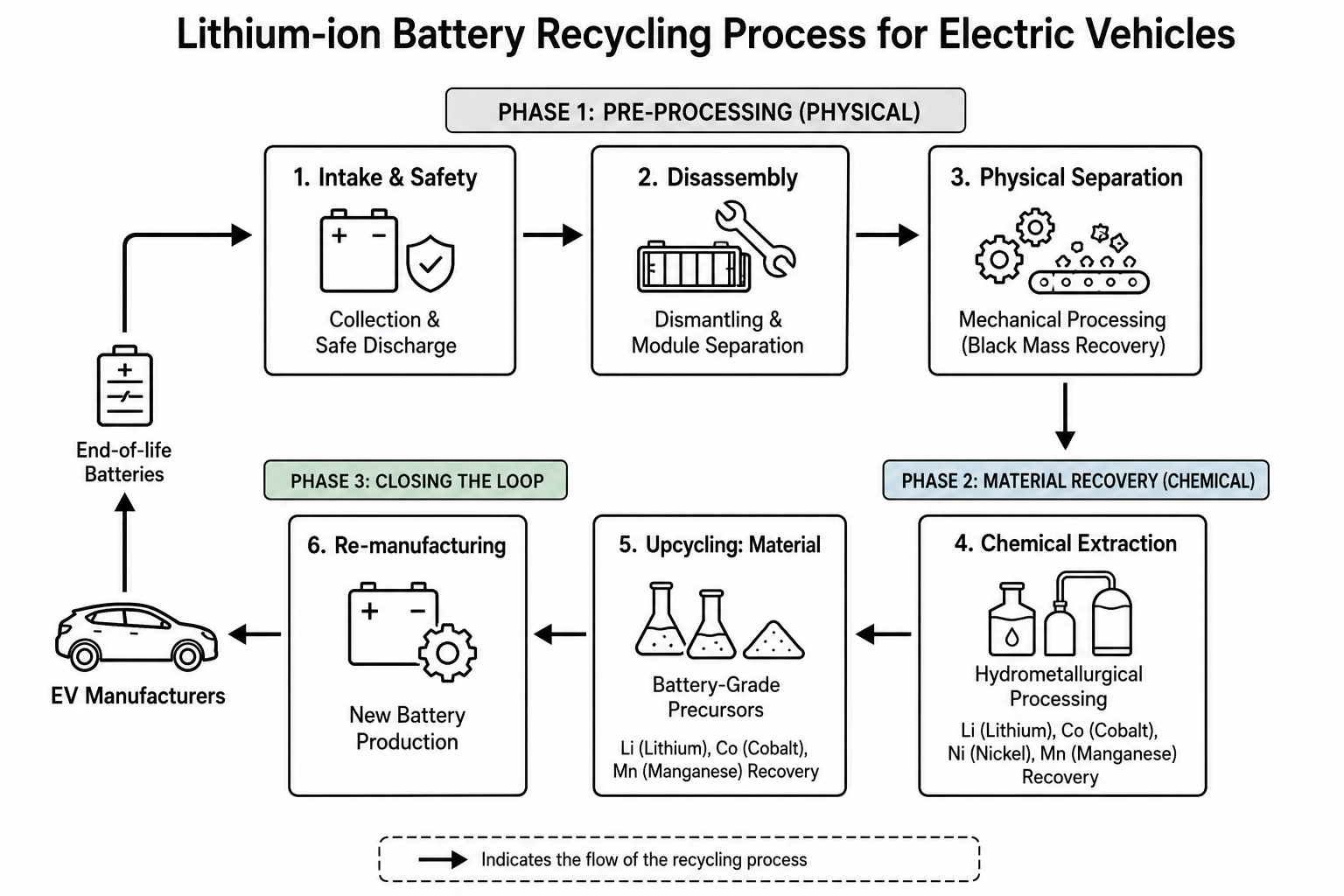
The diagram below illustrates the process of recycling lithium-ion batteries from end-of-life electric vehicles and shows how recovered materials are used to produce new batteries.
Summarise the information by selecting and reporting the main features.
Want to see your estimated band score?
Check your writing scorePart 1 · Band 9 Sample Answer
The diagram depicts a closed-loop system for recycling lithium-ion batteries removed from electric vehicles, from their collection and treatment to the manufacture of replacement batteries.
Overall, the cycle comprises six steps grouped into three phases: physical pre-processing, chemical material recovery and closure of the production loop. End-of-life batteries are first made safe and mechanically broken down; valuable metals are then extracted and upgraded into battery-grade inputs before being incorporated into new batteries for electric-vehicle manufacturers. These batteries eventually reach the end of their service life and re-enter the same process.
In the first phase, used batteries from electric vehicles are collected at the intake stage and safely discharged to eliminate electrical hazards. They are subsequently dismantled, with their modules separated. The resulting components then undergo mechanical processing during physical separation. This produces a concentrated material known as black mass, which proceeds to chemical treatment.
The second phase begins with hydrometallurgical processing. Through chemical extraction, four elements—lithium, cobalt, nickel and manganese—are recovered from the black mass. The extracted material is then upcycled to create battery-grade precursors suitable for reuse; lithium, cobalt and manganese are specifically identified among the materials recovered at this point.
Finally, the process enters its closing-the-loop phase. The battery-grade precursors are supplied for re-manufacturing and used in new battery production. Completed batteries are returned to electric-vehicle manufacturers and installed in vehicles. Once these batteries are no longer usable, they become end-of-life units and are directed back to collection and safe discharge, thereby completing the recycling cycle.
Part 1 · Band 8 Sample Answer
The diagram shows how lithium-ion batteries from end-of-life electric vehicles are recycled and how the recovered resources are returned to battery production.
Overall, this is a circular process containing six main steps and three phases. The batteries first undergo physical pre-processing, followed by chemical recovery and upcycling of valuable materials. These materials are then used to manufacture new batteries, which return to electric-vehicle producers and can eventually enter the recycling system again.
At the beginning of the pre-processing phase, expired vehicle batteries are collected and safely discharged. This safety procedure is followed by disassembly, during which the batteries are dismantled and their modules are separated. Mechanical treatment then divides the physical components and recovers black mass, the material that is passed to the chemical stage.
During the second phase, hydrometallurgical processing is used for chemical extraction. This step recovers lithium, cobalt, nickel and manganese from the black mass. The recovered substances subsequently undergo an upcycling stage, where they are processed into battery-grade precursors. The diagram identifies lithium, cobalt and manganese as recovered materials at this point.
In the final phase, described as closing the loop, these battery-grade inputs are used in the re-manufacturing stage to produce new batteries. The finished products are supplied to electric-vehicle manufacturers. After being installed and used in vehicles, the batteries ultimately reach the end of their useful lives. They are then sent back to the intake and safety stage, allowing the entire sequence of physical separation, chemical recovery and new production to be repeated.
Part 1 · Band 7 Sample Answer
The diagram illustrates the recycling process for lithium-ion batteries from electric vehicles. It also shows how recovered materials are used to make new batteries.
Overall, there are six steps divided into three phases. First, end-of-life batteries are made safe and physically separated. Next, useful metals are recovered through chemical processing and prepared for reuse. Finally, these materials are used to manufacture new batteries, which are returned to electric-vehicle manufacturers. The process is therefore a cycle.
In the first phase, used batteries are collected from electric vehicles and safely discharged. They are then dismantled, and the battery modules are separated. After this, the components go through mechanical processing. This physical separation stage produces black mass, which contains materials that can be recovered.
The black mass then moves into the chemical material recovery phase. Hydrometallurgical processing is used to extract lithium, cobalt, nickel and manganese. In the following upcycling step, the recovered material is converted into battery-grade precursors. Lithium, cobalt and manganese are listed as materials recovered during this part of the process.
The final phase closes the loop. The battery-grade materials are sent to the re-manufacturing stage, where they are used to produce new batteries. These batteries are supplied to electric-vehicle manufacturers and used in vehicles. When they reach the end of their useful life, they become end-of-life batteries. They are collected and safely discharged again, and the same six-step recycling process begins once more.