ACADEMIC WRITING SAMPLE ANSWERS

Academic Writing Sample Answers Practice 6 Test 04

This original practice page includes Task 1 (Static Horizontal Bar Chart) and Task 2 (Discuss Both Views and Give Your Opinion), with Band 9, Band 8, and Band 7 sample answers for IELTS preparation.
Academic Writing Task 1

Task 1 · Static Horizontal Bar Chart

Task 1 Prompt

You should spend about 20 minutes on this task. Write at least 150 words.

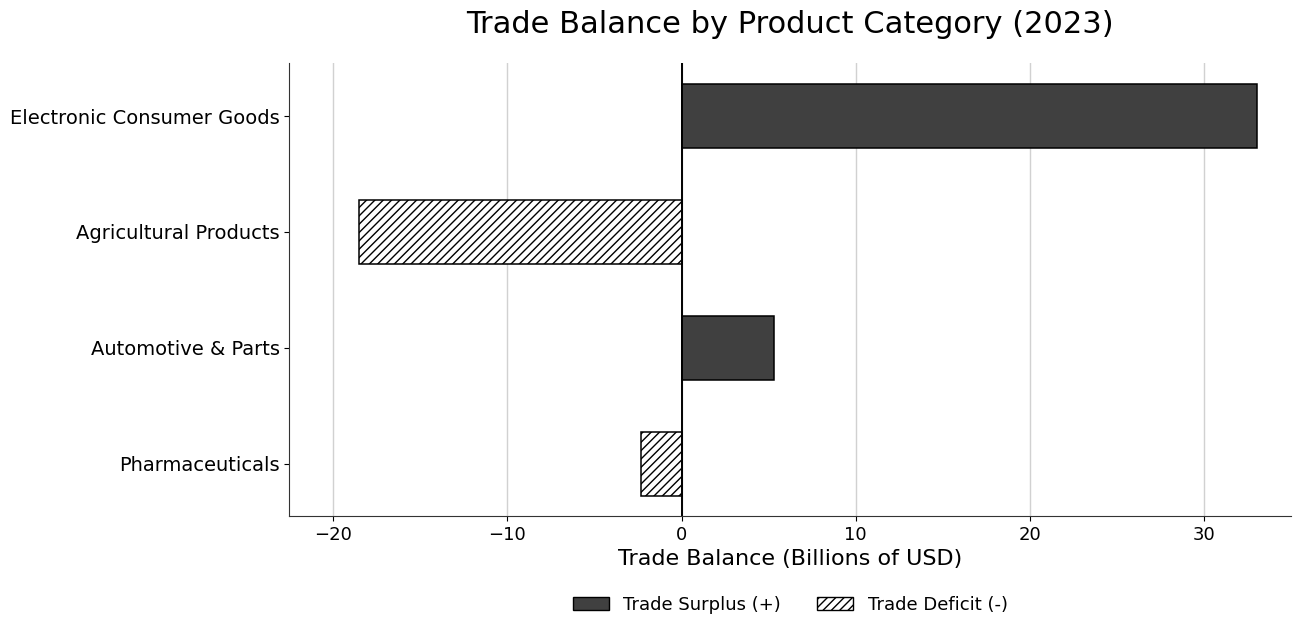
The chart below shows the trade balance (net exports) for four key product categories in a country for the year 2023. A positive value indicates a trade surplus, while a negative value indicates a trade deficit.

Summarise the information by selecting and reporting the main features, and make comparisons where relevant.
Academic Writing Task 1 Static Horizontal Bar Chart practice image
BAND 9

Part 1 · Band 9 Sample Answer

The bar chart compares the value of net exports in four product categories in one country in 2023, measured in billions of US dollars. Bars to the right of zero represent surpluses, whereas those to the left indicate deficits.

Overall, the country exported more than it imported in electronic consumer goods and automotive products and parts, while the reverse was true for agriculture and pharmaceuticals. Electronic goods generated by far the largest balance in either direction, and their surplus was sufficiently high to outweigh both deficits combined. Consequently, the four categories together produced a sizeable positive balance.

Electronic consumer goods recorded a trade surplus of approximately $33 billion. This was more than six times the positive balance for automotive products and parts, which stood at just over $5 billion. Taken together, the two surplus categories therefore contributed around $38 billion in net exports.

Agricultural products showed the largest deficit, at roughly $18.5 billion. This shortfall was more than seven times that for pharmaceuticals, whose imports exceeded exports by only a little over $2 billion. The combined deficit for these two categories was therefore close to $21 billion, or slightly more than half the total surplus recorded by electronics and automotive goods. After the negative balances are deducted from the positive ones, the four sectors shown generated an overall net surplus of approximately $17 billion.

BAND 8

Part 1 · Band 8 Sample Answer

The chart shows the trade balance for four types of products in a country during 2023. The figures are given in billions of US dollars, with positive amounts representing trade surpluses and negative ones indicating deficits.

Overall, two categories produced surpluses and two recorded deficits. Electronic consumer goods had the largest trade balance by a considerable margin, while agricultural products experienced the greatest shortfall. The positive balances were larger in total than the negative ones, meaning that the four categories together showed a net surplus.

The surplus for electronic consumer goods was about $33 billion. By comparison, automotive products and parts recorded a much smaller positive balance of just over $5 billion. Electronics therefore contributed roughly six times as much to the trade balance as the automotive category, and their combined surplus was approximately $38 billion.

On the negative side, agricultural products had a deficit of around $18.5 billion, making this the second-largest absolute figure on the chart. Pharmaceuticals also showed a deficit, but it was relatively minor at slightly more than $2 billion. Together, these two negative balances amounted to about $21 billion. This was around $17 billion less than the total for the surplus categories. Thus, when all four product groups are considered, the country achieved an overall positive balance of approximately $17 billion.

BAND 7

Part 1 · Band 7 Sample Answer

The bar chart presents the trade balance for four product categories in a country in 2023. Values are measured in billions of US dollars. A positive value means exports exceeded imports, while a negative value means imports were higher.

Overall, electronic consumer goods and automotive products and parts had trade surpluses. In contrast, agricultural products and pharmaceuticals recorded deficits. Electronic goods had the largest figure on the chart, whereas pharmaceuticals had the smallest balance in absolute terms. The surpluses were also larger than the deficits when the four categories were added together.

Electronic consumer goods produced a surplus of around $33 billion. This was much higher than the figure for automotive products and parts, which was just over $5 billion. The two positive categories therefore had a combined trade surplus of approximately $38 billion.

Agricultural products showed a deficit of roughly $18.5 billion. This was the largest negative balance and was more than three times the automotive surplus. The pharmaceutical deficit was considerably smaller, at a little over $2 billion. Together, the two deficit categories totalled about $21 billion. As a result, the combined surplus was around $17 billion greater than the combined deficit, leaving the four categories shown with an overall positive trade balance of approximately $17 billion.

Academic Writing Task 2

Task 2 · Discuss Both Views and Give Your Opinion

Task 2 Prompt

You should spend about 40 minutes on this task. Write at least 250 words.

Write about the following topic:

The constant connectivity offered by smartphones and social media is often blamed for shortening attention spans and reducing people’s ability to read deeply or concentrate for long periods. Some people believe that this is changing the way humans think in negative ways, particularly among younger generations. Others argue that it is simply a shift towards new and more efficient ways of processing information and that society will adapt.

Discuss both these views and give your own opinion.

Give reasons for your answer and include any relevant examples from your own knowledge or experience.

BAND 9

Part 2 · Band 9 Sample Answer

Smartphones and social platforms place communication, entertainment and information within constant reach. Some observers argue that alerts and short content are eroding sustained attention, especially among children, while others see faster, selective reading as an adaptation to abundant information. I believe digital media cultivate useful skills, but rapid processing complements rather than replaces deep concentration, which current platforms often undermine.

The negative argument concerns incentives as much as human biology. Notifications, recommendations and endlessly refreshed feeds repeatedly offer a more immediate reward than a demanding book or complex task. A student who pauses whenever a message arrives must reconstruct the context of what they were reading, making comprehension slower and more superficial. Over time, people may avoid material that does not provide quick stimulation. Younger users are particularly vulnerable because habits of patience, reflection and self-control are still being formed. The danger is not necessarily a permanent loss of capacity, but insufficient practice in concentrating.

The opposing view correctly notes that older definitions of literacy are not sufficient for a digital society. People now need to search large quantities of material, compare sources, interpret combinations of text and images, and communicate across networks. Skimming is efficient when locating one relevant fact among hundreds of pages, while brief instructional media can make specialised knowledge more accessible. Societies have adapted to earlier changes in communication, and schools and workplaces can develop conventions for managing digital information.

However, efficiency depends on purpose. Rapid scanning works for choosing a train route or surveying headlines, but it cannot replace close attention when evaluating an argument, learning a difficult concept or making a consequential decision. Someone who processes more items per minute may understand less if each is encountered without context. Furthermore, claims about adaptation overlook the commercial design of many platforms: their success often depends on capturing time and encouraging repeated engagement, not helping users think well.

I therefore favour adaptation accompanied by deliberate protection of attention. Schools should teach both digital navigation and extended reading, while families can establish periods without notifications. Employers should avoid treating immediate replies as proof of productivity, and technology companies should provide meaningful controls for interruptions. Individuals must also recognise that concentration is maintained through use.

In conclusion, connected media have expanded the speed and range of information processing, but sustained attention is not outdated. Unless societies preserve opportunities for deep thought, the shift will be negative overall, particularly for younger people whose intellectual habits are still developing.

BAND 8

Part 2 · Band 8 Sample Answer

Constant access to smartphones and social media has changed how people read, communicate and spend their free time. Some believe that frequent notifications and short online content are damaging concentration, particularly among the young. Others see this as a practical move towards faster ways of handling information. I believe digital skills are valuable, but society should not assume that they can replace the ability to focus deeply.

Those who are concerned point to the interruptions built into everyday technology. A person reading a long article may receive messages, news alerts and entertainment recommendations within a few minutes. Even if each interruption is brief, attention must repeatedly move away from the original argument. Social platforms also tend to present short, rapidly changing posts, so users become accustomed to receiving immediate stimulation. Young people who develop these habits early may find textbooks or complex problems unusually slow and frustrating. This can affect education because genuine understanding often requires readers to connect ideas across many pages.

On the other hand, the modern information environment demands different abilities. It is no longer efficient to read every available document from beginning to end. People must identify useful sources, skim for relevant points and switch between text, video and interactive material. These skills can support learning and work. For example, someone repairing an unfamiliar device might locate a short visual guide more quickly than the same information in a long manual. Supporters therefore argue that shorter attention to each item may represent sensible selection rather than intellectual decline.

There is truth in this argument, but rapid processing and deep reading serve different purposes. Skimming is effective for locating a fact, whereas evaluating evidence or understanding a complicated theory requires continuous attention. Society should adapt by teaching people when to use each method. Schools can combine digital research with uninterrupted reading and extended writing. Applications and phones should also make notifications easy to suspend, while families and workplaces can avoid expecting an immediate response at all times.

In my opinion, technology itself does not make serious thought impossible. The greater problem is an environment that constantly rewards distraction. Individuals can rebuild concentration through regular practice, but institutions and platform designers should make this easier rather than placing the whole responsibility on users.

In conclusion, smartphones and social media have created efficient ways to find and process information, yet they also encourage habits that can weaken sustained concentration. Adaptation is possible, but it must preserve deep reading instead of treating it as an unnecessary skill.

BAND 7

Part 2 · Band 7 Sample Answer

Smartphones and social media allow people to receive information and communicate at almost any time. Some people believe that this constant connection is reducing attention spans and harming the way young people think. Others argue that people are simply learning to process information more quickly. In my opinion, modern technology provides useful skills, but its effect will be negative if people lose the ability to concentrate for long periods.

There are clear reasons for concern. Phones produce frequent messages, alerts and recommendations that interrupt other activities. A person may begin reading an article but stop several times to check a message or watch a short video. As a result, it becomes harder to follow a complicated argument or remember details. Social media also encourages users to move quickly from one short post to another. This may be especially harmful for children and teenagers because they are still developing study habits and self-control. If they rarely read long texts, they may find schoolwork that requires patience increasingly difficult.

However, supporters of digital technology argue that quick information processing is valuable. People now face much more information than they can read fully, so they need to select relevant material and ignore the rest. Videos, summaries and search tools can also explain simple topics faster than traditional books. For example, a traveller can compare routes, prices and reviews in a few minutes instead of reading several separate guides. From this perspective, shorter periods of attention may sometimes show efficiency rather than a lack of ability.

Nevertheless, fast and slow forms of thinking are useful for different tasks. Skimming may be suitable for finding a fact, but reading a serious report, studying a difficult subject or solving a complex problem requires sustained focus. Society should therefore develop both skills. Schools can continue to require extended reading while also teaching effective online research. Individuals can turn off unnecessary notifications and set aside time when phones are not used. Social media companies could also give users better control over distracting features.

In conclusion, constant connectivity has improved access to information and encouraged faster selection of useful content. However, these advantages do not remove the need for deep concentration. People can adapt successfully only if they protect and practise this ability, particularly during childhood and education.

FREE PRACTICE RESOURCES

Download the IELTS Practice PDF Pack.

Get Listening, Reading, and Writing practice materials for self-study. Use a computer to download the 1.9GB pack.

Download PDF Pack
Chat History
My Notes