ACADEMIC WRITING SAMPLE ANSWERS

Academic Writing Sample Answers Practice 8 Test 03

This original practice page includes Task 1 (Process Diagram) and Task 2 (Opinion Essay), with Band 9, Band 8, and Band 7 sample answers for IELTS preparation.
Academic Writing Task 1

Task 1 · Process Diagram

Task 1 Prompt

You should spend about 20 minutes on this task. Write at least 150 words.

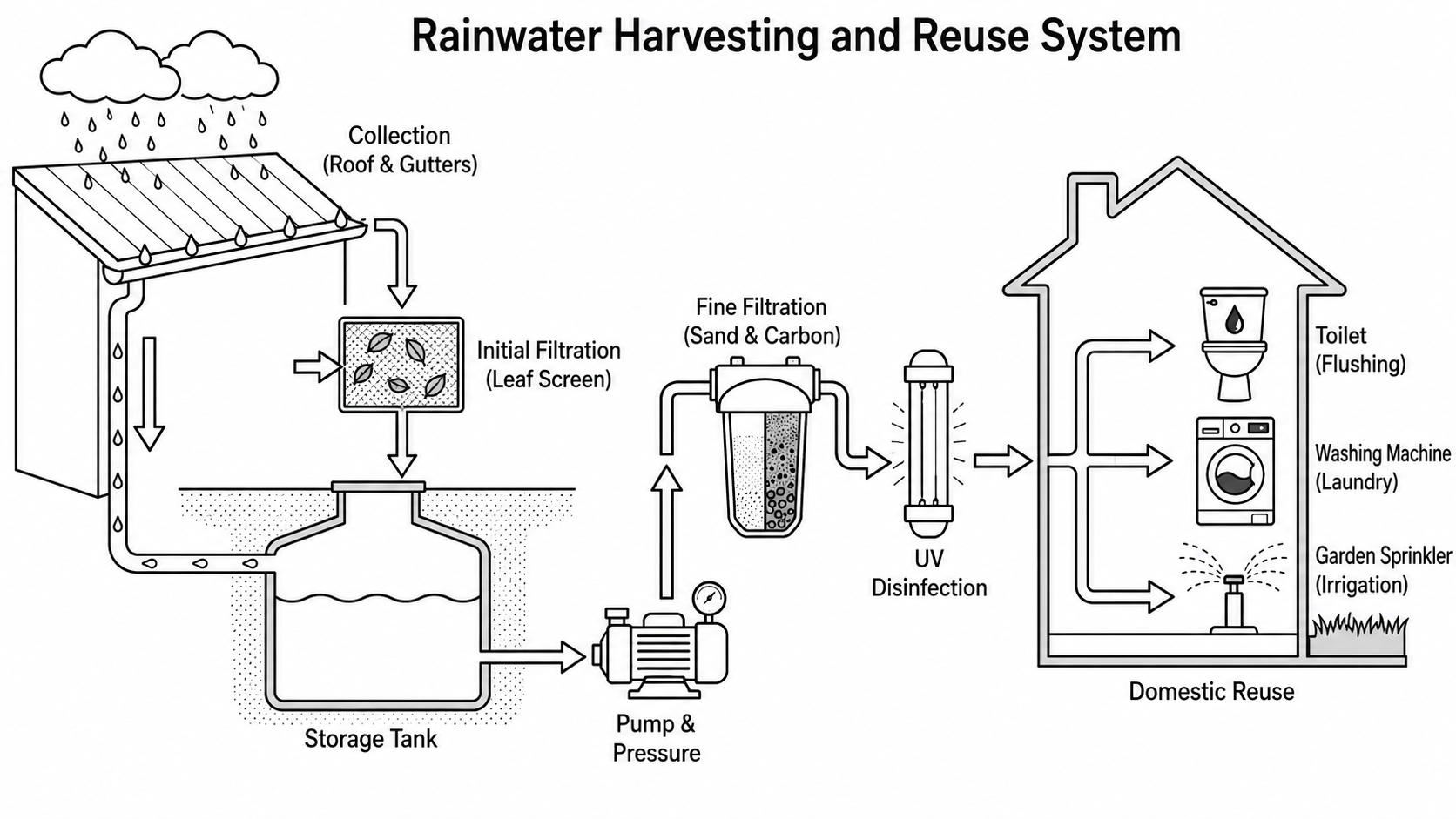
The diagram below illustrates the process by which rainwater is collected, treated, and reused for domestic purposes in a residential property.

Summarise the information by selecting and reporting the main features.
Academic Writing Task 1 Process Diagram practice image
BAND 9

Part 1 · Band 9 Sample Answer

The diagram shows how rainfall captured at a residential property passes through a series of collection, storage and treatment stages before being supplied for domestic reuse.

Overall, this is a linear process beginning with rain falling onto the roof and ending with the treated water being used for toilet flushing, laundry and garden irrigation. Before reuse, the water undergoes two forms of filtration, is held in an underground tank, and is subsequently pumped and disinfected with ultraviolet light.

Initially, rainwater landing on the sloping roof runs into gutters positioned along its lower edge. It is then channelled through a downpipe towards an initial filtration unit fitted with a leaf screen. At this point, leaves and other large debris are separated from the collected water. The screened rainwater then flows into a storage tank installed below ground beside the house.

When water is required, it leaves the base of this tank and enters a pump. This equipment draws the supply onwards and provides the pressure needed for the remaining stages. The pressurised water travels upwards into a fine filtration device containing layers of sand and carbon, which remove smaller impurities not captured by the first screen.

Following fine filtration, the water passes through a separate ultraviolet disinfection unit. The resulting treated supply is then conveyed into the property and divided among three outlets. One branch feeds a toilet for flushing, another supplies a washing machine for laundry, and the final branch leads outside to a garden sprinkler used for irrigation.

BAND 8

Part 1 · Band 8 Sample Answer

The illustration shows a household system that collects rainwater, cleans it and supplies it for domestic purposes.

Overall, rain is first gathered from the roof and stored underground after an initial screening stage. It is later pumped through fine filtration and ultraviolet disinfection before being distributed to a toilet, washing machine and garden sprinkler. The process is linear and consists of collection, storage, treatment and reuse.

At the first stage, rain falls onto the roof of the property and is directed into gutters. From there, it moves down a pipe to an initial filter containing a leaf screen. This screen prevents leaves and larger unwanted materials from continuing through the system. The filtered water then passes into a tank located beneath ground level, where it remains until needed.

The next part of the process begins when water is drawn from the storage tank by a pump. Besides moving the water forwards, this device provides pressure for its passage through the treatment equipment. The supply first enters a fine filter that contains sand and carbon. This represents a more detailed filtration stage than the earlier leaf screen.

Afterwards, the water flows into a UV unit, where it is disinfected. It is then ready to be returned to the residential property through a shared supply line. Inside and around the house, the treated rainwater is used in three ways: it provides water for flushing the toilet, supplies the washing machine for laundry, and feeds an outdoor sprinkler that irrigates the garden.

BAND 7

Part 1 · Band 7 Sample Answer

The diagram illustrates the stages involved in collecting and treating rainwater so that it can be reused in and around a home.

Overall, the process starts when rain falls on the roof and finishes when treated water is supplied for three domestic uses. The main stages are collection, initial filtration, underground storage, pumping, fine filtration and UV disinfection. The system does not return the water to the beginning after use.

First, rainwater runs down the roof and enters the gutters. It is carried through a pipe to an initial filtration box, where a leaf screen removes leaves and other large materials. After passing through this screen, the water flows into a storage tank under the ground.

Next, water from the tank is sent through a pump, which moves it through the later parts of the system and provides pressure. It then enters a fine filter containing sand and carbon. This second filtration stage treats the water more thoroughly than the leaf screen.

The filtered water subsequently passes through a UV disinfection unit. Once this stage has been completed, the treated water travels through a pipe into the house. It is divided between two indoor uses and one outdoor purpose. Indoors, it is supplied to a toilet for flushing and to a washing machine for doing laundry. The remaining water is directed to a garden sprinkler and used for irrigation.

Academic Writing Task 2

Task 2 · Opinion Essay

Task 2 Prompt

You should spend about 40 minutes on this task. Write at least 250 words.

Write about the following topic:

The internet provides unprecedented access to information, but it also allows for the widespread tracking of individuals' online activities. Many people accept this as a necessary trade-off for personalised services and security. However, others argue that this constant surveillance has created a society where privacy is no longer a realistic expectation.

What is your opinion on this issue? Is the loss of personal privacy an acceptable price for the benefits of the digital age, or should stronger measures be taken to protect individual privacy, even if it limits some services?

Give reasons for your answer and include any relevant examples from your own knowledge or experience.

BAND 9

Part 2 · Band 9 Sample Answer

Digital services often exchange convenience for data: maps need locations, recommendations reflect preferences, and banks monitor transactions for fraud. This encourages the belief that extensive tracking is the unavoidable price of participating online. I disagree. Data collection is justified when necessary, transparent and freely chosen, but continuous surveillance should not be the default. Stronger protection is worth some loss of personalisation because privacy underpins autonomy.

There are genuine benefits to analysing online activity. A navigation application cannot calculate a route without knowing where its user is, while a payment provider can identify an unusual purchase by comparing it with previous behaviour. In such cases, however, the benefit normally requires a defined category of data for a defined period; it does not justify storing a permanent record of browsing, movement and communication. Security is likewise strengthened by targeted monitoring, not necessarily by collecting everything about everyone.

The principal danger of routine tracking is the imbalance of knowledge and power it creates. Seemingly harmless clicks can be combined to infer health concerns, political beliefs, financial stress or personal relationships. These conclusions may then influence prices, advertisements or opportunities without the individual ever seeing, let alone challenging, the underlying profile. Surveillance can also change behaviour: people who believe every search is recorded may avoid investigating sensitive medical or political questions. Furthermore, even a responsible company cannot guarantee that a vast database will never be breached, sold or used for a purpose that did not exist when the information was gathered. Clicking a lengthy consent notice is therefore not equivalent to making an informed choice.

Stronger measures should focus on both law and system design. Organisations should collect the minimum information needed for a clearly stated service, delete it after a reasonable period and obtain separate permission for unrelated uses. People should be able to inspect, correct and erase their profiles without losing access to the basic service. Sensitive tracking should require explicit agreement, while government access should be subject to legal authorisation and independent scrutiny. Regulators also need the power to audit automated profiling and impose penalties large enough to affect corporate behaviour. Some advertising or recommendation systems would become less precise, but this would encourage privacy-preserving technologies and business models rather than end useful digital services.

In conclusion, the digital age inevitably involves some information sharing, but it does not require the surrender of meaningful privacy. Society should accept narrowly proportionate data use for clear benefits, while rejecting indiscriminate tracking and protecting individuals through enforceable rights, technical restraint and genuine consent.

BAND 8

Part 2 · Band 8 Sample Answer

The internet has made communication, shopping and access to knowledge much easier, but many of these services record detailed information about their users. Although tracking can improve personalisation and security, I do not believe that the general loss of privacy is an acceptable price for digital progress. Stronger rules are needed, even if some online services become less convenient or accurate as a result.

Supporters of data collection have reasonable arguments. Streaming platforms and online shops can recommend relevant material by learning what a person has previously watched or purchased. Banks can examine transaction patterns to detect possible fraud, and location data allows navigation services to provide directions or warnings about traffic. These functions can save time and protect users. In addition, many people knowingly choose to share information because they value a free or personalised service more than complete privacy.

However, the scale of modern tracking often goes far beyond what is needed to provide these benefits. Companies may follow users across different websites, combine information from several sources and keep it for years. From ordinary searches and clicks, a detailed profile may reveal interests, health worries, income level or political views. Such information could be used to influence purchasing decisions or treat people differently, while they have little understanding of how the judgement was made. Large collections of data also create attractive targets for criminals. Once private information has been leaked or sold, the affected person may never be able to recover control of it.

For these reasons, privacy protection should not depend only on users reading complicated terms and conditions. Laws should require organisations to collect only data that is genuinely necessary and to explain its purpose in plain language. Permission for advertising or other secondary uses should be separate from access to the main service. Users should be able to refuse tracking, view the information held about them and request its deletion. Strong security standards, independent inspections and meaningful penalties are also needed. These measures might make certain recommendations less precise and could reduce income from highly targeted advertising. Nevertheless, businesses would still be able to offer useful services by relying on less data or processing information directly on the device.

In conclusion, some voluntary sharing of information is a normal part of using digital tools, particularly when it provides a clear service or security benefit. Constant and hidden surveillance is different and should not be treated as inevitable. Protecting privacy is worth accepting modest limits on personalisation and convenience.

BAND 7

Part 2 · Band 7 Sample Answer

The digital age offers major benefits, including instant information, convenient services and improved online security. At the same time, websites and applications can monitor much of what people do. In my opinion, giving up personal privacy is not an acceptable general price for these benefits. Some data collection is necessary, but stronger protection should prevent organisations from tracking people without clear limits.

Tracking can be useful when it directly supports a service. For example, a map application needs access to a device location in order to provide directions. Online stores and entertainment platforms can use previous choices to suggest products, films or music that a user may like. Banks also monitor unusual account activity to identify possible fraud. Many users accept these practices because they receive a faster, safer or more personalised experience in return.

Nevertheless, there is an important difference between collecting necessary information and constantly recording online behaviour. A company may gather browsing histories, locations and purchases even when these details are not essential to its service. When information from different sources is combined, it can reveal sensitive facts about a person, such as health problems, financial difficulties or political interests. This can lead to manipulative advertising or unfair decisions. There is also a risk that criminals will steal the information in a data breach. People usually have little control after their details have been copied or sold.

Governments should therefore introduce and enforce stronger privacy measures. Companies should clearly state what they collect, why they need it and how long it will be stored. Users should have a real choice to reject unnecessary tracking without being completely blocked from a basic service. They should also be able to see, correct and delete personal information. Organisations that misuse data or fail to protect it should face serious penalties. These rules may reduce the accuracy of recommendations and make some advertising less profitable, but this is a reasonable cost. Companies can still improve services by using anonymous data or storing less information.

In conclusion, limited data use can be justified when it is transparent and necessary for a specific function. Constant surveillance, however, creates risks that are greater than the extra convenience it provides. Individual privacy should remain a realistic expectation, even if protecting it places some limits on digital services.

FREE PRACTICE RESOURCES

Download the IELTS Practice PDF Pack.

Get Listening, Reading, and Writing practice materials for self-study. Use a computer to download the 1.9GB pack.

Download PDF Pack
Chat History
My Notes