ACADEMIC WRITING SAMPLE ANSWERS

Academic Writing Sample Answers Practice 8 Test 04

This original practice page includes Task 1 (Static Mixed Chart) and Task 2 (Discuss Both Views and Give Your Opinion), with Band 9, Band 8, and Band 7 sample answers for IELTS preparation.
Academic Writing Task 1

Task 1 · Static Mixed Chart

Task 1 Prompt

You should spend about 20 minutes on this task. Write at least 150 words.

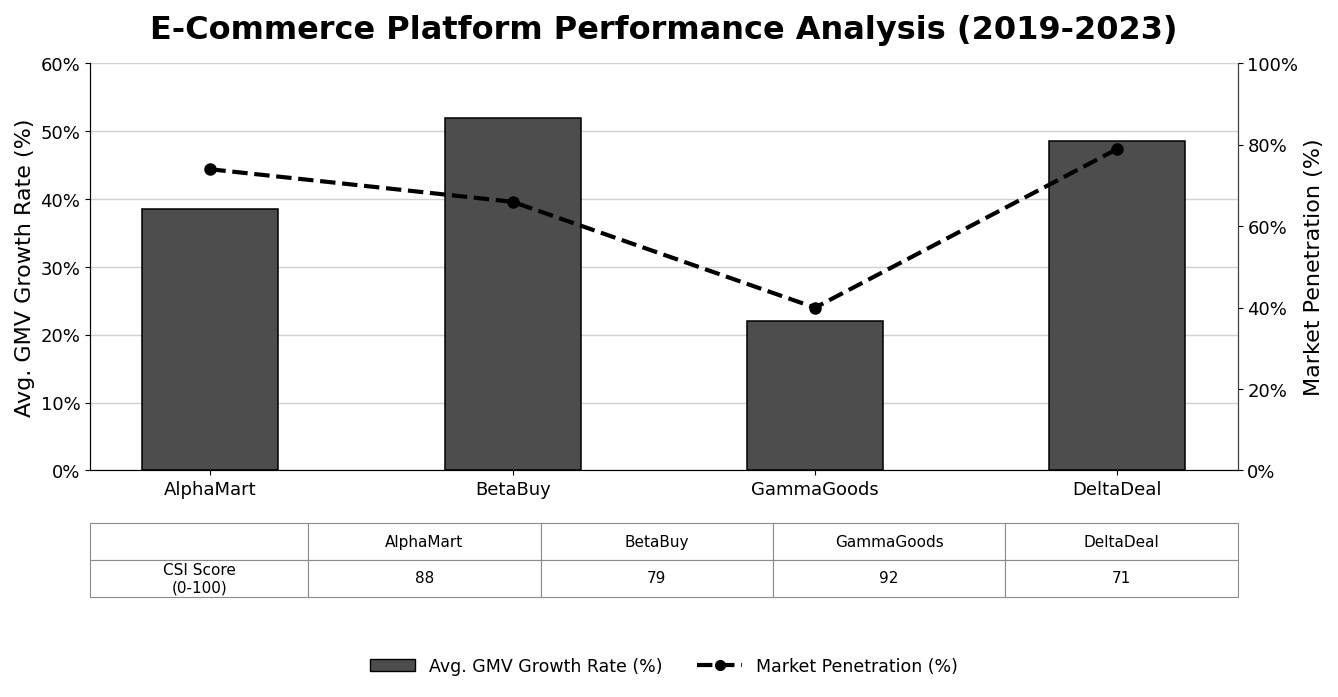
The chart below compares the performance of four major e-commerce platforms from 2019 to 2023 based on their average annual gross merchandise volume (GMV) growth rate, market penetration and customer satisfaction index scores.

Summarise the information by selecting and reporting the main features, and make comparisons where relevant.
Academic Writing Task 1 Static Mixed Chart practice image
BAND 9

Part 1 · Band 9 Sample Answer

The chart assesses four leading e-commerce platforms over the 2019–2023 period using three measures: average annual growth in gross merchandise volume, market penetration, and customer satisfaction on a 100-point index.

Overall, no platform leads on every indicator. BetaBuy records the fastest GMV expansion, whereas DeltaDeal reaches the largest share of the market. By contrast, GammaGoods ranks last for both growth and penetration but achieves the highest customer satisfaction score, while DeltaDeal receives the weakest satisfaction rating.

BetaBuy has an average GMV growth rate of approximately 52%, the highest among the four companies. DeltaDeal follows fairly closely at just under 50%, while AlphaMart occupies third place with roughly 39%. GammaGoods grows much more slowly, at only about 22%, leaving a gap of around 30 percentage points between it and BetaBuy.

Market penetration follows a different ranking. DeltaDeal has the broadest presence at almost 80%, around five percentage points above AlphaMart at approximately 75%. Despite leading in GMV growth, BetaBuy reaches only about two-thirds of the market. GammaGoods again has the lowest figure, at 40%, roughly half the level recorded by DeltaDeal.

The customer satisfaction results reverse parts of these patterns. GammaGoods tops the CSI table with 92 points, followed by AlphaMart at 88. BetaBuy receives a more moderate score of 79, despite its strong growth performance. DeltaDeal, meanwhile, combines high growth and penetration with the lowest satisfaction index, at 71, which is 21 points below the score for GammaGoods.

BAND 8

Part 1 · Band 8 Sample Answer

The bar and line chart compare four e-commerce companies in terms of their average yearly GMV growth and market penetration between 2019 and 2023. The accompanying table provides their customer satisfaction index scores.

Overall, BetaBuy has the highest rate of GMV growth, while DeltaDeal is the most widely used platform. GammaGoods performs weakest on these two business measures but has the most satisfied customers. DeltaDeal shows the opposite contrast, combining strong commercial performance with the lowest CSI score.

Regarding GMV, BetaBuy grows by an annual average of about 52%. DeltaDeal is second at roughly 49%, followed by AlphaMart at just under 40%. GammaGoods records by far the lowest growth rate, at approximately 22%, less than half the figure for either of the two leading platforms.

DeltaDeal also has a market penetration rate of almost 80%, making it the leader on this measure. AlphaMart reaches around three-quarters of the market and therefore ranks second, even though its GMV growth is lower than that of BetaBuy. BetaBuy itself has a penetration level of approximately 66%. GammaGoods is again well behind the other companies, reaching only 40% of the market.

Customer satisfaction does not reflect the commercial rankings. GammaGoods receives the highest index score of 92, four points more than AlphaMart, whose score is 88. BetaBuy is rated at 79, placing it third. Although DeltaDeal leads in market penetration and ranks second for growth, its satisfaction score is only 71, the lowest result shown and eight points below BetaBuy.

BAND 7

Part 1 · Band 7 Sample Answer

The chart compares the average GMV growth rates and market penetration of four e-commerce platforms from 2019 to 2023. It also shows their customer satisfaction index scores on a scale from 0 to 100.

Overall, BetaBuy has the fastest growth in GMV, while DeltaDeal records the highest market penetration. GammaGoods has the lowest figures for both of these measures. However, it receives the best customer satisfaction score, whereas DeltaDeal has the lowest score.

BetaBuy achieves average annual GMV growth of around 52%. DeltaDeal has the second-highest rate at approximately 49%, and AlphaMart grows by about 39%. In comparison, the rate for GammaGoods is much lower at only 22%. Its growth is therefore around 30 percentage points below that of BetaBuy.

For market penetration, DeltaDeal ranks first with a figure of almost 80%. AlphaMart follows at approximately 75%, despite having a lower GMV growth rate than BetaBuy. The penetration rate for BetaBuy is about 66%. GammaGoods once again has the smallest proportion, at 40%, which is only around half the figure for DeltaDeal.

The satisfaction scores show a different order. GammaGoods leads with 92 points, followed by AlphaMart with 88. BetaBuy receives a score of 79 and is placed third. DeltaDeal has the least satisfied customers, with an index score of 71. This is 21 points lower than the score for GammaGoods, even though DeltaDeal performs considerably better in growth and market penetration.

Academic Writing Task 2

Task 2 · Discuss Both Views and Give Your Opinion

Task 2 Prompt

You should spend about 40 minutes on this task. Write at least 250 words.

Write about the following topic:

Genetic engineering may one day be used not only to treat diseases but also to enhance human characteristics such as intelligence, physical ability or lifespan. Some people believe that this would help humans overcome biological limitations and improve their quality of life. Others argue that it could create serious ethical problems and increase inequality between those who can access such technologies and those who cannot.

Discuss both these views and give your own opinion.

Give reasons for your answer and include any relevant examples from your own knowledge or experience.

BAND 9

Part 2 · Band 9 Sample Answer

Editing genes to improve intelligence, strength or longevity would extend medicine from treating illness to redesigning ordinary traits. Advocates see a way to overcome nature, whereas critics fear biological inequality and choices imposed on future generations. I support genetic treatment, but enhancement should not proceed widely until safety, equal access and intergenerational consent are addressed.

Supporters can reasonably argue that the boundary between treatment and improvement is not always clear. Strengthening immunity might protect a vulnerable patient, yet the same intervention could also give a healthy person unusual resistance to disease. If genetic changes could extend healthy rather than merely total lifespan, people might avoid years of frailty and remain independent for longer. Enhancements to memory or physical recovery could similarly improve education, work and daily life. From this perspective, refusing safe enhancement simply because a trait is not a disease would preserve limitations that technology could responsibly reduce.

The opposing case is more compelling at present. Complex characteristics such as intelligence and athletic ability arise from many genes interacting with upbringing and environment, so altering them could have unintended effects. If changes are heritable, an error or disadvantage may pass to descendants who never consented. Access presents an equally serious problem. Wealthy families might purchase advantages that increase educational and economic success, enabling their children to afford still further enhancements. Existing inequality would then become partly biological and far harder to reverse. Social expectations could also narrow acceptable human variation. Parents might feel pressured to select fashionable traits, while unenhanced people or those with disabilities could be treated as irresponsible or inferior.

Policy should therefore distinguish urgent medical benefit from competitive enhancement. Gene-based interventions that prevent serious disease in an existing patient can be assessed through established principles of evidence, consent and clinical oversight. Non-medical alterations, especially those affecting embryos and descendants, should face an international moratorium unless their risks become well understood and broad public agreement emerges. If limited enhancements are eventually approved, access cannot depend entirely on wealth, and laws must prohibit genetic discrimination in education, employment and insurance. Decisions should involve patients, disability advocates, ethicists and the wider public, not only scientists or companies.

In conclusion, genetic engineering could genuinely reduce suffering and perhaps expand human capabilities. Nevertheless, enhancement is not simply better medicine: it can reshape social competition and the inheritance of advantage. Treatment should be supported, while enhancement should advance only cautiously under conditions that protect future people, human diversity and substantive equality.

BAND 8

Part 2 · Band 8 Sample Answer

Genetic engineering could eventually allow people to improve ordinary human abilities as well as prevent or cure disease. Some regard this as an opportunity to live longer, healthier and more capable lives, while others are concerned about ethics and unequal access. I believe medical uses should be encouraged, but enhancement should be introduced only under strict regulation and only when its benefits are not reserved for the wealthy.

There are several possible advantages. Human beings accept many technologies that overcome natural limitations, including vaccines, artificial limbs and corrective surgery. Genetic enhancement could be another step in this process. If scientists could safely increase resistance to illness or slow physical decline, people might enjoy more years of independent and productive life. Improvements in memory could support learning, while greater physical endurance might help individuals in demanding occupations. Such changes could also reduce pressure on healthcare systems if older people remained healthy for longer. Supporters therefore argue that it would be unreasonable to reject a beneficial technology simply because it improves a person beyond the usual level rather than treating a diagnosed condition.

However, enhancement raises problems that ordinary treatment does not. The first is safety. Traits such as intelligence depend on numerous biological and environmental factors, and changing one gene may produce unexpected results elsewhere. Alterations made to embryos could also be inherited, meaning future children would bear consequences they did not choose. The second concern is inequality. If enhancement is expensive, affluent parents could give their children advantages in health, education and employment. These benefits would add to existing differences in income and opportunity, potentially creating a permanent divide between enhanced and unenhanced groups. Furthermore, social pressure might turn an optional procedure into an expectation, leaving parents or individuals who refuse it at a disadvantage.

In my opinion, regulation should begin by separating therapy from enhancement. Procedures intended to prevent serious diseases should continue through careful clinical testing and informed consent. Changes designed mainly to increase competitive abilities should face a much higher standard of evidence, especially if they can affect later generations. Governments should also ban genetic discrimination and prevent companies from marketing unsafe or exaggerated claims. If an enhancement eventually becomes safe and socially valuable, some form of public provision may be necessary to ensure fair access.

In conclusion, genetic technology has the potential to improve health and quality of life, but unrestricted enhancement could make inequality biological and introduce irreversible risks. Society should prioritise treatment and permit enhancement only gradually, transparently and fairly.

BAND 7

Part 2 · Band 7 Sample Answer

In the future, genetic engineering may be able to improve human intelligence, physical performance and lifespan instead of being used only against disease. Some people welcome the chance to overcome natural limits, while others fear ethical difficulties and greater inequality. In my view, treating illness is a valuable use of this technology, but human enhancement should be controlled very carefully because its effects could reach beyond one individual.

Those in favour of enhancement believe it could greatly improve life. A genetic change that strengthens the immune system might help people avoid serious illnesses. If healthy lifespan could be extended, older adults could remain active and independent instead of experiencing a long period of poor health. Improved memory or physical ability could also help people study, work and complete difficult tasks more effectively. Humans already use medicine, education and technology to improve their natural abilities, so supporters may see genetic engineering as another useful tool rather than something completely different.

On the other hand, there are major risks. Genetic changes may have unexpected health effects, especially because characteristics such as intelligence are influenced by many genes and by a person’s environment. Changes made before birth may also be passed to later generations, who cannot agree to them. Inequality is another serious concern. If only rich families can afford enhancement, their children may receive even greater advantages at school and in the labour market. Over time, society could become divided into enhanced and unenhanced groups. People may also feel forced to change themselves or their children simply to compete with others.

I believe governments should allow genetic engineering to treat or prevent serious medical conditions after proper safety testing. However, procedures intended only to create higher intelligence, greater strength or unusually long life should not be freely sold. Heritable changes require particularly strict international rules because their results may be permanent. If safe enhancements are permitted in the future, access should be fair, and employers, schools and insurance companies should be forbidden from discriminating according to genetic status. Public discussion should also take place before major decisions are made.

In conclusion, genetic engineering may help people live healthier and more capable lives, but it could also make social inequality much worse and affect future generations. Medical treatment should remain the priority, while enhancement should proceed only when it is safe, necessary and governed fairly.

FREE PRACTICE RESOURCES

Download the IELTS Practice PDF Pack.

Get Listening, Reading, and Writing practice materials for self-study. Use a computer to download the 1.9GB pack.

Download PDF Pack
Chat History
My Notes