ACADEMIC WRITING SAMPLE ANSWERS

Academic Writing Sample Answers Practice 9 Test 01

This original practice page includes Task 1 (Dynamic Mixed Chart) and Task 2 (Two-part Question), with Band 9, Band 8, and Band 7 sample answers for IELTS preparation.
Academic Writing Task 1

Task 1 · Dynamic Mixed Chart

Task 1 Prompt

You should spend about 20 minutes on this task. Write at least 150 words.

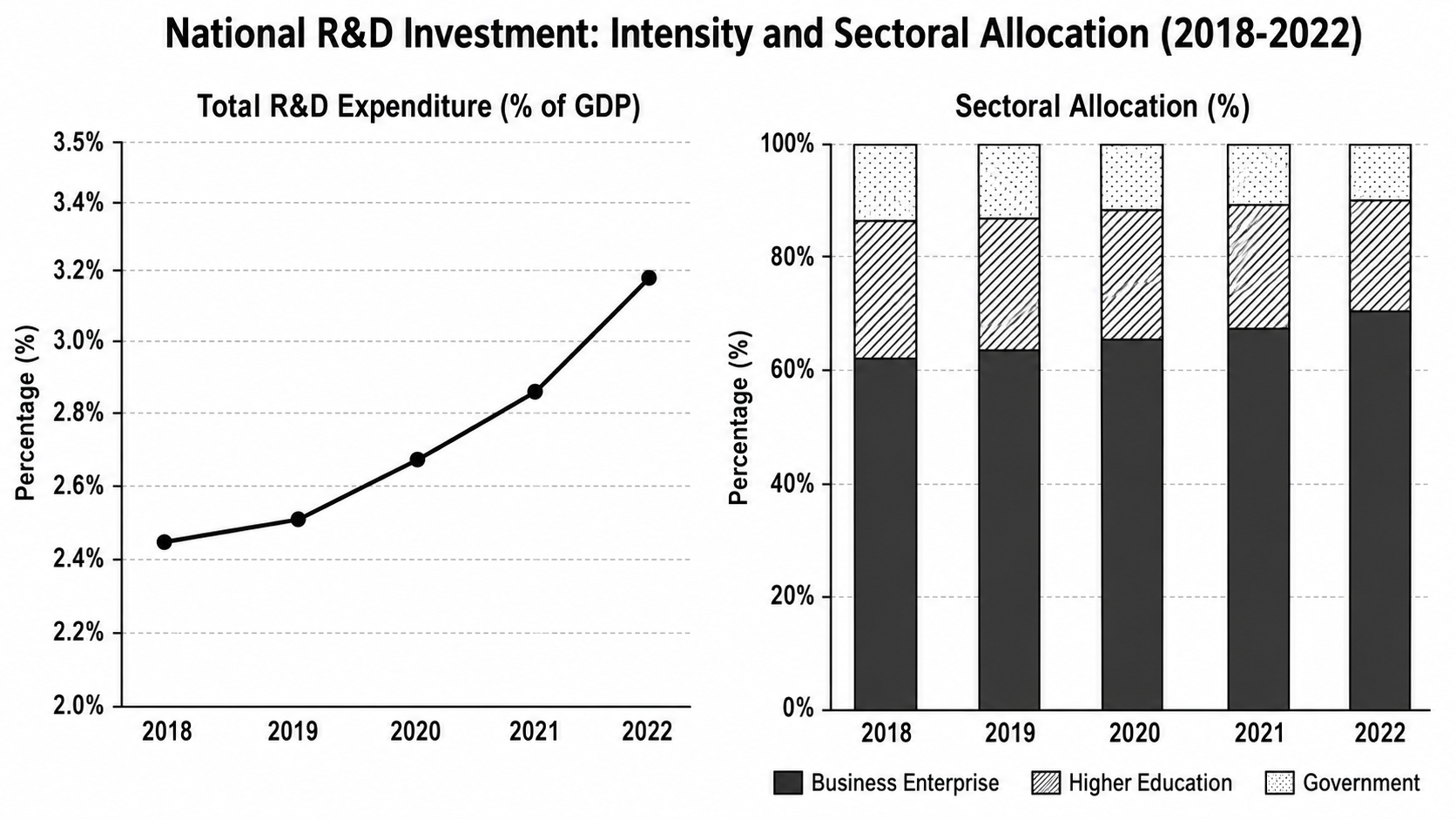
The chart below presents a multi-year analysis of national investment in research and development (R&D), correlating total expenditure as a percentage of GDP with the distribution of funding across three key sectors for the period 2018-2022.

Summarise the information by selecting and reporting the main features, and make comparisons where relevant.
Academic Writing Task 1 Dynamic Mixed Chart practice image
BAND 9

Part 1 · Band 9 Sample Answer

The two-part chart shows changes in a country’s research and development spending between 2018 and 2022, both as a proportion of GDP and in terms of the percentage allocated to business enterprise, higher education and government.

Overall, R&D expenditure increased throughout the period, and the rise became markedly faster towards the end. Business enterprise received by far the largest allocation in every year and its share grew steadily, whereas the proportions assigned to the other two sectors declined. Government consistently accounted for the smallest component.

Total expenditure initially rose only marginally, from approximately 2.45% of GDP in 2018 to 2.5% in 2019. It then climbed more substantially to about 2.67% in 2020 and 2.85% in 2021, before recording its sharpest annual increase and reaching just under 3.2% in 2022. The overall gain was therefore roughly 0.7 percentage points, most of which occurred after 2019.

Regarding sectoral allocation, the business-enterprise share advanced from around 62% in 2018 to 63% in 2019 and 65% in 2020. It rose further to 67% the following year and 70% by 2022. Higher education, by contrast, represented approximately 24% at the start and remained close to this level in 2019, after which it gradually fell to 20%. Government’s portion declined more uniformly, from 14% to 10%. Consequently, the eight-point expansion in the business share was matched by combined reductions of about four points in each of the other sectors.

BAND 8

Part 1 · Band 8 Sample Answer

The charts compare national expenditure on research and development from 2018 to 2022. The line graph presents spending as a percentage of GDP, while the stacked bars show how the total was allocated among business enterprise, higher education and government.

Overall, the proportion of GDP devoted to R&D rose in every year and increased particularly quickly in 2022. Business enterprise was consistently the main recipient of funding and gained a larger share over time. In contrast, both higher education and government experienced declines in their proportions.

R&D expenditure stood at about 2.45% of GDP in 2018 and edged up to 2.5% in the following year. Growth then became stronger, with the figure reaching roughly 2.67% in 2020 and 2.85% in 2021. By 2022, it had risen sharply to approximately 3.18%, the highest level shown. Overall, this represented an increase of just over 0.7 percentage points.

Business enterprise accounted for around 62% of the allocation in 2018. Its share increased gradually to approximately 63% in 2019, 65% in 2020 and 67% in 2021, before reaching 70% in the final year. Higher education received nearly a quarter of the total in the first two years, but its proportion slipped to about 23% in 2020, 22% in 2021 and 20% in 2022. Government had the smallest allocation throughout, declining steadily from roughly 14% to 10%. Thus, by the end of the period, the business share was three and a half times that of higher education and seven times the government proportion.

BAND 7

Part 1 · Band 7 Sample Answer

The line graph shows national spending on research and development as a percentage of GDP between 2018 and 2022. The bar chart gives the percentage of R&D funding allocated to business enterprise, higher education and government during the same period.

Overall, total R&D spending increased continuously and reached its highest point in 2022. Business enterprise had the largest share in all five years, and this share grew over time. Meanwhile, the percentages for higher education and government both became smaller.

In 2018, R&D expenditure was approximately 2.45% of GDP. It rose slightly to 2.5% in 2019 and then increased to about 2.67% in 2020. The upward trend continued in 2021, when the figure reached roughly 2.85%. The largest rise happened in the final year, taking expenditure to just below 3.2% of GDP.

Business enterprise received about 62% of the funding in 2018, compared with around 24% for higher education and 14% for government. The business proportion rose by one percentage point in 2019 and reached approximately 65% in 2020. It then increased to 67% in 2021 and 70% in 2022. Higher education remained at about 24% in 2019 before falling gradually to 20% by the end of the period. Government funding followed a steady downward pattern, dropping by about one point each year to finish at 10%.

Academic Writing Task 2

Task 2 · Two-part Question

Task 2 Prompt

You should spend about 40 minutes on this task. Write at least 250 words.

Write about the following topic:

Some argue that the most fundamental challenge of the 21st century is not technological or environmental, but philosophical: the need to redefine concepts like ‘progress’, ‘success’, and ‘well-being’ beyond material consumption and economic growth. They believe that without this foundational shift in values, technological solutions to climate change or inequality will be ineffective.

To what extent do you agree that a profound re-evaluation of societal values is a prerequisite for solving other major global problems? What might be the obstacles to achieving such a cultural and philosophical shift on a global scale?

Give reasons for your answer and include any relevant examples from your own knowledge or experience.

BAND 9

Part 2 · Band 9 Sample Answer

Technological ingenuity is indispensable to addressing climate change, poverty and other transnational threats. However, I largely agree that it cannot deliver durable solutions while societies continue to define progress chiefly as ever-increasing production and consumption. A reappraisal of collective values is therefore a prerequisite in the sense that it must accompany practical reform, although it need not be completed before technological or political action begins.

Values determine both the objectives to which technology is applied and the criteria by which outcomes are judged. For example, cleaner energy can reduce the emissions associated with each unit of electricity, yet its benefits may be offset if success still means consuming progressively more energy and replacing usable products at an accelerating rate. Similarly, economic growth can coexist with severe deprivation when its proceeds are concentrated among a small minority. If public policy instead treated health, security, leisure, ecological stability and fair opportunity as central measures of well-being, governments would have stronger reasons to promote durable goods, preventive healthcare and accessible public services. Such priorities would not replace engineering or investment; they would guide these resources towards outcomes that actually solve the underlying problem.

Nevertheless, cultural change and concrete solutions should be mutually reinforcing rather than sequential. Affordable public transport, for instance, can make lower-consumption lifestyles realistic and gradually alter attitudes towards private car ownership. Waiting for a universal philosophical consensus would merely delay urgent action. What is required is a sufficiently broad shift to sustain reforms, not complete agreement among all societies.

Several formidable obstacles stand in the way. First, existing institutions reward material expansion: companies depend on sales, governments rely on growing tax bases, and political performance is commonly assessed through GDP. Groups benefiting from this arrangement can resist alternative measures of progress. Second, countries occupy radically different economic positions. Appeals for reduced consumption may appear hypocritical to populations still seeking reliable housing, electricity and sanitation, particularly when they come from nations that became wealthy through intensive resource use. Finally, concepts such as success and well-being are culturally contested. Global communication may encourage common concern, but nationalism, distrust and misinformation can turn even shared risks into identity-based disputes.

In conclusion, I agree to a great extent that global problems cannot be solved permanently without redefining what development is for. Yet this ethical transition should evolve alongside immediate technological and institutional measures. Its greatest barriers are entrenched incentives, unequal starting points and the difficulty of building agreement across diverse cultures.

BAND 8

Part 2 · Band 8 Sample Answer

Many global problems are usually presented as technical questions requiring better machines, more efficient markets or new regulations. I agree to a large extent, however, that lasting solutions also depend on changing the values by which societies understand progress and success. This change does not have to precede every practical measure, but without it, many advances will address symptoms while leaving the forces that created the problems untouched.

The clearest example is climate change. Renewable power and electric vehicles can lower emissions, but their impact will be limited if people are continually encouraged to buy larger homes, travel more frequently and replace products unnecessarily. A culture that associates achievement with high consumption creates endless demand for energy and raw materials, regardless of improvements in efficiency. Redefining well-being to include time, health, strong communities and a safe environment would support different policies, such as reliable public transport and products designed to last. The same principle applies to inequality. Economic expansion alone does not guarantee broad prosperity, whereas a stronger commitment to dignity and equal opportunity can influence how wealth, education and healthcare are distributed.

Even so, a philosophical shift should not be treated as a condition that must be fully achieved before action starts. Environmental laws, cleaner infrastructure and social programmes can improve lives immediately and may themselves change public expectations. The relationship therefore works in both directions: values shape institutions, while well-designed institutions make new ways of living possible and acceptable.

Achieving this transition globally would face several obstacles. Powerful businesses and political groups benefit from consumption-led growth and may oppose policies that threaten profits or employment. Governments also focus on short election cycles, whereas cultural change takes decades. In addition, poorer countries reasonably want the material security already enjoyed by wealthier nations, so messages about consuming less may seem unfair. Finally, there is no universal definition of a good life. Religious traditions, family expectations and individual ambitions differ considerably, making a single global philosophy unrealistic. Advertising and social media can further strengthen status competition by displaying wealth as evidence of personal worth.

Overall, re-evaluating social values is essential for making solutions to climate change and inequality durable, although it should occur alongside rather than before practical action. Entrenched economic interests, unequal levels of development, political short-termism and cultural diversity are likely to make this shift slow and uneven.

BAND 7

Part 2 · Band 7 Sample Answer

Technology has an important role in solving problems such as climate change, poverty and inequality. However, I mostly agree that these problems cannot be solved in the long term unless societies reconsider their ideas of progress and success. Practical action should not be delayed until everyone accepts new values, but a broad cultural change is needed to support effective solutions.

One reason is that many problems are connected to the belief that greater consumption always means a better life. Renewable energy may make electricity cleaner, for example, but total environmental damage can remain high if people continually buy more goods, use more energy and throw products away quickly. If success were measured partly through good health, free time, secure communities and environmental quality, people and governments might make different choices. They could place more importance on public services, repairable products and green spaces instead of focusing only on higher incomes and sales.

Changing values is also relevant to inequality. A country can experience economic growth while many people still lack access to education, healthcare or safe housing. When fairness and basic security are treated as signs of national success, governments are more likely to ensure that the benefits of development are widely shared. Nevertheless, technology and policy remain necessary. New values alone cannot build clean energy systems or fund schools, and useful reforms can begin before a complete cultural transformation occurs.

There are several obstacles to such a global shift. The first is financial interest. Many companies earn money by encouraging frequent consumption, while governments often use economic growth as the main sign that their policies are working. Both may therefore resist major change. Another difficulty is the gap between rich and poor countries. People who do not yet have comfortable homes or reliable electricity may see calls for lower consumption as an attempt to deny them the living standards that richer societies already possess.

Furthermore, cultures have different views of success. Some emphasise individual achievement, while others give greater importance to family or community. Reaching global agreement would therefore be extremely difficult. Advertising, competition and the desire for social status also influence personal behaviour, even when individuals understand environmental or social problems.

In conclusion, I largely agree that societies need to redefine progress if solutions to major global challenges are to last. However, this shift should develop together with technological and political action. Economic interests, international inequality and cultural differences are the main barriers to achieving it worldwide.

FREE PRACTICE RESOURCES

Download the IELTS Practice PDF Pack.

Get Listening, Reading, and Writing practice materials for self-study. Use a computer to download the 1.9GB pack.

Download PDF Pack
Chat History
My Notes