IELTS WRITING TASK 1 CHECKER

IELTS Writing Task 1 Checker

Check IELTS Academic Writing Task 1 reports in Auvoxi Studio. Submit your response, receive an AI-estimated band score, and review detailed feedback for Task Achievement, Coherence, Vocabulary, and Grammar.

The checker runs inside Auvoxi Studio. Free account required. Free users receive 10,000 credits each month, usually enough for about three normal IELTS Writing checks. AI-estimated score, not an official IELTS result.
SAMPLE TASK 1 RESULT
Estimated Band
5
Task 1 CEFR B1 382 words
Task Achievement 5
Coherence & Cohesion 5
Lexical Resource 5
Grammatical Range & Accuracy 5
Top priority

Stop writing opinions in Task 1. Never use I think, In my opinion, or To conclude with a personal view.

View full sample report ↓
QUICK WRITING REPORT

Check your writing now.

Get an estimated band score and a short diagnosis of the most important issue in your response.

Task 1
0 / 1,500 characters
Task 1 image
0 words · 150–450 required
SAMPLE WRITING REPORT

See a full Task 1 sample report.

The sample below uses a Task 1 response and shows the criteria scores, priority fixes, detailed feedback, highlighted writing issues, and original task context available in Auvoxi Studio.

Full Sample Task 1 Report Collapse or expand

Overall Result

5
Type: Task 1 Words: 382 CEFR: B1

2026-04-17 00:00:00

Criteria Scores

Task Achievement
5
Coherence & Cohesion
5
Lexical Resource
5
Grammatical Range & Accuracy
5
Fast Track to Next Band

Priority Action Plan

💡 To improve your score by 0.5 - 1.0 band, make sure to master these 3 priorities:

1
Stop writing opinions in Task 1. Never use I think, In my opinion, or To conclude with a personal view.
2
Stick strictly to the visual data provided. Do not guess what happens before or after the steps shown.
3
Practice writing the passive voice correctly, for example: The glass is crushed and melted.

Validity Checklist

✅ Valid Attempt
✅ Word Count Met
✅ Original Wording

Overall Feedback

This essay demonstrates a fundamental misunderstanding of IELTS Writing Task 1. Instead of providing an objective, factual summary of the diagram, it reads like a Task 2 opinion essay. While the core steps of the recycling process are mentioned, the inclusion of personal views, invented details, and frequent grammatical errors significantly lower the score.

  • Including personal opinions and recommendations in a Task 1 report.
  • Adding information and specific examples that are not present in the source diagram.
  • Incorrect formation of the passive voice, which is crucial for process descriptions.

Criteria Breakdown

Task Achievement
Band 5

The response addresses the task by describing the stages of the process, but it is severely compromised by the inclusion of personal opinions and information not found in the diagram.

Strengths
  • Identifies the main stages of the process from collection to the final products.
  • Attempts to group the recyclable materials into distinct categories.
Weaknesses
  • Includes extensive personal opinions, which is strictly forbidden in Task 1.
  • Invents details not shown in the diagram, such as waste being burned in the factory and items going back to shops.
  • The overview is subjective rather than an objective summary of the main features.
Next Band Advice

Eliminate all personal opinions, recommendations, and outside knowledge. Only report exactly what is visible in the diagram.

Coherence & Cohesion
Band 5

Information is presented with some organization, but the overall structure is inappropriate for a Task 1 report, resembling a Task 2 essay instead.

Strengths
  • Follows the chronological order of the process diagram.
  • Uses basic paragraphing to separate different parts of the description.
Weaknesses
  • The introduction and conclusion are formatted like an opinion essay.
  • Cohesive devices are used mechanically and repetitively.
  • Referencing is sometimes unclear or inaccurate.
Next Band Advice

Adopt a strictly objective, report-style structure. Use a clear introductory sentence, an objective overview paragraph, and logical body paragraphs without a concluding opinion.

Lexical Resource
Band 5

The vocabulary is limited and often informal, with noticeable errors in spelling and word formation that occasionally cause difficulty for the reader.

Strengths
  • Successfully uses some vocabulary from the diagram, such as sorting facility and landfill disposal.
Weaknesses
  • Frequent spelling errors.
  • Relies on basic, informal vocabulary.
  • Inaccurate word choices appear throughout the response.
Next Band Advice

Focus on learning the correct spelling of common words and use more precise, academic vocabulary suitable for describing a technical process.

Grammatical Range & Accuracy
Band 5

The essay attempts some complex structures, but grammatical errors are frequent and pervasive, particularly concerning passive voice and subject-verb agreement.

Strengths
  • Attempts to use a mix of simple and compound sentences to describe the sequence of events.
Weaknesses
  • Severe errors in forming the passive voice.
  • Consistent subject-verb agreement errors.
  • Errors in pluralization and article usage.
Next Band Advice

Master the passive voice, which is essential for describing processes. Review basic subject-verb agreement rules.

Candidate Response

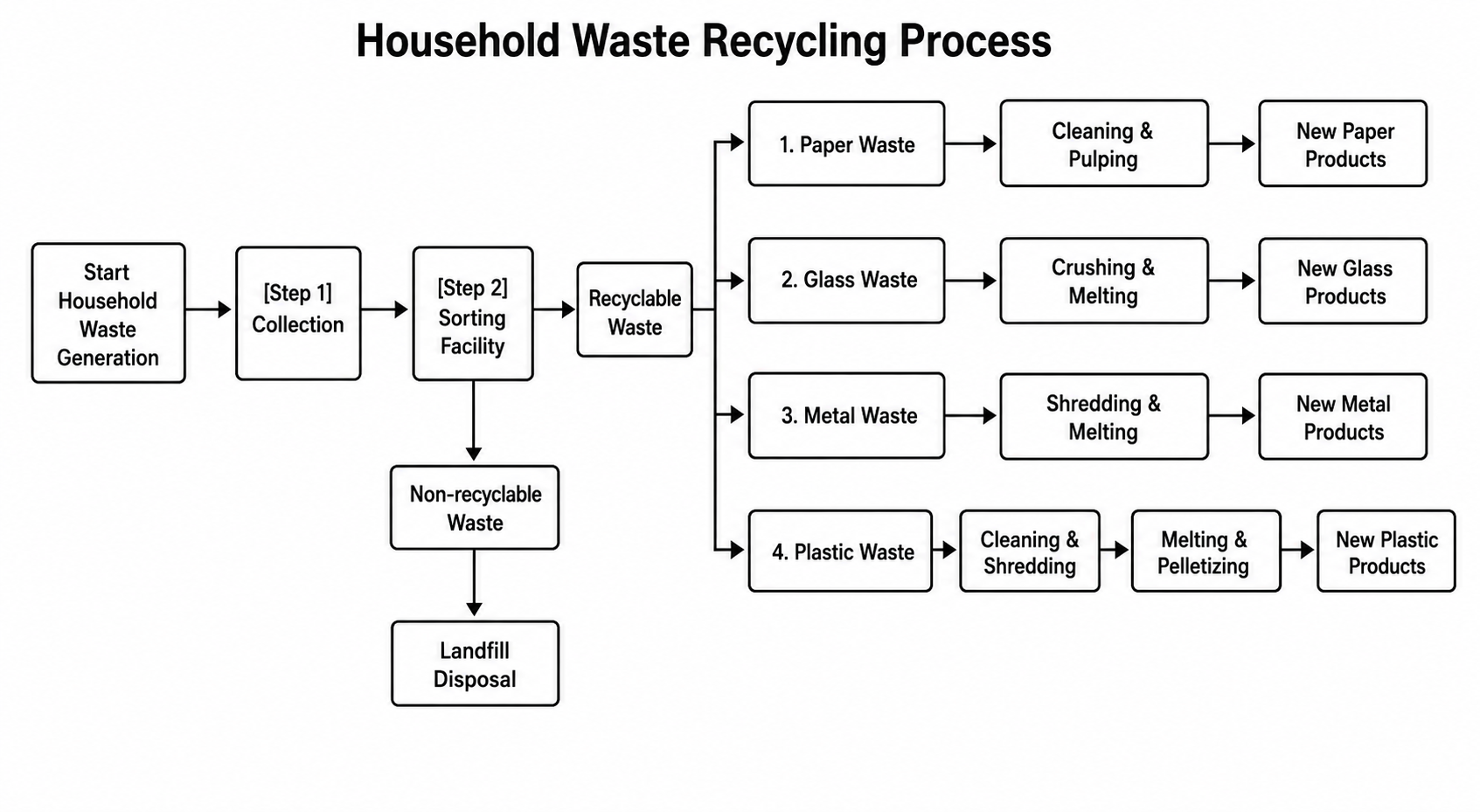
The diagram show how household waste are recycled in the society and I think this process is very good[1] and helpful for the enviroment, because nowadays people throw too much rubbish everydays. Overall, it can be clearly saw that all garbage become useful things again, and almost nothing is wasted, although some of them also goes to landfill which is not very nice[2]. Also, plastic is probably the most complicated one while paper is more easy. In my opinion, government should tell[3] more people to do recycling because it is a serious problem. At the begining, households produce many kind of waste and then the waste is collected by a truck in step 1. After that, the car send all rubbishes to a sorting facility, where workers and machine sort them into different catagorys. In this stage, there are two main direction. One is recyclable waste and another one are non-recyclable waste. The non-recyclable things are burned in the factory[4] and finally become landfill disposal. For the recyclable waste, there are four types, namely paper, glass, metal and plastic. First, paper waste is cleaned and pulped, then it turn into new paper products such as books and tissue rolls. Second, glass waste are washed and melting[5] by a machine, after that it becomes new glasses products. Third, metal waste is shredding and melted, and then be made into new metal product like cans. Finally, plastic waste is cleaning and shredding first, then melting and pelleting, after this step it can produced many new plastic products, for example bottle, toys and other containers. Comparing with the other three kinds of waste, plastic has more steps, so it is obviously more difficult and maybe more expensive[6]. Paper and glass seems easier because they only have one or two process before becoming new items. Metal is similar with glass, but I think metal may be more dangerous[7] because it need high temperature. Another important feature is all recyclable waste go back to shops in the end[8], which means people can buy them again and use forever. To conclude, the process is very modern and successful[9]. Personally speaking, I strongly support[10] this kind of recycling system, and I believe in the future all countries must copy this method, otherwise the Earth will become dirtier and dirtier.
The diagram show how household waste are recycled in the society and I think this process is very good and helpful for the enviroment, because nowadays people throw too much rubbish everydays. Overall, it can be clearly saw that all garbage become useful things again, and almost nothing is wasted, although some of them also goes to landfill which is not very nice. Also, plastic is[1] probably the most complicated one while paper is more easy. In my opinion, government should tell more people to do recycling because it is a serious problem. At the begining, households produce many kind of waste and then the waste is collected by a truck in step 1. After that, the car send all rubbishes to a sorting facility, where workers and machine sort them into different catagorys. In this stage, there are two main direction. One is recyclable waste and another one are non-recyclable waste. The non-recyclable things are burned in the factory and finally become landfill disposal. For the recyclable waste, there are four types, namely paper, glass, metal and plastic. First, paper waste is cleaned and pulped, then it turn into new paper products such as books and tissue rolls. Second, glass waste are washed and melting by a machine, after that it becomes new glasses products. Third, metal waste is shredding and melted, and then be made into new metal product like cans. Finally, plastic waste is cleaning and shredding first, then melting and pelleting, after this step it can produced many new plastic products, for example bottle, toys and other containers. Comparing with the other three kinds of waste, plastic has more steps, so it is obviously more difficult and maybe more expensive. Paper and glass seems easier because they only have one or two process before becoming new items. Metal is similar with glass, but I think metal may be more dangerous because it need high temperature. Another important feature is all recyclable waste go back to shops in the end, which means people can buy them again and use forever. To conclude, the process is very modern and successful. Personally speaking, I strongly support this kind of recycling system, and I believe in the future all countries must copy this method, otherwise the Earth will become dirtier and dirtier.
The diagram show how household waste are recycled in the society and I think this process is very good and helpful for the enviroment[1], because nowadays people throw too much rubbish everydays[2]. Overall, it can be clearly saw that all garbage become useful things again, and almost nothing is wasted, although some of them also goes to landfill which is not very nice. Also, plastic is probably the most complicated one while paper is more easy. In my opinion, government should tell more people to do recycling because it is a serious problem. At the begining[3], households produce many kind of waste and then the waste is collected by a truck in step 1. After that, the car[4] send all rubbishes to a sorting facility, where workers and machine sort them into different catagorys[5]. In this stage, there are two main direction. One is recyclable waste and another one are non-recyclable waste. The non-recyclable things are burned in the factory and finally become landfill disposal[6]. For the recyclable waste, there are four types, namely paper, glass, metal and plastic. First, paper waste is cleaned and pulped, then it turn into new paper products such as books and tissue rolls. Second, glass waste are washed and melting by a machine, after that it becomes new glasses products. Third, metal waste is shredding and melted, and then be made into new metal product like cans. Finally, plastic waste is cleaning and shredding first, then melting and pelleting, after this step it can produced many new plastic products, for example bottle, toys and other containers. Comparing with the other three kinds of waste, plastic has more steps, so it is obviously more difficult and maybe more expensive. Paper and glass seems easier because they only have one or two process before becoming new items. Metal is similar with glass, but I think metal may be more dangerous because it need high temperature. Another important feature is all recyclable waste go back to shops in the end, which means people can buy them again and use forever. To conclude, the process is very modern and successful. Personally speaking, I strongly support this kind of recycling system, and I believe in the future all countries must copy this method, otherwise the Earth will become dirtier and dirtier.
The diagram show[1] how household waste are[2] recycled in the society and I think this process[27] is very good and helpful for the enviroment, because nowadays people throw too much rubbish everydays. Overall, it can be clearly saw[3] that all garbage become[4] useful things again, and almost nothing is wasted, although some of them[5] also goes to landfill which is not very nice. Also, plastic is probably the most complicated one while paper is more easy[6]. In my opinion, government[7] should tell more people to do recycling because it is a serious problem. At the begining, households produce many kind[8] of waste and then the waste is collected by a truck in step 1. After that, the car send[9] all rubbishes[10] to a sorting facility, where workers and machine[11] sort them into different catagorys. In this stage, there are two main direction[12]. One is recyclable waste and another one are[13] non-recyclable waste. The non-recyclable things are burned in the factory and finally become landfill disposal. For the recyclable waste, there are four types, namely paper, glass, metal and plastic. First, paper waste is cleaned and pulped, then it turn[14] into new paper product[20]s such as books and tissue rolls. Second, glass waste are[15] washed and melting[16] by a machine, after that it becomes new glasses products[17]. Third, metal waste is shredding[18] and melted, and then be made[19] into new metal product like cans. Finally, plastic waste is cleaning and shredding[21] first, then melting and pelleting[22], after this step it can produced[23] many new plastic products, for example bottle[24], toys and other containers. Comparing with[25] the other three kinds of waste, plastic has more steps, so it is obviously more difficult and maybe more expensive. Paper and glass seems[26] easier because they only have one or two process before becoming new items. Metal is similar with[28] glass, but I think metal may be more dangerous because it need[29] high temperature[30]. Another important feature is all[31] recyclable waste go[32] back to shops in the end, which means people can buy them again and use forever[33]. To conclude, the process is very modern and successful. Personally speaking, I strongly support this kind of recycling system, and I believe in the future all countries must copy this method, otherwise the Earth will become dirtier and dirtier.
The diagram show how household waste are recycled in the society and I think this process is very good and helpful for the enviroment, because nowadays people throw too much rubbish everydays. Overall, it can be clearly saw that all garbage become useful things again, and almost nothing is wasted, although some of them also goes to landfill which is not very nice. Also, plastic is probably the most complicated one while paper is more easy. In my opinion, government should tell more people to do recycling because it is a serious problem. At the begining, households produce many kind of waste and then the waste is collected by a truck in step 1. After that, the car send all rubbishes to a sorting facility, where workers and machine sort them into different catagorys. In this stage, there are two main direction. One is recyclable waste and another one are non-recyclable waste. The non-recyclable things are burned in the factory and finally become landfill disposal. For the recyclable waste, there are four types, namely paper, glass, metal and plastic. First, paper waste is cleaned and pulped, then it turn into new paper products such as books and tissue rolls. Second, glass waste are washed and melting by a machine, after that it becomes new glasses products. Third, metal waste is shredding and melted, and then be made into new metal product like cans. Finally, plastic waste is cleaning and shredding first, then melting and pelleting, after this step it can produced many new plastic products, for example bottle, toys and other containers. Comparing with the other three kinds of waste, plastic has more steps, so it is obviously more difficult and maybe more expensive. Paper and glass seems easier because they only have one or two process before becoming new items. Metal is similar with glass, but I think metal may be more dangerous because it need high temperature. Another important feature is all recyclable waste go back to shops in the end, which means people can buy them again and use forever. To conclude, the process is very modern and successful. Personally speaking, I strongly support this kind of recycling system, and I believe in the future all countries must copy this method, otherwise the Earth will become dirtier and dirtier.

Task Achievement Insights

1Subjective Opinion
and I think this process is very good(Remove this clause entirely)

Task 1 must be strictly objective. Personal opinions and evaluations are not allowed.

2Subjective Opinion
which is not very nice(Remove this phrase)

Subjective commentary is strictly banned in Task 1.

3Subjective Opinion / Recommendation
In my opinion, government should tell(Remove this sentence entirely)

Task 1 requires an objective summary of the data, not personal opinions or recommendations.

4Inaccurate Data Reporting
burned in the factorytransported to a landfill

The diagram shows non-recyclable waste going to landfill disposal, not being burned in a factory.

5Inaccurate Data Reporting
washed and meltingcrushed and melted

The diagram specifies crushing and melting for glass waste.

6Speculation
maybe more expensive(Remove this phrase)

Speculation about cost is not supported by the diagram.

7Subjective Opinion / Speculation
but I think metal may be more dangerous(Remove this clause)

Personal opinions and speculation are not permitted in Task 1.

8Unsupported Claim
go back to shops in the endare transformed into new products

The diagram shows the creation of new products, but does not show them going to shops.

9Subjective Opinion
very modern and successful(Remove this phrase)

Subjective evaluations are inappropriate for an objective Task 1 report.

10Subjective Opinion / Recommendation
Personally speaking, I strongly support(Remove the entire concluding paragraph)

Task 1 must not contain personal opinions or recommendations.

Coherence Improvements

1Mechanical Cohesion / Overuse
Also, plastic isFurthermore, processing plastic is

Overuse of basic linkers; better to integrate cohesion.

Lexical Upgrades

1Spelling
enviromentenvironment

The word environment is misspelled.

2Spelling / Word Form
everydaysevery day

Every day should be two words when used as an adverbial phrase.

3Spelling
beginingbeginning

The word beginning requires a double n.

4Word Choice
the carthe truck

The diagram shows a garbage truck or vehicle, not a car.

5Spelling
catagoryscategories

The correct spelling is categories.

6Collocation
become landfill disposalare sent to a landfill

Waste does not become disposal; it is sent to or disposed of in a landfill.

Grammar Refinements

1Subject-Verb Agreement
The diagram showThe diagram shows

The singular subject diagram requires the singular verb shows.

2Subject-Verb Agreement
household waste arehousehold waste is

The noun waste is uncountable and takes a singular verb.

3Passive Voice
can be clearly sawcan be clearly seen

The passive voice requires the past participle seen.

4Subject-Verb Agreement
all garbage becomeall garbage becomes

Garbage is an uncountable noun and requires a singular verb.

5Pronoun Agreement
some of themsome of it

The pronoun refers to uncountable garbage, so it should be it.

6Comparative Adjective
more easyeasier

The comparative form of easy is easier.

7Article
governmentthe government

The noun government requires the definite article in this context.

8Plural Noun
many kindmany kinds

The quantifier many must be followed by a plural noun.

9Subject-Verb Agreement
sendsends

The singular subject requires a singular verb.

10Uncountable Noun
rubbishesrubbish

Rubbish is an uncountable noun and cannot be pluralized.

11Plural Noun
machinemachines

In a general sense alongside workers, machines should be plural.

12Plural Noun
two main directiontwo main directions

The number two requires a plural noun.

13Subject-Verb Agreement
another one arethe other is

When referring to the second of two options, the other is used with a singular verb.

14Subject-Verb Agreement
it turnit turns

The singular pronoun it requires the singular verb turns.

15Subject-Verb Agreement
glass waste areglass waste is

Waste is uncountable and takes a singular verb.

16Passive Voice
meltingmelted

The passive voice requires the past participle melted.

17Noun as Adjective
glasses productsglass products

When a noun modifies another noun, it is typically singular.

18Passive Voice
is shreddingis shredded

The passive voice requires the past participle shredded.

19Passive Voice
be madeis made

The verb must agree with the subject metal waste.

20Plural Noun
productproducts

The context implies multiple items.

21Passive Voice
is cleaning and shreddingis cleaned and shredded

The passive voice requires past participles.

22Passive Voice
melting and pelletingmelted and pelleted

Continuing the passive construction, these verbs must be in the past participle form.

23Modal Verb
can producedcan produce

Modal verbs like can must be followed by the base form of the verb.

24Plural Noun
bottlebottles

Countable nouns should be plural in a list of examples.

25Participle Clause
Comparing withCompared with

The past participle compared is required here.

26Subject-Verb Agreement
Paper and glass seemsPaper and glass seem

The compound subject is plural and requires seem.

27Plural Noun
processprocesses

The phrase one or two requires the plural noun processes.

28Preposition
similar withsimilar to

The adjective similar is followed by to, not with.

29Subject-Verb Agreement
it needit needs

The singular pronoun it requires needs.

30Plural Noun
high temperaturehigh temperatures

It is more natural to use the plural temperatures here.

31Conjunction
is allis that all

The conjunction that is needed to introduce the nominal clause.

32Subject-Verb Agreement
waste gowaste goes

Waste is uncountable and requires the singular verb goes.

33Missing Object
use foreveruse them forever

The transitive verb use requires an object.

Vocabulary Distribution

100%
A1
100%
A2
80%
B1
40%
B2
10%
C1
2%
C2

Practice Set 15 - Test 1 - Task 1

The diagram below shows the process by which household waste is recycled. Summarise the information by selecting and reporting the main features, and make comparisons where relevant.

IELTS Writing Task 1 sample prompt image

What this Writing checker covers

IELTS Writing Task 1 Checker IELTS Academic Task 1 Checker IELTS Task 1 Report Checker IELTS Writing Task 1 Report Checker IELTS Graph Report Checker IELTS Chart Report Checker IELTS Task 1 Band Score Checker

Ready to check your Task 1 response?

Create a free account and open Auvoxi Studio to submit your IELTS Academic Writing Task 1 response.

Check Task 1 in Studio for Free
Chat History
My Notes