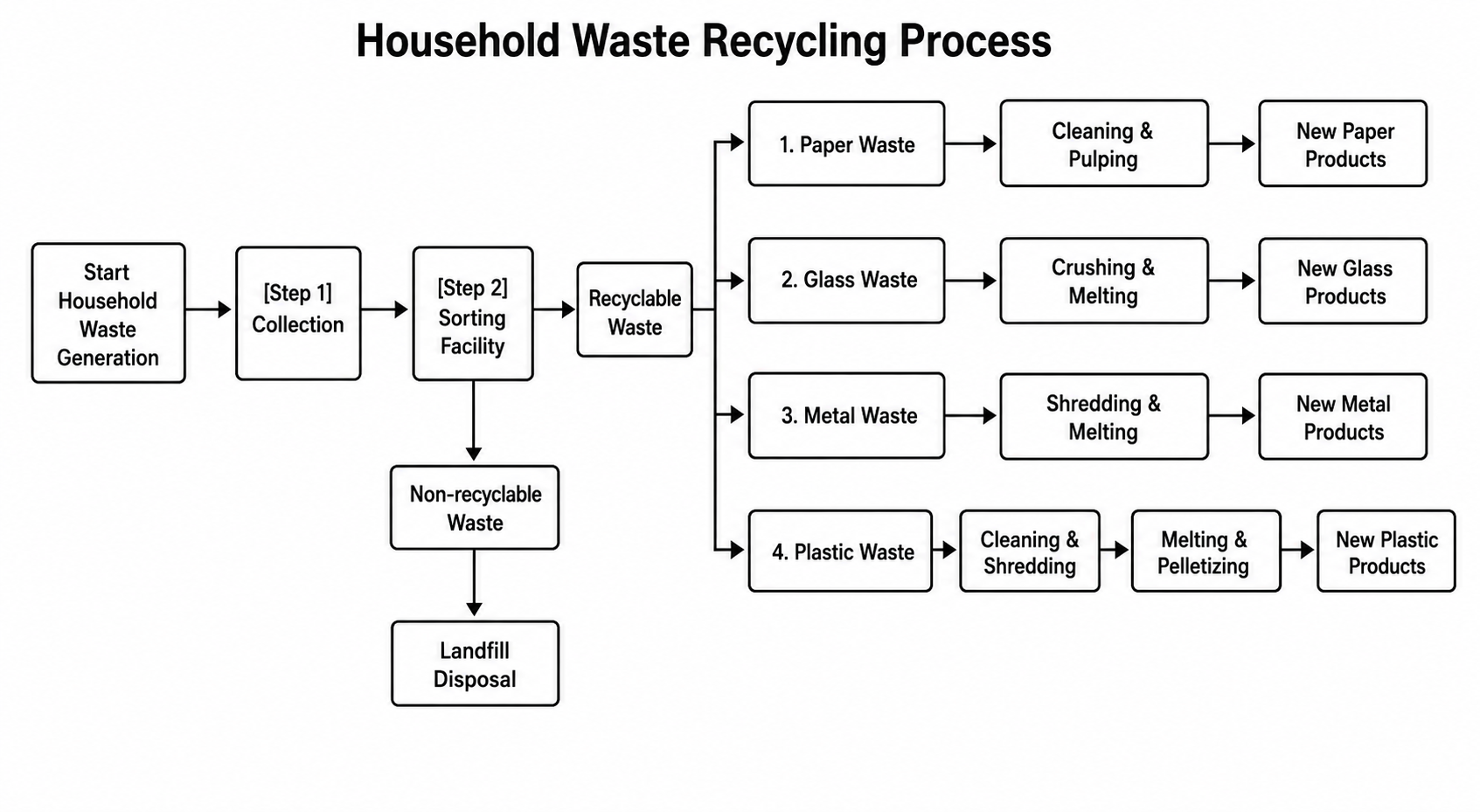
The diagram show how household waste are recycled in the society and I think this process is very good[1] and helpful for the enviroment, because nowadays people throw too much rubbish everydays.
Overall, it can be clearly saw that all garbage become useful things again, and almost nothing is wasted, although some of them also goes to landfill which is not very nice[2]. Also, plastic is probably the most complicated one while paper is more easy. In my opinion, government should tell[3] more people to do recycling because it is a serious problem.
At the begining, households produce many kind of waste and then the waste is collected by a truck in step 1. After that, the car send all rubbishes to a sorting facility, where workers and machine sort them into different catagorys. In this stage, there are two main direction. One is recyclable waste and another one are non-recyclable waste. The non-recyclable things are burned in the factory[4] and finally become landfill disposal.
For the recyclable waste, there are four types, namely paper, glass, metal and plastic. First, paper waste is cleaned and pulped, then it turn into new paper products such as books and tissue rolls. Second, glass waste are washed and melting[5] by a machine, after that it becomes new glasses products. Third, metal waste is shredding and melted, and then be made into new metal product like cans. Finally, plastic waste is cleaning and shredding first, then melting and pelleting, after this step it can produced many new plastic products, for example bottle, toys and other containers.
Comparing with the other three kinds of waste, plastic has more steps, so it is obviously more difficult and maybe more expensive[6]. Paper and glass seems easier because they only have one or two process before becoming new items. Metal is similar with glass, but I think metal may be more dangerous[7] because it need high temperature. Another important feature is all recyclable waste go back to shops in the end[8], which means people can buy them again and use forever.
To conclude, the process is very modern and successful[9]. Personally speaking, I strongly support[10] this kind of recycling system, and I believe in the future all countries must copy this method, otherwise the Earth will become dirtier and dirtier.
The diagram show how household waste are recycled in the society and I think this process is very good and helpful for the enviroment, because nowadays people throw too much rubbish everydays.
Overall, it can be clearly saw that all garbage become useful things again, and almost nothing is wasted, although some of them also goes to landfill which is not very nice. Also, plastic is[1] probably the most complicated one while paper is more easy. In my opinion, government should tell more people to do recycling because it is a serious problem.
At the begining, households produce many kind of waste and then the waste is collected by a truck in step 1. After that, the car send all rubbishes to a sorting facility, where workers and machine sort them into different catagorys. In this stage, there are two main direction. One is recyclable waste and another one are non-recyclable waste. The non-recyclable things are burned in the factory and finally become landfill disposal.
For the recyclable waste, there are four types, namely paper, glass, metal and plastic. First, paper waste is cleaned and pulped, then it turn into new paper products such as books and tissue rolls. Second, glass waste are washed and melting by a machine, after that it becomes new glasses products. Third, metal waste is shredding and melted, and then be made into new metal product like cans. Finally, plastic waste is cleaning and shredding first, then melting and pelleting, after this step it can produced many new plastic products, for example bottle, toys and other containers.
Comparing with the other three kinds of waste, plastic has more steps, so it is obviously more difficult and maybe more expensive. Paper and glass seems easier because they only have one or two process before becoming new items. Metal is similar with glass, but I think metal may be more dangerous because it need high temperature. Another important feature is all recyclable waste go back to shops in the end, which means people can buy them again and use forever.
To conclude, the process is very modern and successful. Personally speaking, I strongly support this kind of recycling system, and I believe in the future all countries must copy this method, otherwise the Earth will become dirtier and dirtier.
The diagram show how household waste are recycled in the society and I think this process is very good and helpful for the enviroment[1], because nowadays people throw too much rubbish everydays[2].
Overall, it can be clearly saw that all garbage become useful things again, and almost nothing is wasted, although some of them also goes to landfill which is not very nice. Also, plastic is probably the most complicated one while paper is more easy. In my opinion, government should tell more people to do recycling because it is a serious problem.
At the begining[3], households produce many kind of waste and then the waste is collected by a truck in step 1. After that, the car[4] send all rubbishes to a sorting facility, where workers and machine sort them into different catagorys[5]. In this stage, there are two main direction. One is recyclable waste and another one are non-recyclable waste. The non-recyclable things are burned in the factory and finally become landfill disposal[6].
For the recyclable waste, there are four types, namely paper, glass, metal and plastic. First, paper waste is cleaned and pulped, then it turn into new paper products such as books and tissue rolls. Second, glass waste are washed and melting by a machine, after that it becomes new glasses products. Third, metal waste is shredding and melted, and then be made into new metal product like cans. Finally, plastic waste is cleaning and shredding first, then melting and pelleting, after this step it can produced many new plastic products, for example bottle, toys and other containers.
Comparing with the other three kinds of waste, plastic has more steps, so it is obviously more difficult and maybe more expensive. Paper and glass seems easier because they only have one or two process before becoming new items. Metal is similar with glass, but I think metal may be more dangerous because it need high temperature. Another important feature is all recyclable waste go back to shops in the end, which means people can buy them again and use forever.
To conclude, the process is very modern and successful. Personally speaking, I strongly support this kind of recycling system, and I believe in the future all countries must copy this method, otherwise the Earth will become dirtier and dirtier.
The diagram show[1] how household waste are[2] recycled in the society and I think this process[27] is very good and helpful for the enviroment, because nowadays people throw too much rubbish everydays.
Overall, it can be clearly saw[3] that all garbage become[4] useful things again, and almost nothing is wasted, although some of them[5] also goes to landfill which is not very nice. Also, plastic is probably the most complicated one while paper is more easy[6]. In my opinion, government[7] should tell more people to do recycling because it is a serious problem.
At the begining, households produce many kind[8] of waste and then the waste is collected by a truck in step 1. After that, the car send[9] all rubbishes[10] to a sorting facility, where workers and machine[11] sort them into different catagorys. In this stage, there are two main direction[12]. One is recyclable waste and another one are[13] non-recyclable waste. The non-recyclable things are burned in the factory and finally become landfill disposal.
For the recyclable waste, there are four types, namely paper, glass, metal and plastic. First, paper waste is cleaned and pulped, then it turn[14] into new paper product[20]s such as books and tissue rolls. Second, glass waste are[15] washed and melting[16] by a machine, after that it becomes new glasses products[17]. Third, metal waste is shredding[18] and melted, and then be made[19] into new metal product like cans. Finally, plastic waste is cleaning and shredding[21] first, then melting and pelleting[22], after this step it can produced[23] many new plastic products, for example bottle[24], toys and other containers.
Comparing with[25] the other three kinds of waste, plastic has more steps, so it is obviously more difficult and maybe more expensive. Paper and glass seems[26] easier because they only have one or two process before becoming new items. Metal is similar with[28] glass, but I think metal may be more dangerous because it need[29] high temperature[30]. Another important feature is all[31] recyclable waste go[32] back to shops in the end, which means people can buy them again and use forever[33].
To conclude, the process is very modern and successful. Personally speaking, I strongly support this kind of recycling system, and I believe in the future all countries must copy this method, otherwise the Earth will become dirtier and dirtier.
The diagram show how household waste are recycled in the society and I think this process is very good and helpful for the enviroment, because nowadays people throw too much rubbish everydays.
Overall, it can be clearly saw that all garbage become useful things again, and almost nothing is wasted, although some of them also goes to landfill which is not very nice. Also, plastic is probably the most complicated one while paper is more easy. In my opinion, government should tell more people to do recycling because it is a serious problem.
At the begining, households produce many kind of waste and then the waste is collected by a truck in step 1. After that, the car send all rubbishes to a sorting facility, where workers and machine sort them into different catagorys. In this stage, there are two main direction. One is recyclable waste and another one are non-recyclable waste. The non-recyclable things are burned in the factory and finally become landfill disposal.
For the recyclable waste, there are four types, namely paper, glass, metal and plastic. First, paper waste is cleaned and pulped, then it turn into new paper products such as books and tissue rolls. Second, glass waste are washed and melting by a machine, after that it becomes new glasses products. Third, metal waste is shredding and melted, and then be made into new metal product like cans. Finally, plastic waste is cleaning and shredding first, then melting and pelleting, after this step it can produced many new plastic products, for example bottle, toys and other containers.
Comparing with the other three kinds of waste, plastic has more steps, so it is obviously more difficult and maybe more expensive. Paper and glass seems easier because they only have one or two process before becoming new items. Metal is similar with glass, but I think metal may be more dangerous because it need high temperature. Another important feature is all recyclable waste go back to shops in the end, which means people can buy them again and use forever.
To conclude, the process is very modern and successful. Personally speaking, I strongly support this kind of recycling system, and I believe in the future all countries must copy this method, otherwise the Earth will become dirtier and dirtier.