ACADEMIC WRITING SAMPLE ANSWERS

Academic Writing Sample Answers Practice 20 Test 02

This original practice page includes Task 1 (Dynamic Mixed Chart) and Task 2 (Problems and Solutions Essay), with Band 9, Band 8, and Band 7 sample answers for IELTS preparation.
Academic Writing Task 1

Task 1 · Dynamic Mixed Chart

Task 1 Prompt

You should spend about 20 minutes on this task. Write at least 150 words.

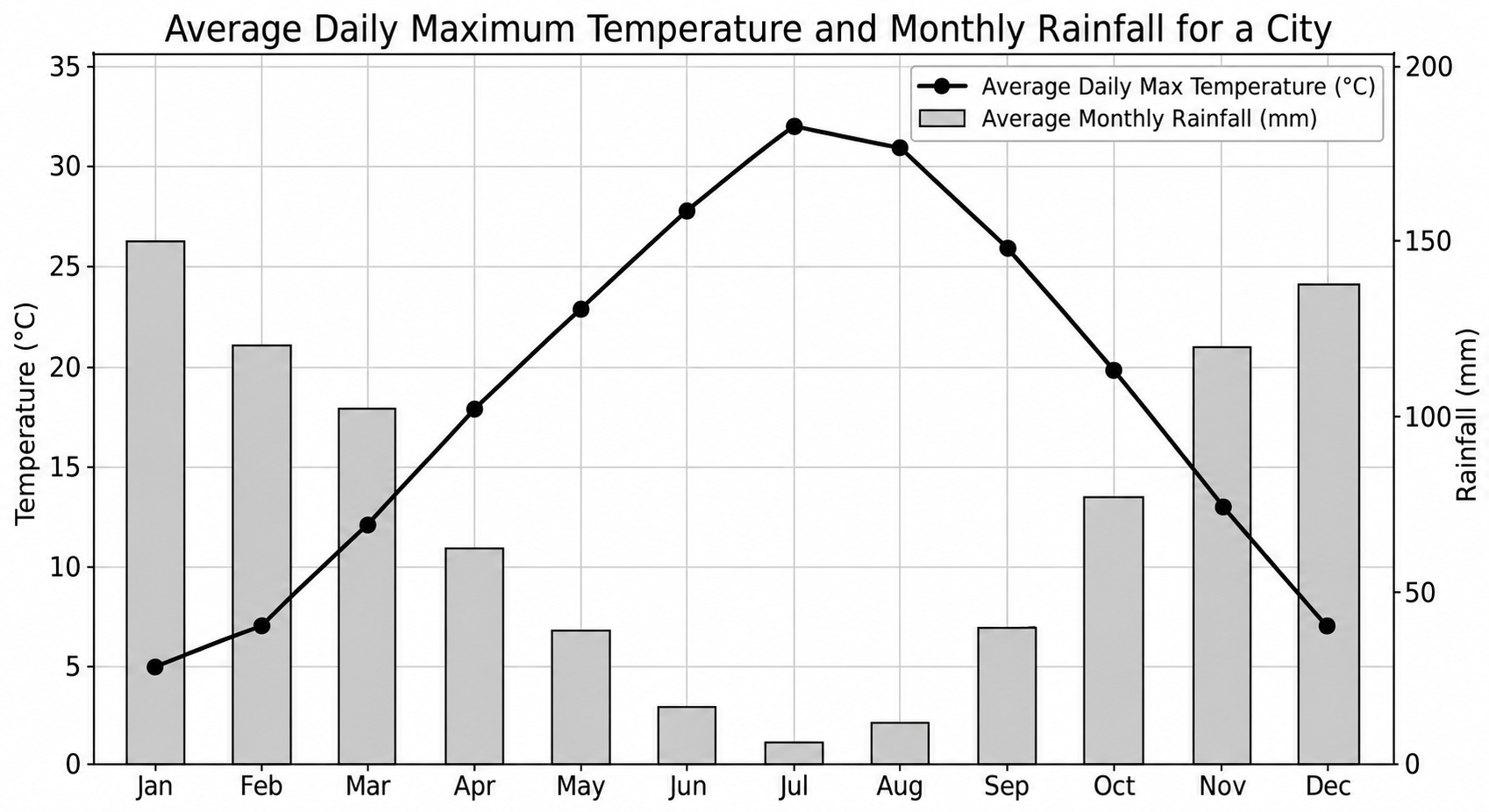
The graph below shows the changes in the average daily maximum temperature (in degrees Celsius) and the average monthly rainfall (in millimetres) for a city over the course of a year.

Summarise the information by selecting and reporting the main features, and make comparisons where relevant.
Academic Writing Task 1 Dynamic Mixed Chart practice image
BAND 9

Part 1 · Band 9 Sample Answer

The graph compares a city’s average daily maximum temperature with its average monthly rainfall throughout the year, measured in degrees Celsius and millimetres respectively.

Overall, the two measures follow almost opposite seasonal patterns. Temperatures rise steadily from the beginning of the year to a mid-year peak in July before declining, whereas rainfall falls sharply over the same period and then recovers. Consequently, July is both the hottest and driest month, while January records the lowest maximum temperature and the greatest rainfall.

The average daily high begins at 5°C in January and increases to 7°C in February and 12°C in March. The rise then accelerates, with the figure reaching 18°C in April, 23°C in May and approximately 28°C in June. It peaks at 32°C in July, remains almost as high at 31°C in August, and subsequently drops to 26°C in September. Further declines take the average to 20°C in October, 13°C in November and 7°C by December.

Rainfall moves in the reverse direction. From a yearly high of 150 mm in January, it decreases to about 120 mm in February and 100 mm in March. Monthly precipitation then falls from roughly 60 mm in April to 40 mm in May and 20 mm in June, reaching a low of only around 5 mm in July. After a slight increase to 10 mm in August, rainfall climbs to 40 mm in September and approximately 75 mm in October. It then rises substantially to 120 mm in November and finishes at 140 mm in December.

BAND 8

Part 1 · Band 8 Sample Answer

The chart presents information about average daily maximum temperatures and average monthly rainfall in a particular city across the twelve months of the year.

Overall, temperature and rainfall display contrasting trends. The temperature rises continuously until July and then falls for the remainder of the year. By comparison, rainfall declines to its minimum in July before increasing again. January is the wettest and coolest month, while July has the highest temperature and least rain.

In January, the average maximum temperature is 5°C. It rises modestly to 7°C in February and then reaches 12°C in March. A stronger increase follows, taking the figure to 18°C in April, 23°C in May and about 28°C in June. The temperature reaches a high of 32°C in July and remains close to this level in August, at 31°C. It then falls to 26°C in September and 20°C in October, before ending the year at 13°C in November and 7°C in December.

Rainfall begins at 150 mm in January, the highest amount shown, and drops to around 120 mm in February and 100 mm in March. It continues to decrease through the following months, reaching approximately 60 mm in April and 40 mm in May. After falling to 20 mm in June, it reaches its lowest point of roughly 5 mm in July. The total rises only slightly to 10 mm in August, but then increases more rapidly to 40 mm in September and about 75 mm in October. November receives around 120 mm, followed by 140 mm in December.

BAND 7

Part 1 · Band 7 Sample Answer

The graph shows how the average daily highest temperature and the average amount of monthly rainfall change during a year in one city.

Overall, the temperature becomes higher from January to July and then decreases towards December. Rainfall follows the opposite pattern, falling during the first seven months and rising afterwards. July is the hottest and driest month, whereas January has the lowest temperature and the most rain.

At the start of the year, the average maximum temperature is 5°C. This increases to 7°C in February and 12°C in March. It then rises more quickly, reaching 18°C in April, 23°C in May and around 28°C in June. The highest figure is 32°C in July. After remaining high at 31°C in August, the temperature drops to 26°C in September and 20°C in October. It falls further to 13°C in November and 7°C in December.

The city receives 150 mm of rain in January. Rainfall then declines to about 120 mm in February and 100 mm in March, before falling to roughly 60 mm in April. The totals for May and June are lower, at around 40 mm and 20 mm respectively. Rainfall reaches a minimum of about 5 mm in July and rises slightly to 10 mm in August. It then increases to 40 mm in September, approximately 75 mm in October and 120 mm in November. By December, the monthly total has reached 140 mm.

Academic Writing Task 2

Task 2 · Problems and Solutions Essay

Task 2 Prompt

You should spend about 40 minutes on this task. Write at least 250 words.

Write about the following topic:

In many tourist destinations, local residents feel that the costs of international tourism are greater than the benefits they receive.

Why does this happen, and what measures can be taken to ensure that local communities benefit more from tourism?

Give reasons for your answer and include any relevant examples from your own knowledge or experience.

BAND 9

Part 2 · Band 9 Sample Answer

International tourism can generate employment and public revenue, yet many host communities conclude that the disruption it causes outweighs what they gain. This perception commonly arises because income is captured by outside businesses while residents bear higher living costs and pressure on shared resources. A fairer tourism model therefore requires local economic participation, community influence over development and effective management of visitor impacts.

One cause is the leakage of tourism revenue from the destination. International hotel groups, booking platforms and tour operators may own the most profitable parts of the industry, whereas local people receive mainly seasonal, low-paid service work. Even when visitor spending is substantial, only a limited share may circulate through neighbourhood businesses. At the same time, demand for holiday accommodation can encourage landlords to replace long-term rentals with short stays, raising housing costs for residents. Crowded roads, beaches and public transport, together with waste and noise, create further burdens that households experience daily but for which they may receive little compensation.

Communities can benefit more if governments deliberately strengthen local ownership and employment. Licensing rules could reserve space in popular areas for locally owned guesthouses, restaurants and guides, while grants and training could help residents meet professional and digital marketing standards. Large resorts should also be encouraged, or required through planning agreements, to purchase food and services locally and provide skilled career paths rather than relying mainly on insecure work. These policies would keep a greater proportion of tourist expenditure within the regional economy.

The costs of tourism must also be priced and controlled. A transparent visitor levy could finance waste collection, public transport, conservation and affordable housing in the places receiving tourists. However, collecting money is insufficient unless residents help decide how it is spent. Local representatives should participate in planning decisions, and authorities should be able to limit cruise arrivals, short-term rentals or access to overcrowded sites when local capacity is exceeded. Promoting travel outside peak periods and directing visitors towards less congested districts could distribute both demand and income more evenly.

In conclusion, resentment develops when tourism profits leave the area but congestion, environmental damage and rising prices remain. Combining local enterprise support with targeted levies, sensible limits and genuine community decision-making would make the industry more rewarding and sustainable for its hosts.

BAND 8

Part 2 · Band 8 Sample Answer

Although international tourism brings money into many destinations, local residents do not always receive a fair share of its advantages. This happens mainly because profits are distributed unevenly, while communities experience higher prices, overcrowding and environmental pressure. Governments and tourism businesses can address these problems by keeping more spending in the local economy and using tourism revenue to improve residents’ lives.

A major issue is that many hotels, travel companies and online booking services are owned outside the destination. Their profits may therefore leave the area, while local workers are offered relatively low-paid or seasonal jobs. Residents can also face increasing housing costs when homes are converted into short-term tourist accommodation. Meanwhile, popular streets, beaches and public transport become crowded, and local authorities must manage additional traffic, rubbish and water use. If residents encounter these problems without seeing better services or stable employment, it is understandable that they view tourism negatively.

One solution is to create more opportunities for local people to own businesses and obtain skilled jobs. Authorities could offer training and small-business funding to residents who want to operate guesthouses, restaurants, cultural tours or transport services. Hotels could be required to advertise jobs locally and encouraged to buy food, furniture and other supplies from nearby producers. This would allow tourist spending to pass through more parts of the community instead of being concentrated in a few large companies.

In addition, destinations should collect and invest tourism revenue more fairly. A modest charge on hotel stays or entry to heavily visited sites could fund rubbish collection, parks, public transport and the protection of cultural attractions. Residents should be consulted about which projects receive this money. Local governments can also regulate holiday rentals to protect the supply of long-term housing and introduce visitor limits where natural or public facilities are under severe pressure. Encouraging travel during quieter months would further reduce seasonal overcrowding and provide steadier employment.

In conclusion, communities often feel disadvantaged because they carry tourism’s social and environmental costs but receive limited economic rewards. Supporting local ownership and employment, reinvesting visitor charges in public services, and controlling excessive demand would produce a more balanced relationship between tourists and residents.

BAND 7

Part 2 · Band 7 Sample Answer

International tourism is an important source of income for many places, but local people sometimes believe that it creates more disadvantages than advantages. This situation occurs when residents receive little of the money from tourism but have to deal with expensive housing, crowded facilities and environmental problems. Several practical measures can make the industry more beneficial to them.

First, much of the income from visitors may go to international hotel chains, airlines and travel companies rather than local businesses. Residents may only obtain seasonal jobs with limited pay, so the economic benefit to their families is small. Tourism can also increase the cost of living. For example, property owners may prefer to rent homes to short-term visitors, which reduces the number of homes available to local families and pushes up rents. Large numbers of tourists can also cause traffic, noise and litter, while placing pressure on beaches, water supplies and public transport.

Governments should help residents earn a larger share of tourism income. They can provide training and affordable loans so that local people can open accommodation, restaurants, shops or tour services. Hotels and resorts could employ more local workers and buy products from nearby farmers and suppliers. These actions would create more stable jobs and ensure that visitor spending remains in the destination.

Tourism should also help pay for the problems it creates. A small tax on hotel rooms or entrance tickets could be used to improve transport, collect waste and protect natural and historic sites. Local residents should have a voice in deciding how this money is spent because they understand their community’s main needs. Authorities could also limit the number of holiday rentals in residential areas and control visitor numbers at places that become seriously overcrowded. Promoting visits outside the busiest season would reduce pressure and give workers a more regular income.

In conclusion, negative attitudes develop when tourism profits mainly benefit outside companies while local residents face rising costs and disruption. Greater support for local businesses, fair investment of tourism taxes and sensible controls on accommodation and visitor numbers can ensure that host communities receive more lasting benefits.

FREE PRACTICE RESOURCES

Download the IELTS Practice PDF Pack.

Get Listening, Reading, and Writing practice materials for self-study. Use a computer to download the 1.9GB pack.

Download PDF Pack
Chat History
My Notes