ACADEMIC WRITING SAMPLE ANSWERS

Academic Writing Sample Answers Practice 19 Test 04

This original practice page includes Task 1 (Process Diagram) and Task 2 (Agree or Disagree Essay), with Band 9, Band 8, and Band 7 sample answers for IELTS preparation.
Academic Writing Task 1

Task 1 · Process Diagram

Task 1 Prompt

You should spend about 20 minutes on this task. Write at least 150 words.

The diagram below shows the process by which honey is produced and prepared for sale in a supermarket.

Summarise the information by selecting and reporting the main features.
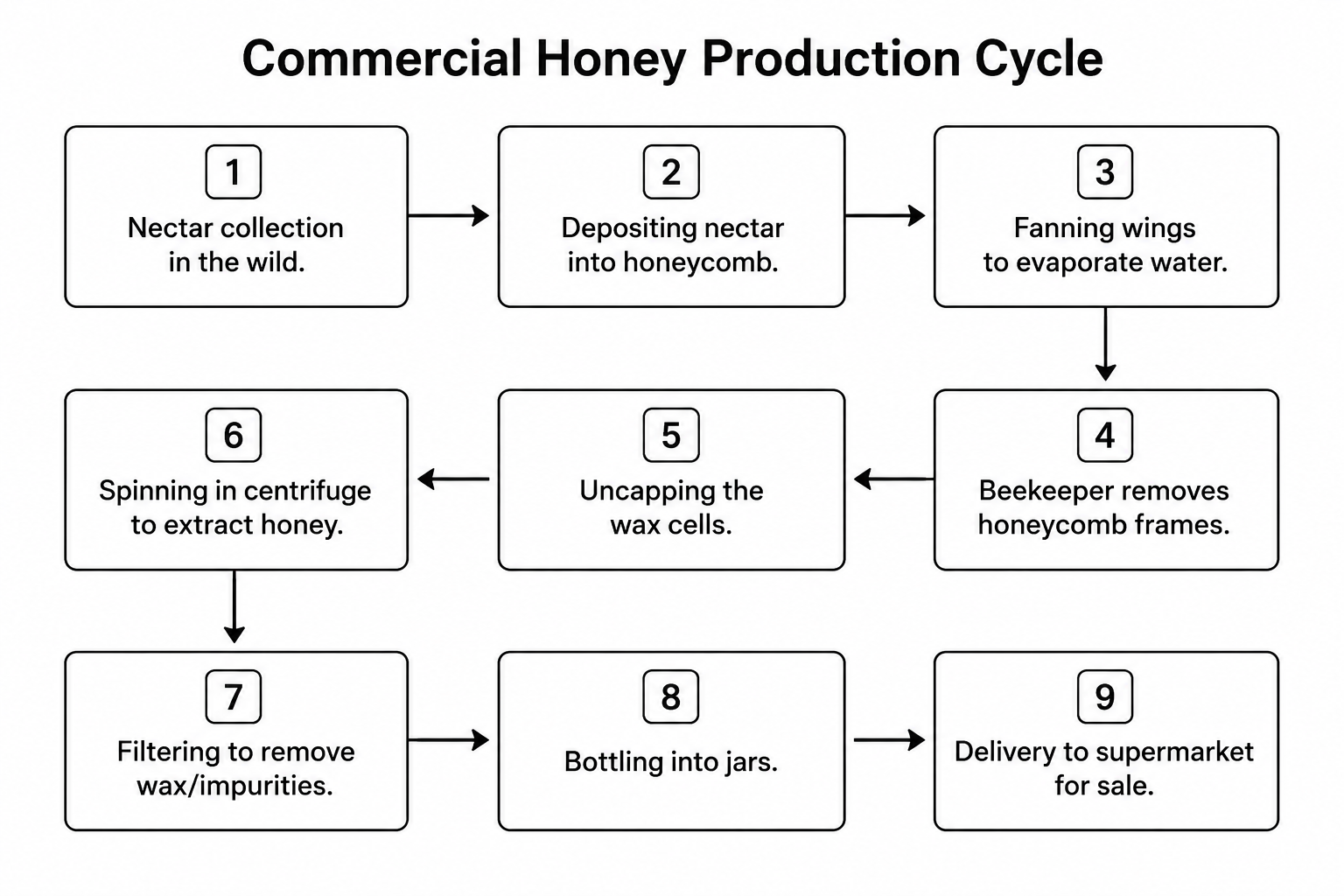
Academic Writing Task 1 Process Diagram practice image
BAND 9

Part 1 · Band 9 Sample Answer

The diagram illustrates the nine-stage commercial process through which bees produce honey and beekeepers subsequently extract, package and distribute it for retail sale.

Overall, the procedure is linear, beginning with nectar being gathered in the wild and ending with jars of finished honey being delivered to a supermarket. Broadly, the first three stages are carried out naturally by bees inside and outside the hive, whereas the remaining six involve human extraction, purification and distribution.

Initially, bees collect nectar in the wild and transport it back to the hive. They then deposit this liquid in the individual cells of the honeycomb. Once the nectar has been stored, the bees fan their wings over it, causing water to evaporate and thereby producing honey within the comb.

The beekeeper becomes involved after this natural transformation is complete. First, the honeycomb frames are removed from the hive. The wax caps sealing the cells are then taken off so that their contents can be accessed. Next, the uncapped frames are placed in a centrifuge and spun, which extracts the honey from the cells.

After extraction, the liquid passes through a filter to separate it from residual wax and any other impurities. The cleaned honey is subsequently poured into individual jars. In the final stage, these bottled products are transported to a supermarket, where they are made available for purchase.

BAND 8

Part 1 · Band 8 Sample Answer

The diagram shows how honey is produced by bees and then processed commercially before being sold in a supermarket. There are nine stages in total.

Overall, this is a linear process that starts when bees gather nectar in the wild and finishes with bottled honey being delivered for sale. The first part of the process is completed by the bees, while the later stages require the beekeeper to extract, clean and package the honey.

At the beginning, bees collect nectar in the wild and carry it to their hive. The nectar is deposited in the cells of the honeycomb. The bees then fan their wings, which removes water through evaporation and changes the nectar into honey.

Once this stage has been completed, the beekeeper removes the honeycomb frames from the hive. The wax covering each filled cell is taken off in a process known as uncapping. The opened frames are then put into a centrifuge, where spinning forces the honey out of the honeycomb.

The extracted honey is filtered in order to remove pieces of wax and other impurities. After it has been cleaned, it is poured into jars ready for distribution. Finally, the jars are delivered to a supermarket and placed on sale. Therefore, the complete procedure combines three natural stages performed by bees with six commercial stages involving collection, processing and delivery.

BAND 7

Part 1 · Band 7 Sample Answer

The diagram presents the process of producing honey and preparing it for sale in a supermarket. The process consists of nine stages, involving both bees and a beekeeper.

Overall, honey production begins with bees collecting nectar in the wild. The nectar is changed into honey inside the hive before it is removed, cleaned and bottled. The process ends when jars of honey are delivered to a supermarket.

First, bees fly into the wild to collect nectar and bring it back to the hive. They place the nectar in the cells of the honeycomb. Next, the bees fan their wings over the honeycomb to evaporate water from the nectar. This completes the natural part of the honey-making process.

The beekeeper then removes the frames containing the honeycomb from the hive. The wax caps are taken off the cells so that the honey can be extracted. After this, the frames are placed in a centrifuge. They are spun inside this machine, causing the honey to come out of the cells.

The extracted honey is passed through a filter, which removes wax and other impurities. It is then poured into jars in preparation for sale. In the ninth and final stage, the bottled honey is transported to a supermarket, where customers can purchase it. No additional processing takes place between filtering and bottling in the diagram.

Academic Writing Task 2

Task 2 · Agree or Disagree Essay

Task 2 Prompt

You should spend about 40 minutes on this task. Write at least 250 words.

Write about the following topic:

As international fast-food chains become more popular, some people believe that governments should provide financial support to local restaurants that preserve traditional cuisine.

To what extent do you agree or disagree?

Give reasons for your answer and include any relevant examples from your own knowledge or experience.

BAND 9

Part 2 · Band 9 Sample Answer

The spread of international fast-food chains can narrow the range of food businesses visible in city centres, prompting calls for public support for restaurants serving traditional dishes. I agree that governments may legitimately assist such establishments, but only through carefully targeted and time-limited programmes. Cultural value alone should not guarantee the survival of every private restaurant.

Traditional cuisine is more than a collection of recipes. It embodies local ingredients, skills, celebrations and patterns of social life that may have developed over generations. Small restaurants often transmit this knowledge by training cooks and maintaining demand for specialist farmers, fishers or food producers. If they disappear, reviving the associated techniques and supply networks can be extremely difficult. This creates a public cultural benefit that is not fully reflected in the price of a meal, so modest government intervention can be justified in much the same way as support for crafts, music or historic buildings.

Assistance may also correct disadvantages that have little to do with the quality of the food. Multinational chains can spread advertising, technology and product-development costs across thousands of branches, negotiate lower prices with suppliers and secure prominent premises. An independent restaurant preserving a labour-intensive regional cuisine cannot match that scale. Grants for apprenticeships, kitchen upgrades, multilingual menus or participation in food festivals could help such businesses compete without dictating what customers must eat. Support would be particularly defensible where a restaurant contributes to tourism or serves as one of the few remaining places practising a distinctive culinary tradition.

Nevertheless, direct subsidies can be wasteful or unfair. A poorly managed establishment should not receive endless public money merely because its menu is labelled traditional, nor should innovative local restaurants be disadvantaged because they combine old and new influences. Governments also need objective criteria to prevent funding from favouring politically connected owners. Rather than covering routine losses, schemes should require evidence of cultural significance, proper employment practices and a credible plan for becoming financially sustainable. Low-interest loans, training and shared marketing may often be preferable to permanent cash payments.

In conclusion, I support financial assistance where traditional restaurants generate identifiable cultural and community benefits that the market undervalues. However, funding should strengthen viable businesses and preserve genuine skills, not shield every conventional restaurant from competition. Transparent selection and limited support would achieve this balance.

BAND 8

Part 2 · Band 8 Sample Answer

I agree to some extent that governments should financially support local restaurants which preserve traditional cuisine. These businesses can protect cultural knowledge and strengthen local economies, but public money should be awarded selectively rather than used to keep every traditional restaurant open.

Local food is an important part of a region’s identity. Recipes, preparation methods and the use of particular ingredients are often passed from one generation to another. Restaurants give these traditions a place to survive outside the home and allow both residents and visitors to experience them. They may also buy from nearby farms, markets and specialist producers, spreading their income through the community. If international chains replace most independent establishments, some dishes and cooking skills may gradually disappear because there is no longer enough demand for them.

Traditional restaurants can also face a commercial disadvantage. A global fast-food company can purchase ingredients cheaply in large quantities and advertise through national campaigns. A single family-owned restaurant usually cannot do either. Governments could therefore offer small grants for staff training, improved equipment or promotion at cultural events. This kind of assistance would help a restaurant modernise its operations while retaining the food that makes it distinctive. It could also make a city more attractive to tourists seeking local experiences rather than meals available in many countries.

However, there are strong reasons to limit such support. Restaurants are private businesses, and taxpayers should not continually cover losses caused by poor service, inconvenient opening hours or weak management. It may also be difficult to decide what counts as authentic traditional cuisine, especially when food naturally changes through contact with other cultures. An inflexible definition could exclude creative local chefs or result in unfair decisions.

For these reasons, funding should be competitive, transparent and temporary. Applicants should demonstrate that they preserve meaningful local skills, provide good employment and have a realistic business plan. Training, affordable loans and joint marketing programmes may be more useful than unrestricted subsidies.

Overall, traditional restaurants deserve some public assistance because they create cultural and economic benefits beyond their own profits. Nevertheless, support should help capable businesses adapt and compete; it should not protect them permanently from consumer choice or normal commercial pressure.

BAND 7

Part 2 · Band 7 Sample Answer

I partly agree that governments should give financial support to local restaurants that serve traditional food. Such restaurants can protect an important part of local culture and support other small businesses. However, assistance should be limited because restaurants must also respond to customers and operate successfully.

Traditional dishes represent the history and identity of a place. They may use local ingredients and cooking methods that families have followed for many years. When restaurants continue preparing these dishes, younger cooks can learn the skills and visitors can experience food that is different from international fast food. Local restaurants may also purchase meat, vegetables and other products from nearby suppliers. Government support could therefore benefit not only one restaurant but also farmers and food producers in the area.

Small restaurants often find it difficult to compete with large chains. International companies can spend much more on advertising and can reduce costs by buying huge amounts of food. Governments could help local restaurants by paying for training, better kitchen equipment or local food festivals. This would allow them to improve their service and attract customers without changing their traditional menus completely.

On the other hand, it would be wrong to support every restaurant simply because it claims to serve traditional cuisine. Some may lose customers because the food or service is poor, and public money should not cover these problems forever. It can also be hard to define which dishes are truly traditional because cuisine changes over time. Other independent restaurants might feel that the policy is unfair if they receive no help.

Any financial scheme should therefore have clear conditions. Restaurants should show that they use genuine local skills or ingredients and present a sensible plan for becoming profitable. Grants should be offered for a particular purpose and period rather than paying normal business costs permanently.

In conclusion, governments should provide carefully controlled support to suitable traditional restaurants because they preserve culture and contribute to local economies. Nevertheless, these businesses should still compete for customers, and financial help should be transparent, temporary and based on clear evidence of cultural value.

FREE PRACTICE RESOURCES

Download the IELTS Practice PDF Pack.

Get Listening, Reading, and Writing practice materials for self-study. Use a computer to download the 1.9GB pack.

Download PDF Pack
Chat History
My Notes