ACADEMIC WRITING SAMPLE ANSWERS

Academic Writing Sample Answers Practice 18 Test 01

This original practice page includes Task 1 (Static Grouped Bar Chart) and Task 2 (Discuss Both Views and Give Your Opinion), with Band 9, Band 8, and Band 7 sample answers for IELTS preparation.
Academic Writing Task 1

Task 1 · Static Grouped Bar Chart

Task 1 Prompt

You should spend about 20 minutes on this task. Write at least 150 words.

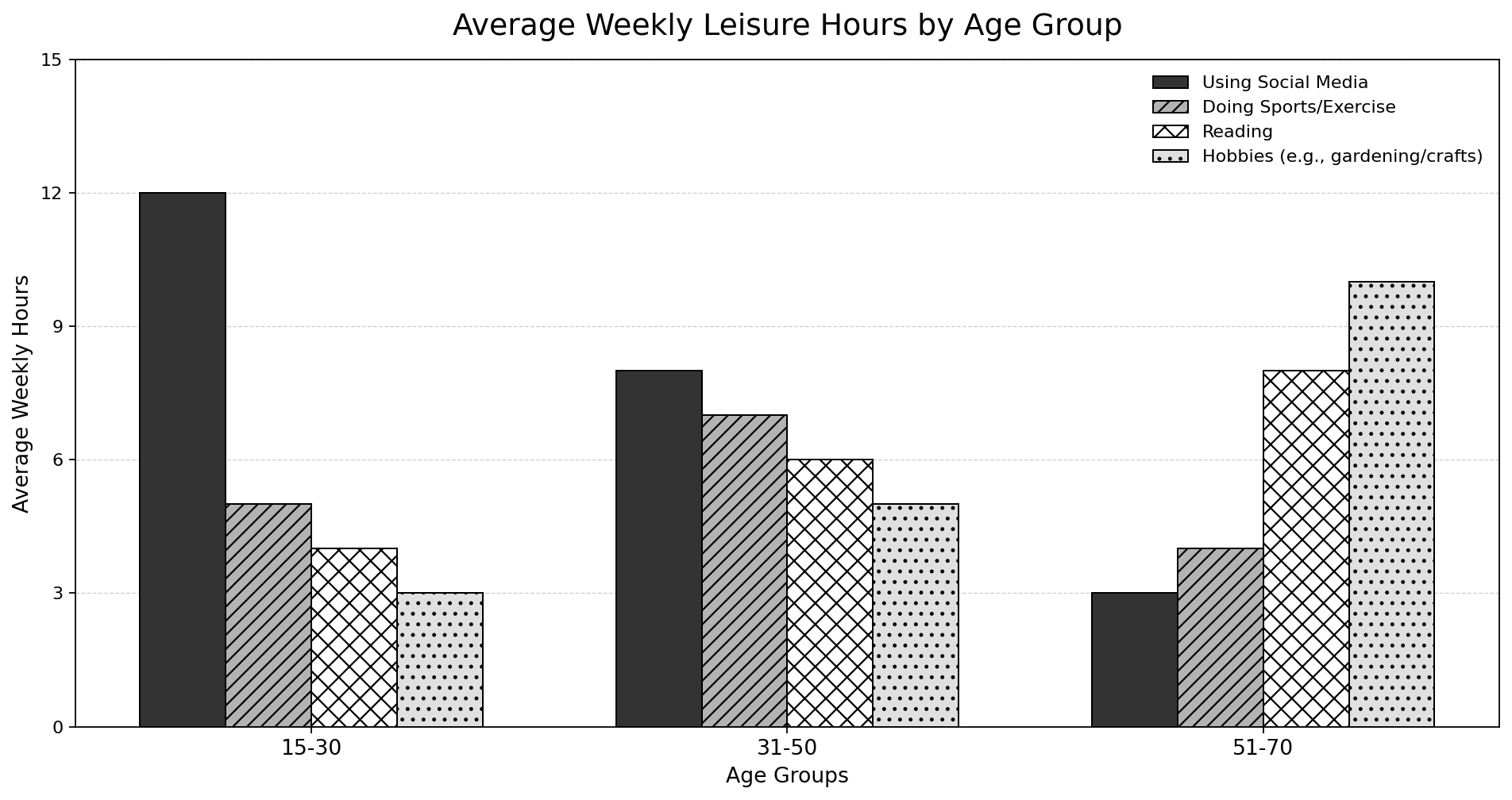
The bar chart below shows the average weekly hours spent on four different leisure activities by three age groups in a particular country.

Summarise the information by selecting and reporting the main features, and make comparisons where relevant.
Academic Writing Task 1 Static Grouped Bar Chart practice image
BAND 9

Part 1 · Band 9 Sample Answer

The bar chart compares the average amount of time that people in three age brackets in a particular country devote each week to social media, sport or exercise, reading and hobbies.

Overall, leisure preferences change markedly with age. Social media dominates the free time of the youngest group but becomes progressively less popular among older people, whereas reading and hobbies show the opposite pattern. The 31–50 group distributes its time most evenly across the four activities, and exercise is the only category to peak among this middle group.

People aged 15–30 spend 12 hours per week using social media, by far the highest figure in this age group and more than double the five hours allocated to sport and exercise. Reading accounts for four hours, while hobbies receive the least time, at three hours.

Among 31–50-year-olds, social-media use declines to eight hours, although it remains their leading activity. Exercise follows closely at seven hours, and this group spends six hours reading and five on hobbies, leaving a gap of only three hours between the highest and lowest figures. The pattern is reversed among those aged 51–70: hobbies rank first at ten hours and reading second at eight. By contrast, exercise occupies four hours and social media just three. Thus, compared with the youngest group, the oldest people spend seven additional hours on hobbies but nine fewer hours on social media.

BAND 8

Part 1 · Band 8 Sample Answer

The chart illustrates how many hours per week, on average, three age groups in one country spend on four leisure pursuits: social media, exercise, reading and hobbies.

Overall, the amount of time devoted to social media falls sharply as age increases, while the figures for reading and hobbies generally rise. The middle age group has a relatively balanced leisure profile, whereas the youngest and oldest groups each show a clear preference for one activity.

For people aged 15–30, social media is easily the most time-consuming pursuit, at 12 hours weekly. This is well above the five hours spent doing sports or exercise. Reading takes up four hours, and hobbies such as gardening and crafts account for only three, the lowest value for this group.

The figures are closer together among 31–50-year-olds. They spend eight hours on social media and seven on exercise, followed by reading at six hours and hobbies at five. Exercise therefore reaches its highest level in this group, despite remaining slightly less popular than social media.

The oldest group, aged 51–70, displays a very different pattern. Hobbies lead at ten hours per week, with reading also comparatively high at eight hours. Exercise and social media are much less prominent, at four and three hours respectively. Social-media use consequently drops by nine hours from the youngest to the oldest group, while time spent on hobbies increases by seven hours.

BAND 7

Part 1 · Band 7 Sample Answer

The bar chart shows the average number of weekly hours that three age groups in a country spend using social media, exercising, reading and doing hobbies.

Overall, younger people spend much more time on social media, while older people prefer reading and hobbies. The figures for the 31–50 age group are more evenly distributed than those for the other two groups. Exercise is most popular among middle-aged people.

Those aged 15–30 use social media for 12 hours per week. This is considerably higher than the figures for all their other activities. They spend five hours doing sports or exercise and four hours reading, while hobbies receive the smallest amount of time, at three hours.

In the 31–50 group, social media remains the leading activity at eight hours, but exercise is only one hour lower, at seven. Reading takes six hours per week, followed by hobbies at five hours. Therefore, the difference between all four activities is fairly small for this age group.

Among people aged 51–70, hobbies become the most common leisure activity, occupying ten hours weekly. Reading is second at eight hours. In comparison, these older people spend only four hours on exercise and three hours on social media. The oldest group therefore spends the same amount of time on social media as the youngest group spends on hobbies, showing a clear change in interests with age.

Academic Writing Task 2

Task 2 · Discuss Both Views and Give Your Opinion

Task 2 Prompt

You should spend about 40 minutes on this task. Write at least 250 words.

Write about the following topic:

Governments sometimes provide grants to people pursuing creative careers. Some people believe that such funding protects cultural life and enables talented individuals to continue their work, while others think that artists should earn their income from audiences and private sponsors rather than taxpayers.

Discuss both views and give your own opinion.

Give reasons for your answer and include any relevant examples from your own knowledge or experience.

BAND 9

Part 2 · Band 9 Sample Answer

Whether the state should finance creative work raises a genuine conflict between cultural value and individual economic responsibility. While audience payments and private patronage should provide the main income for commercially viable artists, I believe carefully targeted public grants are justified where work offers substantial cultural benefit but cannot attract adequate market funding.

Supporters of government grants argue that culture has qualities the market does not fully reward. A novel, play or musical performance may preserve a minority language, examine a difficult period of national history or introduce children to the arts, yet still appeal to too small an audience to be profitable. Without assistance, creators may have to abandon such projects for more commercial work or leave their professions entirely. Grants can also help talented people at the beginning of their careers, when they lack the reputation and contacts needed to secure sponsorship. The wider public may ultimately benefit through exhibitions, performances and works that would otherwise never exist.

Opponents reasonably object that artistic ambition does not automatically create an entitlement to taxpayers’ money. Governments face urgent demands for healthcare, education and infrastructure, and citizens should not be compelled to support work they neither value nor consume. Moreover, officials and funding panels may favour fashionable genres, personal connections or politically acceptable ideas. Reliance on grants can also weaken the incentive to understand an audience. Ticket sales, commissions, crowdfunding and private sponsorship provide a direct test of demand and encourage creators to manage costs responsibly.

In my view, however, this argument presents an unnecessary choice between the state and the market. Public funding should complement rather than replace earned income and private support. Grants ought to be awarded competitively by independent panels, with published criteria covering artistic quality, cultural significance and public access. Awards should normally be limited in duration, and recipients could be required to contribute through affordable performances, community workshops or publicly accessible work. Established artists producing clearly commercial material should generally rely on consumers and sponsors, while limited public funds should prioritise emerging talent, experimental work and culturally important forms that the market is unlikely to sustain.

Thus, audiences and private sponsors should remain central to creative livelihoods, but market popularity is too narrow a measure of cultural worth. Transparent and selective grants can protect valuable artistic activity without making taxpayers responsible for every creative career.

BAND 8

Part 2 · Band 8 Sample Answer

Some governments use public money to support people working in fields such as music, literature and visual art. Critics argue that these individuals should depend on customers and private sponsors, whereas supporters see grants as essential to a healthy cultural sector. I believe both sources have a role, although state funding should be limited to projects that provide a clear public benefit.

There are strong reasons for expecting artists to earn money through the market. Tax revenue is needed for services such as hospitals, schools and public transport, so funding an individual painter or musician may appear unfair, particularly to people who have no interest in that work. Income from ticket sales, book purchases and commissions also shows that an artist is producing something others genuinely value. Private sponsorship and crowdfunding offer further options and can help creators build a direct relationship with their supporters. This market pressure may encourage artists to work efficiently and respond to their audiences.

Nevertheless, commercial demand should not determine everything that a society creates. Some valuable forms of art attract relatively small audiences and are therefore difficult to finance. For example, a theatre production in a regional language may preserve local traditions even if it cannot sell enough tickets to cover all its costs. New artists face a similar difficulty because they often need time, equipment or workspace before they can establish a reputation. Public grants can give such people an opportunity and may also allow schools and lower-income communities to experience art that would otherwise be inaccessible.

My own view is that a mixed system is the most sensible approach. Artists whose work already generates substantial sales should normally support themselves through audiences and commercial partners. Government assistance should focus instead on emerging talent, cultural preservation and projects with educational or community value. Decisions must be made by independent experts under transparent rules, rather than by politicians choosing work they personally approve of. Funding could also be temporary, and recipients could provide public exhibitions, affordable performances or workshops in return.

In conclusion, private income encourages independence and responsiveness, but it cannot support every worthwhile creative project. Carefully controlled grants are therefore legitimate, provided that they serve the public and do not become a permanent substitute for earning income.

BAND 7

Part 2 · Band 7 Sample Answer

The question of whether governments should give grants to artists is controversial. Some people believe public support is needed to protect culture and help talented individuals, while others argue that creative workers should be paid by audiences or businesses. In my opinion, artists should try to earn most of their income privately, but limited government funding is still necessary for work that benefits society.

Those who oppose grants often focus on fairness. Taxpayers have different interests, and many may not want their money used to support a particular singer, writer or painter. Governments also have to pay for essential services, including healthcare, education and transport. In addition, earning money from ticket sales, books or private commissions proves that there is real demand for an artist’s work. Sponsors and online fundraising can provide support without placing the cost on the general public. Depending on audiences may also encourage artists to control their expenses and produce work that people want to experience.

On the other hand, popularity and cultural value are not always the same. Some creative projects are important even though they cannot attract a large paying audience. Traditional music, local crafts and performances in minority languages, for example, can preserve a community’s identity. Young artists may also have considerable ability but lack the money and professional connections required to begin their careers. A grant can give them time to develop their skills and present their work to the public. Without this opportunity, only people from wealthy backgrounds may be able to enter certain creative professions.

I believe governments should offer support, but the system needs clear limits. Grants should be awarded through open competition and judged by independent people with relevant experience. Priority should go to new talent, threatened cultural traditions, and projects that provide education or public access. Successful commercial artists should not continue receiving public money when they can attract customers and sponsors themselves. Grant recipients could also give something back by holding workshops, offering low-cost performances or displaying their work publicly.

To conclude, audiences and private sponsors should finance most artistic careers because this is fairer and encourages independence. However, carefully managed public grants remain valuable when they protect culture, widen access and give genuine talent an opportunity to develop.

FREE PRACTICE RESOURCES

Download the IELTS Practice PDF Pack.

Get Listening, Reading, and Writing practice materials for self-study. Use a computer to download the 1.9GB pack.

Download PDF Pack
Chat History
My Notes