ACADEMIC WRITING SAMPLE ANSWERS

Academic Writing Sample Answers Practice 18 Test 04

This original practice page includes Task 1 (Process Diagram) and Task 2 (Discuss Both Views and Give Your Opinion), with Band 9, Band 8, and Band 7 sample answers for IELTS preparation.
Academic Writing Task 1

Task 1 · Process Diagram

Task 1 Prompt

You should spend about 20 minutes on this task. Write at least 150 words.

The diagram below shows how a solar-powered water distillation unit works to produce fresh water.

Summarise the information by selecting and reporting the main features.
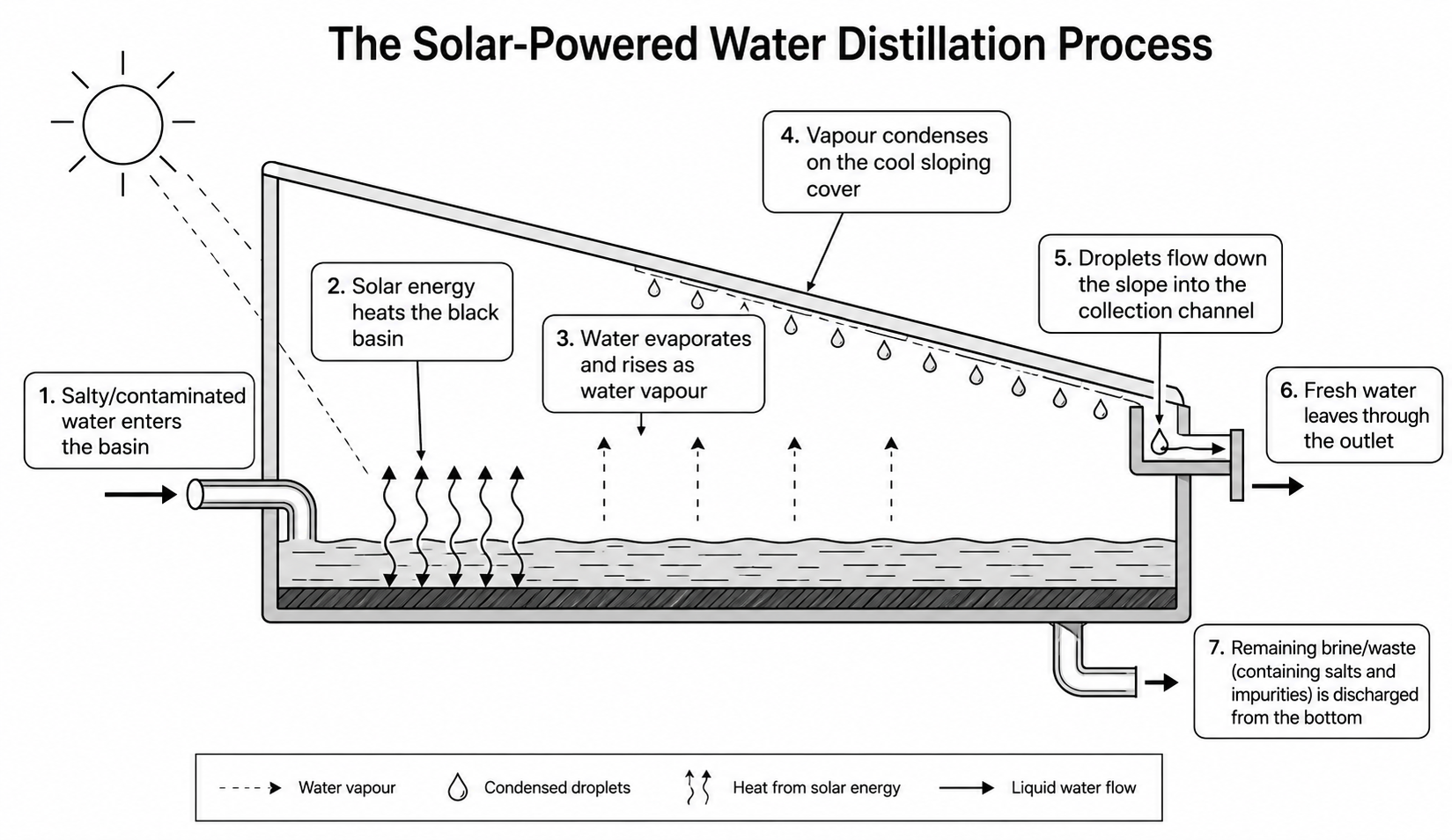
Academic Writing Task 1 Process Diagram practice image
BAND 9

Part 1 · Band 9 Sample Answer

The diagram illustrates the operation of a solar-powered distillation unit that separates fresh water from salty or contaminated water.

Overall, the system uses sunlight to heat and evaporate the incoming water before condensing the resulting vapour on an inclined cover. The condensed liquid is collected as fresh water, whereas the salts and other impurities remain in the basin and are removed separately from the bottom. Thus, the unit produces two distinct outputs without mixing the purified water with the residual waste.

Initially, untreated water enters through a pipe on the left and collects inside a shallow basin with a black base. Solar radiation passes through the transparent sloping cover and heats this dark surface. Energy transferred from the basin to the water causes evaporation, and the water vapour then rises through the enclosed space. The salts and contaminants do not rise with the vapour and therefore remain in the basin.

When the warm vapour reaches the cooler underside of the inclined cover, it condenses into droplets. Owing to the downward slope, these droplets move towards the lower right-hand side of the unit rather than falling back into the untreated water. They enter a collection channel positioned at the edge of the cover and are directed through a separate outlet, from which fresh water leaves the apparatus.

Meanwhile, the liquid left at the base becomes brine or waste containing the separated impurities. This residue is discharged through a pipe fitted to the bottom of the basin, completing the process.

BAND 8

Part 1 · Band 8 Sample Answer

The illustration explains how a distillation device powered by solar energy converts salty or polluted water into fresh water.

Overall, water is purified through evaporation and condensation inside a covered basin. Sunlight supplies the heat required for the process, while the sloping cover guides the condensed water into a collection channel. Fresh water and the remaining contaminated waste leave the unit through different outlets.

First, salty or contaminated water flows into the basin through an inlet on the left. The basin has a black base, which is heated by energy from the sun. This heat raises the temperature of the water and causes it to evaporate. The water rises as vapour, but the salts and other impurities are left behind in the liquid at the bottom.

The vapour then reaches the underside of the cover above the basin. Since this surface is cool, the vapour condenses on it and forms droplets. The cover slopes downwards from left to right, so the droplets flow along its inner surface towards the lower end.

Next, the droplets enter a small collection channel on the right-hand side. The collected fresh water passes through an outlet and leaves the unit. The materials that were not carried upwards during evaporation remain inside the basin as brine or contaminated waste. At the final stage, this residual liquid is removed separately through a discharge pipe beneath the unit. The two outlets therefore keep the fresh product apart from the waste.

BAND 7

Part 1 · Band 7 Sample Answer

The diagram shows the stages used by a solar-powered unit to produce fresh water from salty or contaminated water.

Overall, the unit uses solar heat to evaporate water and a cool sloping cover to turn the vapour back into liquid. The fresh water is collected at one side of the device, while the salts and impurities that remain in the basin are discharged from the bottom.

First, untreated water enters the basin through a pipe on the left. The bottom of the basin is black and absorbs energy from the sun. As the basin becomes heated, the water inside it begins to evaporate. Water vapour rises towards the cover, whereas salt and other unwanted substances stay in the basin.

The vapour reaches the cooler surface on the inside of the cover and condenses. This produces small droplets of clean water. Because the cover slopes downwards towards the right, the droplets run along it in this direction. They then fall into a collection channel near the lower end of the cover.

After entering this channel, the fresh water flows out of the unit through a side outlet. Meanwhile, the substances separated from the water are left at the bottom in the form of brine or waste. This remaining liquid contains the original salts and impurities. It is finally released from the device through another pipe connected to the bottom of the basin. In this way, fresh water and contaminated waste leave through separate routes.

Academic Writing Task 2

Task 2 · Discuss Both Views and Give Your Opinion

Task 2 Prompt

You should spend about 40 minutes on this task. Write at least 250 words.

Write about the following topic:

Some people argue that space exploration is a waste of resources and that the money should be spent solving problems on Earth, such as poverty and climate change. Others believe that space research is essential for humanity's future.

Discuss both views and give your own opinion.

Give reasons for your answer and include any relevant examples from your own knowledge or experience.

BAND 9

Part 2 · Band 9 Sample Answer

Debate over space exploration is often framed as a choice between distant scientific ambitions and urgent human needs. Critics are right that public budgets involve real opportunity costs, especially when people lack food, housing or protection from climate-related disasters. Nevertheless, I believe sustained space research is essential, provided that expenditure is selective, internationally coordinated and connected to clear scientific or public benefits.

Those who oppose such spending argue that its rewards are uncertain and may arrive only after decades. A costly mission to a remote planet can appear difficult to justify when the same resources could expand clean-energy infrastructure, improve sanitation or support communities facing extreme weather. Moreover, prestige sometimes influences national space programmes. Governments may duplicate one another’s work or pursue highly visible missions primarily to demonstrate technological power. The commercial gains can also flow to a small group of contractors, while taxpayers carry the financial risk. From this perspective, directing additional money towards proven solutions on Earth is both fairer and more effective.

Supporters respond that space research already helps address terrestrial problems rather than competing with them entirely. Satellites monitor deforestation, ocean temperatures, ice loss and greenhouse gases, giving policymakers evidence that ground observations alone cannot provide. They also support weather forecasting, disaster warnings, navigation and communications in remote areas. Beyond these immediate uses, the demanding conditions of space programmes stimulate advances in materials, robotics and energy systems. Long-term research is important as well: studying asteroids, solar activity and planetary environments improves knowledge of threats that, although unlikely in any particular year, could have enormous consequences.

In my view, abandoning space exploration would sacrifice valuable scientific capacity without guaranteeing that the savings reached disadvantaged people. Poverty and climate change result partly from political choices and unequal distribution, not simply from a shortage of money equivalent to a space budget. However, this does not justify every mission. Governments should prioritise Earth observation, planetary defence and fundamental research with openly published results. Expensive projects driven mainly by national prestige should face strict independent review, and countries should share equipment and data to avoid unnecessary duplication. Private companies benefiting from public contracts should also bear an appropriate portion of commercial risk.

In conclusion, immediate social and environmental needs deserve the larger share of public resources, but they do not make space science dispensable. A disciplined programme can help solve problems on Earth while preserving the knowledge and technology needed to protect humanity in the future.

BAND 8

Part 2 · Band 8 Sample Answer

Some people consider government spending on space exploration irresponsible while poverty and climate change remain serious problems. Others see space research as necessary for human progress and survival. I believe governments should continue to fund it, but projects must provide genuine scientific or practical value and should not reduce essential social and environmental spending.

The argument against space exploration is based mainly on opportunity cost. Launching spacecraft, building specialised equipment and supporting missions over many years can require substantial public investment. That money could instead provide housing, healthcare, clean water or renewable-energy systems, all of which improve lives more directly. The benefits of exploring distant planets may also be uncertain, particularly when human settlement beyond Earth remains extremely difficult. In addition, governments sometimes use space achievements to increase national prestige. Funding a repeated or mainly symbolic mission is hard to defend when urgent domestic programmes lack resources.

However, space research produces important benefits on Earth. Satellites allow scientists to observe changes in forests, oceans, weather systems and polar ice across large areas. This information supports climate research and can help authorities prepare for storms, floods and fires. Satellite technology also provides navigation, communication and services for communities that are difficult to reach by ground infrastructure. Space missions require reliable materials, computing and robotic systems, so research in this field can contribute to wider technological development. Looking further ahead, monitoring asteroids and solar activity may help protect the planet from rare but potentially severe threats.

In my opinion, the two goals should not be treated as complete opposites. Ending every space programme would not automatically eliminate poverty or ensure effective climate policy, because these problems also involve governance and distribution. At the same time, scientific ambition should not become an excuse for unlimited spending. Independent experts should assess the likely value of major missions, and results obtained with public money should be openly available. International cooperation could reduce costs by preventing countries from constructing similar systems separately. Priority should go to climate monitoring, communications, planetary defence and research with broad benefits, rather than prestige projects.

In conclusion, spending on Earth’s immediate needs must remain the main priority. Nevertheless, carefully chosen space research supports environmental action, useful technology and long-term security. Its advantages justify continued investment as part of, rather than a replacement for, efforts to improve life on Earth.

BAND 7

Part 2 · Band 7 Sample Answer

There are different opinions about whether governments should spend money on space exploration. Some people think these funds should be used to reduce poverty and protect the environment, while others believe space research is important for the future. In my view, space programmes should continue, but governments must control their cost and give priority to projects that benefit the public.

People who oppose space exploration have understandable concerns. Missions require expensive rockets, equipment and highly trained workers, and their results are not always immediately useful. Meanwhile, many people need affordable housing, food, healthcare and education. Governments also need to invest in renewable energy, public transport and protection against floods or extreme heat. Spending large amounts on a distant planet may therefore seem unfair when serious problems are affecting people now. Some missions may also be designed mainly to improve a country’s international image rather than answer an important scientific question.

On the other hand, space research has several practical benefits. Satellites help scientists observe the climate, follow major storms and measure environmental changes. This information allows governments to prepare for natural disasters and make better environmental decisions. Satellites are also used for navigation, communication and delivering services to remote regions. Research for space missions can lead to stronger materials, improved computers and more capable robots that may later be useful in other industries. In the longer term, observing asteroids and activity around the sun could help protect Earth from natural threats.

I believe it would be a mistake to stop space research completely. Solving poverty depends not only on the total amount of money available but also on how resources are distributed and how policies are managed. However, this does not mean every proposed mission deserves funding. Governments should compare costs with likely benefits and cancel projects that only repeat existing work or serve national pride. Countries can share technology, information and launch systems to reduce unnecessary expense. Projects that monitor Earth, improve communication or investigate genuine dangers should receive priority.

In conclusion, poverty and climate change require greater and more immediate investment than space exploration. Even so, carefully managed space research has important benefits for daily life and humanity’s future, so its funding should be reduced where wasteful rather than removed altogether.

FREE PRACTICE RESOURCES

Download the IELTS Practice PDF Pack.

Get Listening, Reading, and Writing practice materials for self-study. Use a computer to download the 1.9GB pack.

Download PDF Pack
Chat History
My Notes