ACADEMIC WRITING SAMPLE ANSWERS

Academic Writing Sample Answers Practice 17 Test 02

This original practice page includes Task 1 (Dynamic Grouped Bar Chart) and Task 2 (Discuss Both Views and Give Your Opinion), with Band 9, Band 8, and Band 7 sample answers for IELTS preparation.
Academic Writing Task 1

Task 1 · Dynamic Grouped Bar Chart

Task 1 Prompt

You should spend about 20 minutes on this task. Write at least 150 words.

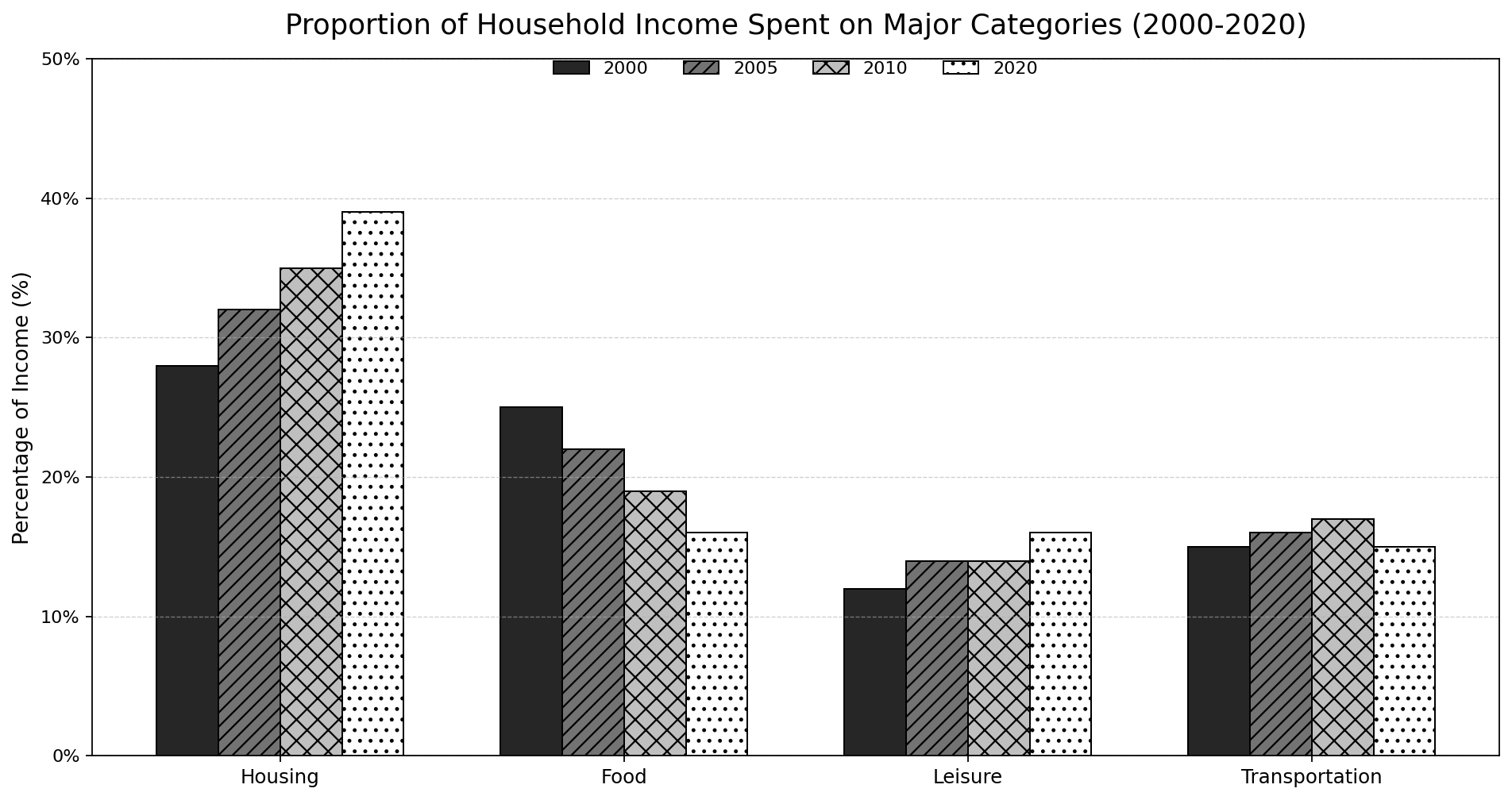
The chart below shows the proportion of household income spent on four major categories in a European country between 2000 and 2020.

Summarise the information by selecting and reporting the main features, and make comparisons where relevant.
Academic Writing Task 1 Dynamic Grouped Bar Chart practice image
BAND 9

Part 1 · Band 9 Sample Answer

The bar chart compares the percentages of household income allocated to housing, food, leisure and transportation in a European nation in 2000, 2005, 2010 and 2020.

Overall, housing absorbed the largest share of income in every year shown, and this proportion rose considerably over the period. By contrast, spending on food declined steadily. The figures for leisure and transportation were substantially lower and changed only modestly, with food and leisure accounting for equal shares by 2020.

In 2000, households devoted 28% of their income to housing, only three percentage points more than the 25% spent on food. The gap subsequently widened in each surveyed year: housing expenditure increased to 32% in 2005 and 35% in 2010, before reaching a peak of 39% in 2020. Food followed precisely the opposite pattern, falling by three points at each interval, from 25% initially to 22%, 19% and finally 16%. Consequently, the difference between these two categories expanded from just 3 to 23 percentage points.

The remaining categories displayed much less variation. Leisure represented the smallest expense in 2000, at 12%, but rose to 14% in 2005 and remained at that level in 2010. A further increase to 16% in 2020 placed it level with food. Transportation, meanwhile, edged up from 15% to 16% and then 17% across the first three years shown. It subsequently returned to 15%, making it the smallest of the four categories at the end of the period.

BAND 8

Part 1 · Band 8 Sample Answer

The chart illustrates the proportion of household earnings spent on four main categories in a European country in selected years from 2000 to 2020.

Overall, housing consistently accounted for the greatest percentage and became increasingly dominant over time. Food expenditure moved in the opposite direction, declining throughout the period. Spending on leisure rose slightly, whereas the share allocated to transportation fluctuated within a narrow range.

In 2000, 28% of household income was used for housing and 25% for food, so the difference between the two largest categories was only three percentage points. Housing then increased to 32% in 2005 and 35% in 2010. By 2020, it had reached 39%, representing an overall rise of 11 points. In comparison, the proportion spent on food dropped to 22% in 2005 and 19% five years later, before falling further to 16% in the final year.

Leisure and transportation both took much smaller shares of household budgets. Leisure spending stood at 12% in 2000, the lowest figure on the chart, and increased to 14% in 2005. It remained unchanged in 2010 before reaching 16% in 2020, the same level as food. Transportation began at 15% and rose gradually to 16% in 2005 and 17% in 2010. However, this trend was reversed by 2020, when its share returned to 15% and became slightly lower than both food and leisure.

BAND 7

Part 1 · Band 7 Sample Answer

The bar chart shows how much of household income was spent on housing, food, leisure and transportation in a European country in 2000, 2005, 2010 and 2020.

Overall, housing was the largest expense in all four years, and its share increased steadily. In contrast, the percentage for food fell over time. Leisure spending rose moderately, while transportation changed very little across the period.

Households spent 28% of their income on housing in 2000. This figure climbed to 32% in 2005 and 35% in 2010, before reaching 39% in 2020. Food showed a clear downward trend. It accounted for 25% of income at the start, making it the second-largest category. The proportion then declined to 22% in 2005, 19% in 2010 and 16% in the final year. Therefore, the gap between housing and food became much wider, rising from three percentage points in 2000 to 23 points in 2020.

The other two categories remained below 20% throughout. Leisure was the smallest expense in 2000, at 12%. It rose to 14% in both 2005 and 2010 and then to 16% in 2020, equal to the figure for food. Transportation accounted for 15% in 2000 and increased slightly to 16% in 2005 and 17% in 2010. It later fell back to 15%, which was the lowest proportion among the four categories in 2020.

Academic Writing Task 2

Task 2 · Discuss Both Views and Give Your Opinion

Task 2 Prompt

You should spend about 40 minutes on this task. Write at least 250 words.

Write about the following topic:

Some people think that the main purpose of education should be to prepare students for the workforce. Others, however, believe that education has a broader role in developing individuals and society.

Discuss both views and give your own opinion.

Give reasons for your answer and include any relevant examples from your own knowledge or experience.

BAND 9

Part 2 · Band 9 Sample Answer

Debate about the purpose of education often centres on whether schools and universities should primarily supply the labour market with capable workers or pursue wider human and social aims. Employment preparation is undeniably one of their central responsibilities. Nevertheless, I believe education should equip people not only to earn a living, but also to think independently, participate in civic life and lead fulfilling lives.

Those who prioritise work readiness have compelling practical reasons. Most students will eventually depend on employment for financial security, and societies need people with the expertise to provide healthcare, construct infrastructure and operate complex technologies. If courses bear little relation to contemporary workplaces, graduates may emerge with substantial theoretical knowledge but no ability to apply it. Vocational training, laboratory practice and well-designed internships can narrow this gap, while transferable skills such as communication, numeracy and collaboration benefit almost every occupation. Public investment in education is also easier to justify when it helps reduce skills shortages and enables citizens to support themselves.

However, defining learners mainly as future employees is too restrictive. Particular technical skills can become obsolete as industries and technologies change, whereas intellectual curiosity, ethical judgement and the ability to evaluate evidence remain useful throughout life. A narrowly occupational curriculum may produce competent specialists who are poorly prepared to assess misleading information, understand people unlike themselves or consider the social consequences of their decisions. Education also transmits culture and creates informed citizens. Subjects such as literature, history, science and the arts allow students to examine values, encounter alternative perspectives and develop interests that need not generate immediate economic returns. These outcomes strengthen both individual well-being and democratic society.

The two purposes are not mutually exclusive. The most valuable preparation for an uncertain labour market is often a broad education combined with opportunities to apply knowledge. An engineering student, for example, needs technical proficiency, but courses in ethics and communication may help that person identify risks and explain them responsibly to the public. Similarly, secondary pupils can study academic subjects while undertaking projects with employers or community organisations. Such an approach avoids forcing young people into narrow career paths before their abilities and ambitions have fully developed.

In conclusion, education must give students credible routes into employment, since independence and productive work matter greatly. Yet its main purpose should be broader: to cultivate adaptable, thoughtful and socially responsible people. Workforce preparation is best understood as an essential component of this mission rather than its defining limit.

BAND 8

Part 2 · Band 8 Sample Answer

People disagree about whether education should concentrate mainly on making students employable or serve wider personal and social purposes. Although schools and universities must give learners skills that are useful at work, I believe their role should be broader because individuals also need to become adaptable thinkers and responsible members of society.

There is a strong case for giving employment a central place in education. Students invest many years in study, and most reasonably expect their qualifications to help them find secure work. Employers also require staff with practical knowledge, from nurses and electricians to programmers and accountants. Courses that include technical training, teamwork, presentations and work placements can make the transition into employment easier. Furthermore, when graduates possess skills needed by the economy, businesses can expand and governments may spend less addressing unemployment. From this viewpoint, an education system that leaves young adults unable to perform real workplace tasks has failed an important part of its duty.

Nevertheless, present employment needs should not determine the entire curriculum. Labour markets change quickly, so training students for one specific role may be less useful than teaching them how to learn, analyse unfamiliar problems and communicate clearly. Education also shapes character and social awareness. Through history and literature, learners can understand experiences beyond their own; through science, they can distinguish evidence from unsupported claims. These abilities help people make sound choices about health, public policy and relationships, not merely perform a job. Schools also provide opportunities to cooperate with people from different backgrounds, which can increase tolerance and strengthen communities.

In my opinion, the best system should connect these aims instead of choosing only one. All students need a foundation in literacy, numeracy, digital competence and interpersonal skills, followed by meaningful choices between vocational and academic routes. Practical projects can demonstrate how classroom knowledge applies outside school without turning every lesson into job training. For instance, a project on local water quality could develop scientific and statistical skills while also encouraging concern for the community. Universities should likewise maintain professional courses alongside humanities and fundamental research.

To conclude, preparing young people to enter the workforce is essential because employment supports both individuals and the economy. However, education should ultimately develop capable human beings and citizens, not simply workers. A broad curriculum with strong practical elements is therefore the most balanced approach.

BAND 7

Part 2 · Band 7 Sample Answer

Some people argue that education should mainly give students the knowledge and skills required for employment. Others think it should also develop people personally and improve society. I agree that job preparation is important, but I believe education has a wider purpose that should not be ignored.

Focusing on employment has several clear benefits. Most young people need to find work after completing their education, so schools and colleges should help them meet the needs of employers. Practical lessons, vocational courses and work experience can teach students how to use equipment, solve workplace problems and cooperate with colleagues. These abilities may help graduates find jobs more quickly and become productive without a long period of additional training. Society also benefits because essential industries need qualified workers. For example, healthcare systems require trained nurses and technicians, while construction depends on people who understand both technical methods and safety rules.

However, education is about more than earning an income. Students need to learn how to think critically, judge information and make responsible decisions. These skills are particularly important when people encounter false claims online or vote on difficult public issues. Subjects such as history, literature and art can also help learners understand their culture and appreciate the experiences of others. In addition, school is a place where children learn patience, respect and how to communicate with people from different backgrounds. These qualities contribute to stronger communities and are valuable in personal life as well as at work.

In my view, schools should provide a balance between practical preparation and broader learning. Basic literacy, numeracy and digital skills are useful in nearly every career, while a range of academic and creative subjects allows students to discover their interests. Older students could then choose more specialised courses or placements related to possible careers. This would prepare them for employment without limiting their education to the requirements of one particular job, which may later change or disappear.

In conclusion, education must help students gain the qualifications and practical abilities needed for work. Nevertheless, its main role is wider because it should also produce informed, confident and considerate individuals. Combining career preparation with personal and social development is therefore the best way forward.

FREE PRACTICE RESOURCES

Download the IELTS Practice PDF Pack.

Get Listening, Reading, and Writing practice materials for self-study. Use a computer to download the 1.9GB pack.

Download PDF Pack
Chat History
My Notes