ACADEMIC WRITING SAMPLE ANSWERS

Academic Writing Sample Answers Practice 17 Test 04

This original practice page includes Task 1 (Static Grouped Bar Chart) and Task 2 (Discuss Both Views and Give Your Opinion), with Band 9, Band 8, and Band 7 sample answers for IELTS preparation.
Academic Writing Task 1

Task 1 · Static Grouped Bar Chart

Task 1 Prompt

You should spend about 20 minutes on this task. Write at least 150 words.

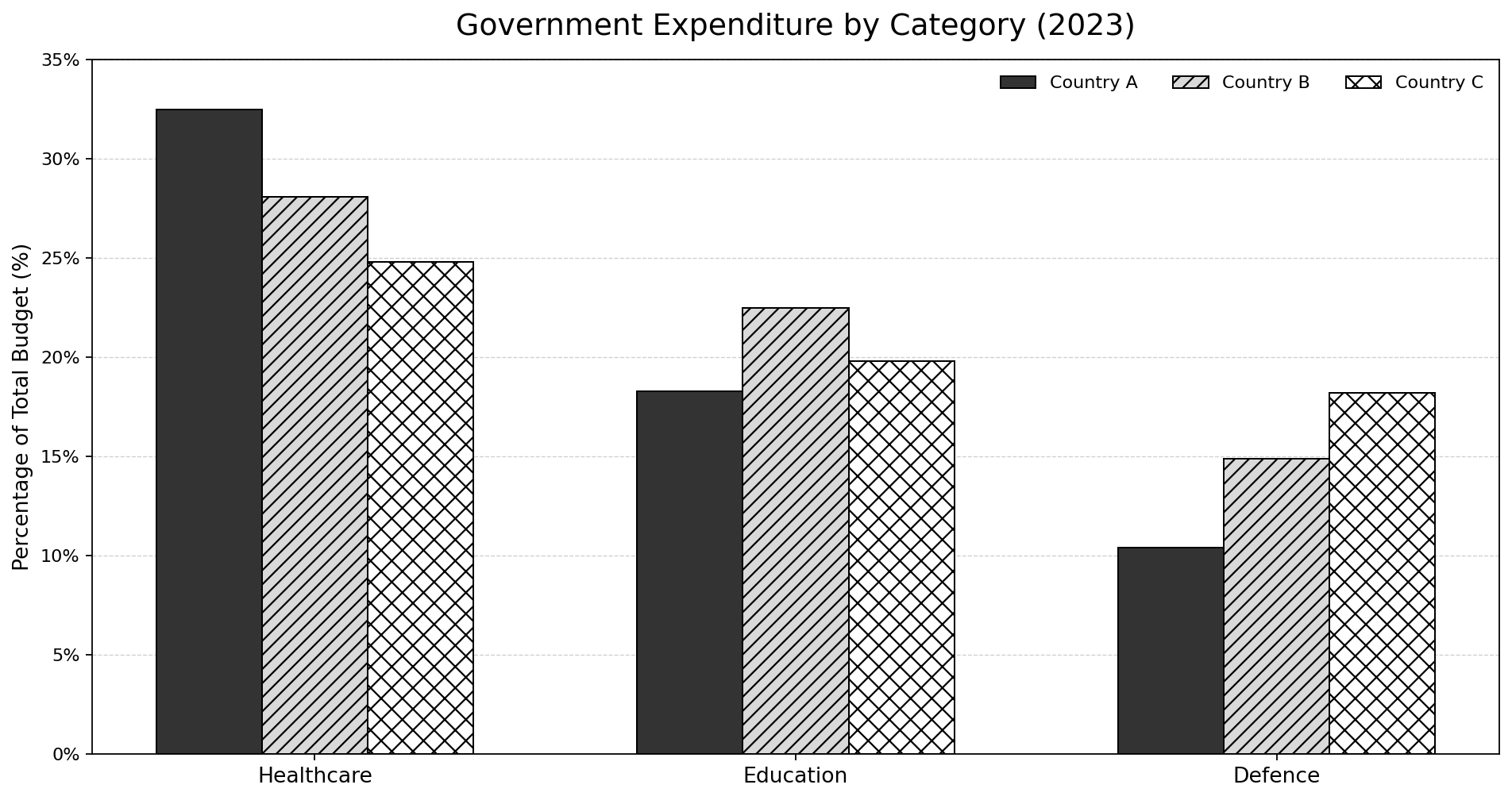
The bar chart below compares the expenditure of three countries on three key areas as a percentage of their total government budgets in 2023.

Summarise the information by selecting and reporting the main features, and make comparisons where relevant.
Academic Writing Task 1 Static Grouped Bar Chart practice image
BAND 9

Part 1 · Band 9 Sample Answer

The bar chart compares the proportions of total government spending allocated to healthcare, education and defence in Countries A, B and C in 2023.

Overall, healthcare received the largest budget share in all three countries, whereas defence attracted the smallest. Country A prioritised healthcare most strongly but assigned the lowest proportions to the other two fields. By contrast, Country B led spending on education, while Country C devoted the greatest share to defence and distributed its expenditure more evenly across the three areas.

Approximately 32.5% of Country A’s budget went to healthcare, compared with about 28% in Country B and just under 25% in Country C. Thus, the figure for A exceeded that for C by nearly eight percentage points. Within Country A itself, healthcare spending was almost three times its defence allocation of slightly over 10%, while education represented roughly 18%.

The ranking was different for education. Country B recorded the highest proportion, at around 22.5%, followed by Country C at just under 20%; Country A had the lowest figure, at a little over 18%. Defence spending showed the reverse of the pattern seen in healthcare, rising across the countries from approximately 10.5% in A to almost 15% in B and just above 18% in C. As a result, the gap between healthcare and defence was widest in Country A, at about 22 percentage points, but narrowed to roughly six or seven points in Country C.

BAND 8

Part 1 · Band 8 Sample Answer

The chart illustrates the percentages of government budgets spent on healthcare, education and defence in three countries during 2023.

Overall, healthcare accounted for the greatest proportion of expenditure in every country, while defence received the smallest share. Country A spent the most on healthcare but the least on education and defence. Country B had the highest education figure, whereas Country C allocated the largest percentage to defence.

For healthcare, Country A devoted approximately 32.5% of its total budget to this area. The corresponding proportion was lower in Country B, at about 28%, and fell further to just under 25% in Country C. Healthcare therefore took around eight percentage points more of the budget in A than in C. Education spending displayed a different order: Country B led at roughly 22.5%, followed by C at nearly 20% and A at just over 18%.

Defence represented about 10.5% of Country A’s expenditure, the lowest individual figure shown on the chart. Country B assigned close to 15% to this category, while the share in Country C was higher, at approximately 18%. Within Country A, the proportion for healthcare was more than 20 percentage points above that for defence. The difference was smaller in B, at around 13 points, and narrowest in C, where healthcare exceeded defence by only about six or seven points.

BAND 7

Part 1 · Band 7 Sample Answer

The bar chart shows the percentages of the total government budget spent on healthcare, education and defence in Countries A, B and C in 2023.

Overall, all three governments spent the largest share on healthcare and the smallest on defence. However, Country A had the highest healthcare figure, Country B spent the most on education, and Country C had the greatest proportion for defence.

Country A allocated around 32.5% of its budget to healthcare. This was higher than the figures for Country B and Country C, at approximately 28% and 25% respectively. In Country A, education accounted for just over 18%, while only about 10.5% was used for defence. The difference between its healthcare and defence shares was therefore roughly 22 percentage points.

Country B spent about 22.5% on education, which was the highest education figure among the three nations. Its healthcare proportion was 28%, while defence made up almost 15% of its budget. In Country C, the three percentages were closer together. Healthcare still ranked first at just under 25%, followed by education at approximately 20%. Defence represented about 18%, which was only around two percentage points lower than education. Country C’s defence share was therefore much higher than Country A’s, although its healthcare allocation was the lowest of the three countries.

Academic Writing Task 2

Task 2 · Discuss Both Views and Give Your Opinion

Task 2 Prompt

You should spend about 40 minutes on this task. Write at least 250 words.

Write about the following topic:

Some people believe that caring for the elderly is primarily the responsibility of the family and that governments should not be expected to provide financial support. Others argue that it is the government's duty to ensure the well-being of its senior citizens through pensions and care facilities.

Discuss both views and give your own opinion.

Give reasons for your answer and include any relevant examples from your own knowledge or experience.

BAND 9

Part 2 · Band 9 Sample Answer

Whether older people should rely principally on relatives or receive publicly funded pensions and care is increasingly important as populations age. Families are often best placed to provide affection and personalised assistance, so they should not be treated as irrelevant. Nevertheless, I believe government must guarantee a secure minimum income and appropriate care, because family circumstances vary too widely for support in old age to depend on them alone.

Those who assign primary responsibility to families emphasise reciprocity and personal connection. Parents commonly devote years to raising children, and it may seem both natural and fair for adult children to help them later. Relatives understand an older person’s habits, language and preferences in a way that rotating professional carers may not, and regular family contact can reduce loneliness. Home-based support may also allow elderly people to remain in familiar surroundings rather than enter an institution. Extensive state provision can also strain taxpayers as populations age.

However, this position assumes that every senior citizen has a willing, financially secure and physically available family. Some people have no children, have outlived their relatives or live far from them. Others require skilled nursing that affection cannot replace. Even devoted adult children may be supporting their own children, paying housing costs and working full time. Requiring them to fund or deliver intensive care can force someone, usually one family member, to leave employment, creating hardship in two generations.

Government provision solves a collective problem through shared risk. A dependable pension protects older citizens from poverty, while regulated home-care services and residential facilities ensure that serious medical and personal needs are met safely. Such programmes recognise that today’s pensioners contributed to society through taxes, paid work and unpaid care. Public responsibility need not mean unlimited benefits or the exclusion of relatives. Pensions can combine universal protection with additional assistance based on need, and professional carers can handle demanding tasks while families provide companionship and make personal decisions.

In my view, this partnership is more sustainable than either extreme. Governments should establish and inspect services, train care workers and guarantee that nobody lacks food, housing or necessary care. Families, when able, should visit regularly, advocate for older relatives and contribute practical help without being expected to perform clinical work or absorb unaffordable costs.

In conclusion, families have a genuine moral role in caring for elderly members, but this cannot replace public protection. The state should carry ultimate responsibility for a reliable safety net, supplemented by the irreplaceable human support that families can provide.

BAND 8

Part 2 · Band 8 Sample Answer

There is disagreement over whether families should take main responsibility for elderly relatives or whether governments must support older citizens through pensions and care services. Although relatives play an essential role in providing personal attention and companionship, I believe the state has a duty to ensure that every elderly person can live safely and with dignity.

Supporters of family responsibility argue that care is part of the relationship between generations. Parents normally invest considerable time and money in their children, so helping them in old age can be viewed as a reasonable return. Family members also know their relatives well and may notice changes in their health or behaviour earlier than an unfamiliar carer. Keeping an older person at home can preserve routines, maintain emotional bonds and prevent isolation. Extensive state provision can also strain public budgets as the elderly population grows.

On the other hand, relying mainly on relatives produces serious inequalities. Not every older person has children or a positive family relationship. Some adult children live in another region, have low incomes or already care for young dependants. A person with dementia or limited mobility may need continuous supervision and professional treatment that relatives are not qualified to provide. Expecting one family member to stop working can reduce household income and damage that person’s own future pension. Therefore, family-only care may transfer the problems of ageing rather than solve them.

Governments are better able to spread these costs across society. Public pensions can provide a basic income, while home-care programmes and residential facilities can meet different levels of need. Standards and inspections can also protect vulnerable residents from neglect. This support is justified because older people have usually contributed through taxes, employment, raising families or other valuable unpaid work. However, state involvement should not remove all personal responsibility. Relatives who are able to help should remain involved and should not regard public services as a substitute for regular contact.

In my opinion, a shared system is the fairest solution. Government should guarantee an adequate pension and access to professional care, with extra assistance directed towards people with greater needs and fewer resources. Families can provide company, practical help and information about individual preferences. This division uses the strengths of both sides without placing an impossible burden on either.

In conclusion, families should support their elderly members whenever possible, but their ability to do so cannot be guaranteed. The government must therefore provide the financial security and care services required to protect all senior citizens.

BAND 7

Part 2 · Band 7 Sample Answer

Some people believe that families should look after elderly relatives without expecting financial help from the government. Others think the state must provide pensions and care facilities for older citizens. In my view, families should remain closely involved, but governments have the main responsibility for ensuring that every elderly person receives basic financial support and suitable care.

There are good reasons for expecting families to help. Adult children often feel a moral duty to support parents who cared for them when they were young. Relatives also understand an elderly person’s personality, daily routine and preferences. This knowledge can make care at home more comfortable and personal than care provided by strangers. Regular visits and conversations may also prevent loneliness. Another argument is that government pensions and residential facilities cost a great deal of public money, and taxpayers may face a heavier burden if the elderly population continues to grow.

However, family care is not possible in every situation. Some senior citizens have no children, while others have relatives who live far away or cannot afford to support another person. Adult children may already be paying for housing and raising their own families. Serious health conditions also require trained nurses and specialised equipment. Love and good intentions cannot replace this professional care. If relatives are forced to leave their jobs to become full-time carers, their household may experience financial difficulties, and they may be unable to save for their own retirement.

For these reasons, governments should provide a basic pension that allows older people to pay for food, housing and other necessities. They should also offer safe residential facilities and home-care services for those who cannot live independently. These services need clear standards and regular inspections. Older people have contributed to society through employment, taxes and family responsibilities, so helping them in later life is a reasonable public duty.

Nevertheless, government support should not mean that families have no role. Relatives can visit, provide company, help with shopping and communicate an older person’s needs to professional carers. The state can manage the major financial and medical responsibilities, while families provide personal and emotional support.

In conclusion, it is desirable for families to care for elderly relatives, but not every family has the same money, time or skills. Governments must guarantee pensions and professional care so that no senior citizen is left without support.

FREE PRACTICE RESOURCES

Download the IELTS Practice PDF Pack.

Get Listening, Reading, and Writing practice materials for self-study. Use a computer to download the 1.9GB pack.

Download PDF Pack
Chat History
My Notes