ACADEMIC WRITING SAMPLE ANSWERS

Academic Writing Sample Answers Practice 16 Test 01

This original practice page includes Task 1 (Dynamic Pie Chart) and Task 2 (Discuss Both Views and Give Your Opinion), with Band 9, Band 8, and Band 7 sample answers for IELTS preparation.
Academic Writing Task 1

Task 1 · Dynamic Pie Chart

Task 1 Prompt

You should spend about 20 minutes on this task. Write at least 150 words.

The two pie charts below show the distribution of energy production from different sources in a country for the years 2000 and 2020.

Summarise the information by selecting and reporting the main features, and make comparisons where relevant.
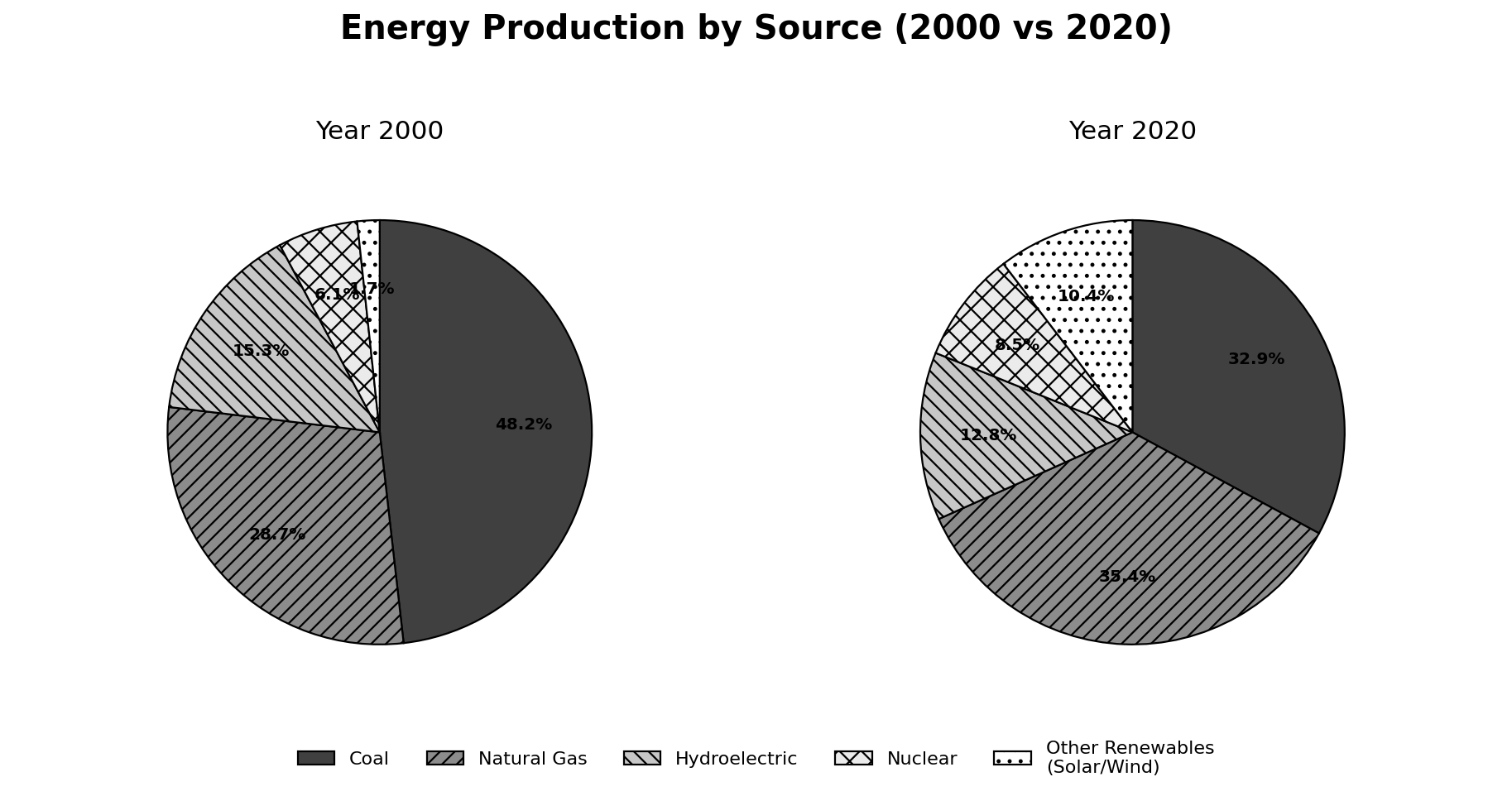
Academic Writing Task 1 Dynamic Pie Chart practice image
BAND 9

Part 1 · Band 9 Sample Answer

The two pie charts compare the proportions of energy generated from five sources in a country in 2000 and 2020.

Overall, fossil fuels remained the dominant basis of energy production in both years, although their combined contribution declined. The mix also became markedly less reliant on coal, which was overtaken by natural gas, while nuclear power and other renewables both gained ground.

In 2000, coal alone accounted for 48.2% of national energy output, making it by far the largest source. Natural gas supplied a further 26.7%, so these two fossil fuels together represented almost three quarters of production. Hydroelectricity was the leading non-fossil source at 15.3%. By contrast, nuclear energy contributed only 6.1%, and solar and wind, grouped as other renewables, had the smallest share, at 3.7%.

Twenty years later, natural gas had risen by 8.7 percentage points to 35.4%, becoming the biggest contributor. Coal experienced a much larger movement in the opposite direction, falling by 15.3 points to 32.9%. Consequently, the combined fossil-fuel share decreased from 74.9% to 68.3%. Among the remaining sources, hydroelectric power slipped moderately to 12.8%. However, other renewables nearly tripled their proportion to 10.4%, the sharpest relative growth of any category, while nuclear production also increased, reaching 8.5%. Taken together, the three non-fossil sources therefore expanded from 25.1% to 31.7% of the total.

BAND 8

Part 1 · Band 8 Sample Answer

The charts illustrate the percentage of energy produced from coal, natural gas, hydroelectric power, nuclear power and other renewable sources in one country in 2000 and 2020.

Overall, coal and natural gas provided most of the country’s energy in both years. Nevertheless, coal became considerably less important over the period, whereas gas became the largest source. The shares of nuclear power and other renewables increased, while hydroelectricity declined slightly.

At the beginning of the period, nearly half of all energy came from coal, at 48.2%. This was substantially more than the figure for natural gas, which stood at 26.7%. Hydroelectric power ranked third and produced 15.3% of the total. The two smallest categories were nuclear energy and other renewables, contributing 6.1% and 3.7% respectively.

By 2020, the proportion supplied by coal had fallen sharply to 32.9%, a reduction of 15.3 percentage points. In contrast, natural gas increased to 35.4%, placing it slightly ahead of coal. Changes among the other sources were less dramatic in absolute terms. Hydroelectricity decreased by 2.5 points to 12.8%, but other renewables rose strongly to 10.4%, almost three times their original share. Nuclear power also grew, although more modestly, to 8.5%. As a result, sources other than coal and gas collectively accounted for 31.7% of production in 2020, compared with 25.1% in 2000.

BAND 7

Part 1 · Band 7 Sample Answer

The two charts show how energy production in a country was divided among five different sources in 2000 and 2020.

Overall, coal and natural gas were the main energy sources in both years. However, coal lost a large part of its share and was replaced by natural gas as the biggest source in 2020. Other renewables and nuclear power became more important, while the proportion for hydroelectric power fell.

In 2000, coal made up 48.2% of energy production, which was almost twice the share of natural gas at 26.7%. Hydroelectricity was the third-largest source, accounting for 15.3%. Much smaller proportions came from nuclear power and other renewables such as solar and wind, at 6.1% and 3.7% respectively. Altogether, coal and gas supplied 74.9% of the energy produced that year.

By 2020, natural gas had increased to 35.4% and moved into first place. At the same time, the figure for coal dropped significantly to 32.9%. Hydroelectricity also declined, but only from 15.3% to 12.8%. In comparison, the share of other renewables rose considerably to 10.4%, while nuclear energy grew to 8.5%. Therefore, although fossil fuels still provided over two thirds of production in 2020, the country used a more balanced range of energy sources than it had twenty years earlier.

Academic Writing Task 2

Task 2 · Discuss Both Views and Give Your Opinion

Task 2 Prompt

You should spend about 40 minutes on this task. Write at least 250 words.

Write about the following topic:

In many cities, there is a shortage of housing. Some people believe that governments should prioritise building new homes in existing urban areas, even if it means building on parks and green spaces. Others disagree and think that green spaces must be protected.

Discuss both views and give your own opinion.

Give reasons for your answer and include any relevant examples from your own knowledge or experience.

BAND 9

Part 2 · Band 9 Sample Answer

Housing shortages force city governments to confront a genuine conflict between providing an essential necessity and preserving the environmental assets that make urban life tolerable. Although building within the existing city can be more sustainable than outward expansion, I do not believe established parks should ordinarily be sacrificed. Urban housing should instead be increased through denser and more imaginative use of land already devoted to buildings and infrastructure.

Supporters of construction on green space have two persuasive arguments. First, homes in established districts place residents close to employment, schools, utilities and public transport. They can therefore be delivered without the extensive roads and service networks required by distant suburbs. Second, where demand is acute, withholding sizeable areas from development may appear inequitable. A centrally located but lightly used grassed site could accommodate hundreds of households that would otherwise face excessive rents, insecure accommodation or lengthy commutes. From this perspective, housing is an immediate human need, whereas every existing green parcel is not necessarily of equal ecological or recreational value.

Nevertheless, functioning parks are not simply vacant plots awaiting a more profitable use. They give residents, including those without private gardens, free places to exercise, socialise and recover from the pressures of dense city life. Trees and permeable ground also moderate summer heat, absorb rainfall and support wildlife. These benefits become more important as population density rises. Moreover, the conversion of a park is largely irreversible: a temporary housing deficit may eventually ease, but mature trees and connected habitats cannot be recreated quickly. Removing amenities from the very neighbourhoods receiving more residents may solve a numerical shortage while making those areas substantially less healthy and attractive.

In my view, governments should protect valuable green spaces while pursuing urban development in a clear order of priority. Derelict industrial land, surface car parks, vacant sites and obsolete commercial premises should be redeveloped first. Planning rules can also permit additional storeys, apartments above shops and medium-rise housing around transport stations. Authorities should map both housing capacity and the quality of open space, so that a neglected patch with little public or environmental function is not treated identically to a well-used park. Only an exceptional site with negligible value should even be considered, and any loss should be replaced nearby.

In conclusion, building homes inside cities is generally desirable, but building them on important parks is a short-sighted response. Compact development and green-space protection can coexist if governments exhaust the considerable potential of previously developed and underused urban land.

BAND 8

Part 2 · Band 8 Sample Answer

The lack of affordable homes is a serious challenge in many cities, and some argue that urban parks should be available for housing construction. While this approach could increase supply in convenient locations, I believe green spaces should generally remain protected because cities have other opportunities to accommodate new homes.

There are clear reasons for building within existing urban areas, even when some open land is affected. New residents can use transport links, schools, hospitals and utility systems that are already in place. This may allow homes to be completed faster and at a lower public cost than constructing an entirely new suburb. It can also limit urban sprawl and reduce the distance people travel to work. In a city where families are living in temporary accommodation, keeping a poorly used piece of grass untouched may seem less important than providing safe and permanent housing.

However, parks provide benefits that become increasingly necessary in crowded cities. They offer space for exercise, relaxation and community activities, particularly for people living in flats without gardens. Vegetation also provides shade, improves the local environment and helps rainwater enter the ground instead of overwhelming drains. If parks are steadily replaced by buildings, residents may gain homes but lose much of their quality of life. In addition, once green land has been developed, restoring it later would be difficult and expensive. This makes its loss different from many other planning decisions.

I therefore favour protecting established green spaces while increasing the number of homes through alternative measures. Local authorities can convert abandoned factories, empty offices and large surface car parks into residential developments. They can also allow taller buildings in suitable locations and encourage apartments to be constructed above shops or near railway stations. These policies use land more efficiently without removing places that serve the whole community. Small areas with little environmental or recreational value could be assessed individually, but public parks should not become the normal answer to housing shortages.

In conclusion, supporters of building on green land are right that homes are urgently needed and that central development has practical advantages. Nevertheless, parks are essential long-term infrastructure rather than unused space. Governments should meet housing demand by redeveloping underused built land and increasing density in appropriate parts of the city.

BAND 7

Part 2 · Band 7 Sample Answer

Many urban areas do not have enough homes for their populations. One proposed solution is to construct housing inside the city, even on parks and other green land. Although this could provide homes in useful locations, I believe most green spaces should be protected and that governments should develop other urban sites first.

People who support building on parks point to the urgent need for housing. If more homes are built in areas where people already want to live, the additional supply may give families more choice and reduce pressure on the housing market. Existing urban areas also have roads, schools, shops and public transport. Residents of new developments can use these services, whereas a new community outside the city would require expensive infrastructure. Building centrally may also shorten journeys to work and prevent the city from spreading further into the surrounding countryside.

On the other hand, green spaces are important to everyone who lives in a city. Parks give adults and children safe places to exercise, meet others and spend time outdoors. This is especially valuable for residents of apartments who do not have their own gardens. Trees and plants provide shade during hot weather and help manage heavy rain. If a growing population has access to fewer parks, overcrowding and poor living conditions may become worse. Furthermore, a park that is covered with concrete cannot easily be restored in the future.

In my opinion, governments should build more homes within cities but avoid using valuable green areas. There are often old industrial buildings, empty offices, unused plots and large car parks that can be redeveloped. More apartments could also be created above shops or by allowing some buildings to have extra floors. These options may require changes to planning rules, but they can produce housing without removing public parks. If a very small piece of open land is rarely used and has little environmental value, development might be considered after consultation, but it should be an exception.

To conclude, using parks for housing could deliver well-located homes and reduce the need for outward expansion. However, the social and environmental value of green spaces is too great to ignore. Cities should protect them while meeting housing demand through redevelopment and carefully planned increases in building density.

FREE PRACTICE RESOURCES

Download the IELTS Practice PDF Pack.

Get Listening, Reading, and Writing practice materials for self-study. Use a computer to download the 1.9GB pack.

Download PDF Pack
Chat History
My Notes