ACADEMIC WRITING SAMPLE ANSWERS

Academic Writing Sample Answers Practice 16 Test 03

This original practice page includes Task 1 (Process Diagram) and Task 2 (Two-part Question), with Band 9, Band 8, and Band 7 sample answers for IELTS preparation.
Academic Writing Task 1

Task 1 · Process Diagram

Task 1 Prompt

You should spend about 20 minutes on this task. Write at least 150 words.

The diagram below illustrates the steps involved in the commercial production of coffee, from the initial harvest to sale in supermarkets.

Summarise the information by selecting and reporting the main features.
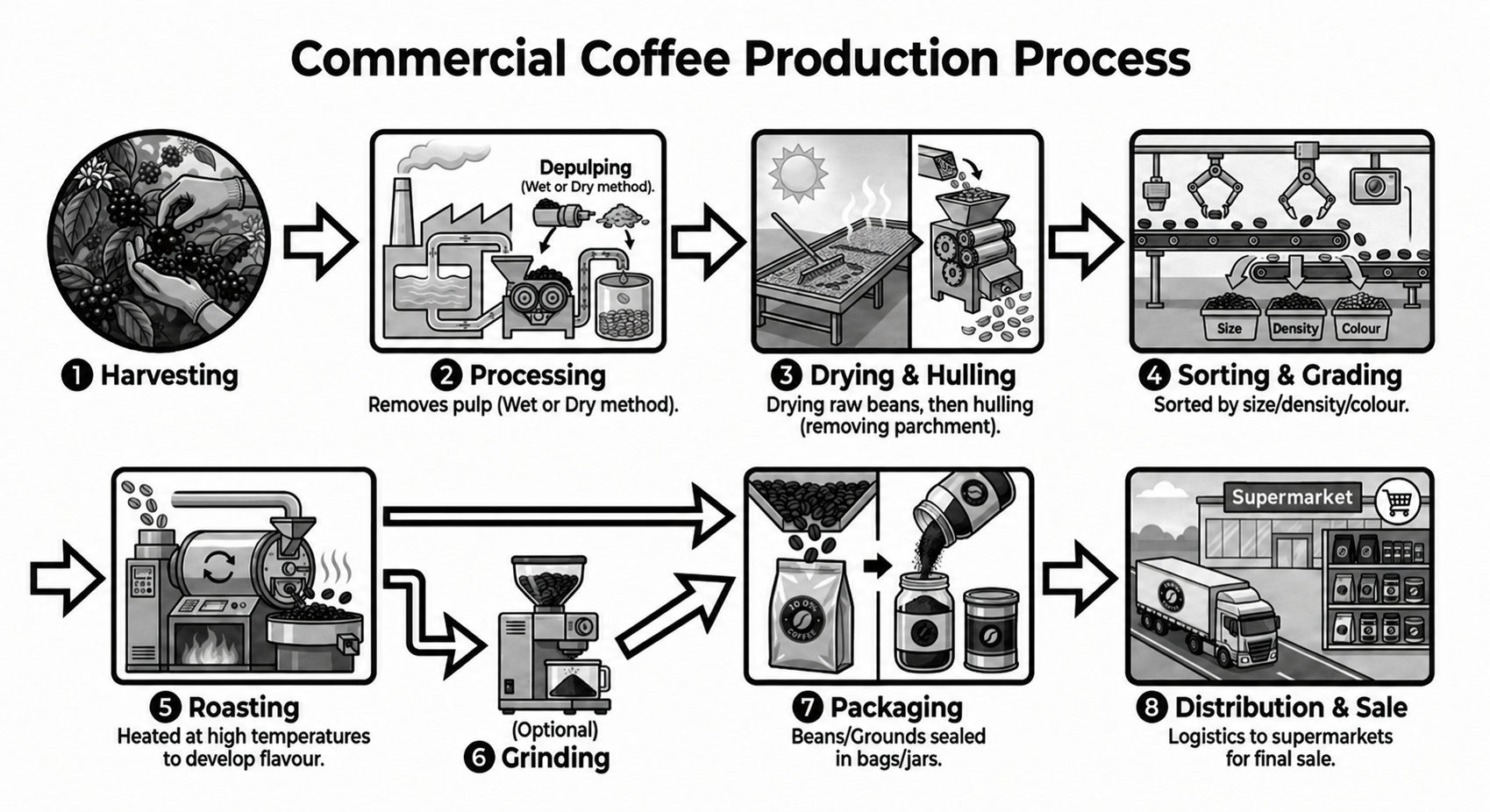
Academic Writing Task 1 Process Diagram practice image
BAND 9

Part 1 · Band 9 Sample Answer

The diagram outlines the eight stages through which coffee passes during commercial production, beginning with the harvesting of coffee cherries and culminating in retail sale.

Overall, the process is predominantly linear and can be divided into preparation, quality control, transformation and delivery. The fruit is stripped away and the beans are dried, hulled and graded before being roasted. Grinding is the only optional stage, meaning that the finished coffee can be packaged either as whole beans or in ground form prior to distribution.

Initially, ripe coffee cherries are picked from the plants. They then undergo processing by either a wet or dry method, both of which remove the surrounding pulp and release the raw beans. These beans are subsequently dried, shown spread across a raised surface under the sun, before entering hulling machinery that removes the parchment layer. Once hulled, the beans are sorted and assigned grades according to three criteria: size, density and colour.

The selected beans are next transferred to a roasting machine, where exposure to high temperatures develops their flavour. At this point, two routes are available. Coffee intended for sale as whole beans bypasses the grinder and proceeds directly to packaging, whereas the remainder is ground first. Both forms are then sealed in suitable bags or jars. In the final stage, the packaged products are loaded for transportation through the logistics system and delivered to supermarkets, where they are placed on shelves for sale to consumers.

BAND 8

Part 1 · Band 8 Sample Answer

The diagram shows how coffee is produced commercially in a process consisting of eight stages, from picking the crop to selling the finished product in supermarkets.

Overall, coffee beans must be extracted, dried, cleaned and graded before they are roasted and packed. Most stages follow a single sequence, although grinding is optional because producers can package coffee as either whole beans or grounds. Distribution to supermarkets completes the process.

First, coffee cherries are harvested from the plants. During the processing stage, their pulp is removed using either the wet method or the dry method. The raw beans are then dried and passed through a hulling machine, which removes the parchment covering them. After this, machinery sorts and grades the beans according to their size, density and colour. This ensures that they are classified before further production takes place.

Next, the graded coffee beans are heated to a high temperature in a roasting machine so that their flavour can develop. Once roasting has finished, some of the beans are sent straight to the packaging stage. If ground coffee is required, however, they first pass through a grinder. The whole beans and coffee grounds are then sealed in bags or jars, depending on the type of product being prepared. Finally, the packaged coffee is transported by the distribution system to supermarkets. It is then displayed there as the finished retail product and made available for customers to purchase.

BAND 7

Part 1 · Band 7 Sample Answer

The diagram illustrates the commercial production of coffee through eight main steps, starting with harvesting and ending with distribution and sale.

Overall, the coffee fruit is processed to obtain raw beans, which are then dried, hulled and sorted. After roasting, the coffee may be ground, although this stage is not required for products sold as whole beans. All products are packaged before they are delivered to supermarkets.

At the first stage, coffee cherries are picked from the plants. They are then processed by a wet or dry method to remove the pulp. Next, the raw beans are dried before a machine removes their parchment covering in the hulling stage. The beans then move to sorting and grading equipment. Here, they are separated into groups based on size, density and colour.

Following grading, the beans are roasted at high temperatures. This treatment is used to develop the flavour of the coffee. The roasted beans can then follow one of two paths. They may move directly to packaging if they are going to be sold whole, or they can be put through a grinder to produce ground coffee. At the packaging stage, the beans or grounds are sealed in bags and jars. Finally, these packaged coffee products are transported to supermarkets, where they are placed on sale for customers.

Academic Writing Task 2

Task 2 · Two-part Question

Task 2 Prompt

You should spend about 40 minutes on this task. Write at least 250 words.

Write about the following topic:

In many cities, there is a trend towards replacing parks and gardens with new housing or commercial buildings.

Why is this happening?

Is this a positive or negative development?

Give reasons for your answer and include any relevant examples from your own knowledge or experience.

BAND 9

Part 2 · Band 9 Sample Answer

The conversion of urban parks and gardens is driven not only by population pressure but also by the way cities value land. Housing and commercial premises generate visible financial returns, whereas the benefits of open space are less easily recorded on a balance sheet. Although selective development can serve the public interest, I regard the trend as negative because it removes essential assets as cities grow denser.

The most immediate cause is intense competition for well-located land. Growing urban populations require homes, while businesses seek offices, shops and warehouses near customers and transport links. Building on a green site may appear faster than assembling plots or cleaning contaminated industrial land, because roads and utilities already exist nearby. High property prices strengthen this pressure by making every undeveloped parcel look economically inefficient.

Institutional incentives also matter. A municipality may obtain revenue by selling land or approving projects that enlarge its tax base, while continuing to maintain a public park creates an annual expense. Private gardens are similarly vulnerable when owners can profit by selling them to developers. Furthermore, planning decisions often measure the number of homes or jobs created but assign no equivalent figure to shade, rainwater absorption, recreation or neighbourhood character. This imbalance makes development benefits immediate and measurable, while environmental losses appear distant.

There are admittedly circumstances in which conversion is defensible. New housing in an established district can reduce commuting and limit outward expansion into farmland or natural habitats. A neglected, inaccessible patch of ground may also serve residents better as homes combined with a smaller, well-designed public space. However, these exceptions do not justify routinely treating functioning parks as vacant land. Their trees reduce heat, their soil absorbs rainfall, and their open areas support exercise and social contact. These services are especially important for lower-income residents who lack private gardens or the means to travel elsewhere. Once mature vegetation has been replaced by concrete, recreating it may take decades or become impossible.

In my view, cities should therefore meet demand by redeveloping empty buildings, brownfield sites and surface car parks, while permitting suitable increases in building height and density. Green areas should be assessed as connected infrastructure rather than isolated parcels, since losing several small spaces can damage an entire neighbourhood even if one major park survives.

Overall, urban growth and financial incentives explain why parks and gardens are disappearing. Yet the short-term gain in floor space generally comes at the cost of environmental resilience, public health and equal access to recreation, making this trend predominantly harmful.

BAND 8

Part 2 · Band 8 Sample Answer

Parks and gardens are increasingly being developed for housing and business use in many urban areas. This is mainly caused by rising demand for land and the financial value of construction. While such projects may provide useful buildings, I believe the overall development is negative because green space performs essential social and environmental functions.

One major reason is continuing urban population growth. As more people move to cities, local authorities face pressure to increase the number of homes, schools, shops and workplaces. Green areas are often located in established neighbourhoods where roads, electricity and public transport are already available, so building there can be simpler than creating a new district outside the city. In addition, urban land is expensive. Developers can earn substantial returns from apartments or commercial property, and landowners may therefore prefer construction to maintaining a garden. Governments may also approve these schemes because they promise jobs, tax income and a quick response to housing shortages.

This change can have some benefits. More centrally located homes may reduce long journeys from distant suburbs, and commercial buildings can support employment and local services. If a green site is abandoned, unsafe or unavailable to the public, redesigning part of it could make the land more useful. However, these advantages depend on the quality and location of each project and should not be used to support widespread loss of parks.

In most cases, the negative effects are greater. Parks give residents free places to exercise, relax and meet other people, which is particularly important for families living in small flats. Trees provide shade during hot weather, offer habitats for wildlife and help the ground absorb heavy rain. Removing green areas while adding more residents places additional pressure on whatever open space remains. It can also increase inequality because wealthier households may have private gardens, whereas poorer communities rely more heavily on public parks. Unlike a building, mature woodland or a well-established garden cannot be replaced quickly.

Cities should instead convert unused industrial sites, empty offices and large car parks, as well as allow taller housing in appropriate locations. These approaches can meet demand without automatically sacrificing valuable public land.

In conclusion, population pressure, high land values and financial incentives are causing green areas to be developed. Although this may create homes and jobs, the long-term loss of environmental protection and public space makes it a largely negative trend.

BAND 7

Part 2 · Band 7 Sample Answer

In a growing number of cities, parks and gardens are being removed to make space for homes, offices and shops. This is happening because urban land is limited and highly valuable. In my opinion, the trend is mainly negative, even though new development can help meet some important needs.

The first reason for this change is the rising demand for housing. City populations often increase as people move there for education and work, but the amount of land does not grow. Governments and developers therefore search for sites where homes can be built quickly. Parks and gardens may seem like convenient choices because they are open areas within neighbourhoods that already have roads and public services. There is also a strong financial reason. Commercial buildings and apartment blocks can produce rent, sales income and taxes, while maintaining a park costs money. As a result, both private owners and local governments may prefer development.

There are certain positive effects. New homes can reduce a housing shortage, and offices or shops can create jobs and provide useful services. Building inside the city may also prevent people from moving to distant suburbs and travelling long distances each day. Therefore, developing a small area of unused green land may sometimes be reasonable.

However, replacing well-used parks and gardens usually causes greater harm. These places allow residents to walk, exercise, play and meet friends without spending money. They are especially important to people who live in apartments and have no private outdoor space. Trees and plants also cool the surrounding area, provide homes for animals and help absorb rainwater. If more buildings and people are added while green space is reduced, cities can become hotter, more crowded and less pleasant. The loss is also difficult to reverse because mature trees take many years to grow.

Instead of building on parks, authorities should first use abandoned factories, empty buildings and unused car parks. They can also allow more housing on suitable sites that are already developed.

To conclude, housing demand and the high financial value of land explain why urban green spaces are disappearing. Although the new buildings may be useful, losing places that support health, community life and the environment makes this development negative overall.

FREE PRACTICE RESOURCES

Download the IELTS Practice PDF Pack.

Get Listening, Reading, and Writing practice materials for self-study. Use a computer to download the 1.9GB pack.

Download PDF Pack
Chat History
My Notes