ACADEMIC WRITING SAMPLE ANSWERS

Academic Writing Sample Answers Practice 14 Test 01

This original practice page includes Task 1 (Dynamic Mixed Chart) and Task 2 (Agree or Disagree Essay), with Band 9, Band 8, and Band 7 sample answers for IELTS preparation.
Academic Writing Task 1

Task 1 · Dynamic Mixed Chart

Task 1 Prompt

You should spend about 20 minutes on this task. Write at least 150 words.

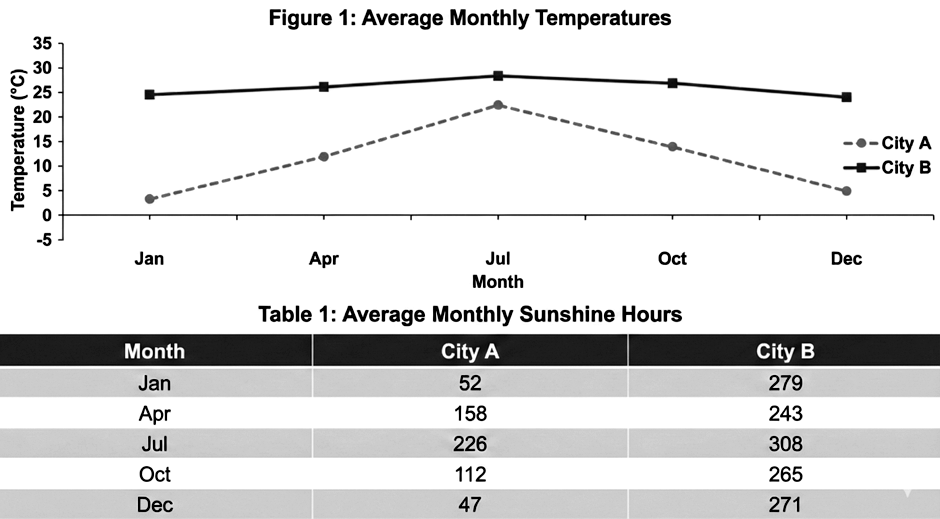
The line graph and table below show the average monthly temperatures and average monthly sunshine hours in two different cities, City A and City B, for five selected months of a year.

Summarise the information by selecting and reporting the main features, and make comparisons where relevant.
Academic Writing Task 1 Dynamic Mixed Chart practice image
BAND 9

Part 1 · Band 9 Sample Answer

The line graph compares average temperatures in City A and City B in five months, while the table gives their monthly sunshine totals.

Overall, City B is warmer and receives substantially more sunshine than City A throughout. Temperatures in both places peak in July before declining, although City A experiences far greater seasonal variation. Sunshine in City A likewise rises to a July maximum and then falls sharply, whereas City B’s total remains comparatively high.

In January, City A records only about 3°C, compared with approximately 24°C in City B. By July, both cities reach their warmest point, at roughly 22°C and 28°C respectively. City A then cools considerably to about 14°C in October and 5°C in December. City B follows a gentler downward trend, slipping from around 27°C to 24°C over the same two months. In April, the respective temperatures are approximately 12°C and 26°C.

A similar seasonal pattern is evident in City A’s sunshine totals, which climb from 52 hours in January to 158 in April and a peak of 226 in July. They subsequently drop to 112 hours in October and just 47 in December. City B, by contrast, receives between 243 and 308 hours in every month shown. Its lowest total occurs in April, while its July peak exceeds City A’s figure by 82 hours. Even in December, City B enjoys 271 hours of sunshine, almost six times City A’s total.

BAND 8

Part 1 · Band 8 Sample Answer

The graph illustrates average monthly temperatures in two cities during five selected months, and the table compares the amount of sunshine they receive.

Overall, City B is much warmer and sunnier than City A in every month presented. Both cities are hottest in July, but temperatures vary more markedly in City A. City A’s sunshine total also changes considerably, while City B records relatively high figures throughout.

City A begins at approximately 3°C in January. Its temperature then increases to about 12°C in April and reaches roughly 22°C in July. Afterwards, the figure falls to around 14°C in October and 5°C in December. By comparison, City B has a much narrower temperature range. It warms gradually from about 24°C in January to 26°C in April and 28°C in July, before decreasing slightly to 27°C in October and 24°C at the end of the year.

Regarding sunshine, City A receives 52 hours in January, but this total triples to 158 hours in April and then peaks at 226 in July. It subsequently drops to 112 hours in October and reaches its lowest point, 47 hours, in December. Totals in City B fall from 279 hours in January to 243 in April, climb to a maximum of 308 in July, and then decline to 265 in October before recovering to 271 in December. The gap between the cities is widest in December, at 224 hours, and narrowest in July, at 82 hours.

BAND 7

Part 1 · Band 7 Sample Answer

The line graph shows the average temperatures of City A and City B in five months, while the table provides information about their average sunshine hours.

Overall, City B is warmer than City A throughout, and it also has more sunshine in every month. July is the hottest month in both cities. However, City A shows much larger changes in both temperature and sunshine.

In City A, the average temperature is about 3°C in January. It rises to around 12°C in April and then reaches approximately 22°C in July. The figure falls afterwards, to about 14°C in October and 5°C in December. City B has higher but more stable temperatures. Its figure increases from roughly 24°C in January to 26°C in April and 28°C in July. It then drops slightly to around 27°C in October and returns to 24°C in December.

City A receives 52 hours of sunshine in January. This total rises to 158 hours in April and reaches its highest level of 226 hours in July. It then decreases sharply to 112 hours in October and only 47 hours in December. In contrast, City B records 279 sunshine hours in January. Although this falls to 243 in April, it rises to a peak of 308 in July. The figure then decreases to 265 hours in October before increasing slightly to 271 hours in December. Thus, the difference in sunshine is especially large at the end of the year.

Academic Writing Task 2

Task 2 · Agree or Disagree Essay

Task 2 Prompt

You should spend about 40 minutes on this task. Write at least 250 words.

Write about the following topic:

Many people use the internet as their main source of knowledge. Some argue that this is weakening our ability to think critically and remember information.

To what extent do you agree or disagree?

Give reasons for your answer and include any relevant examples from your own knowledge or experience.

BAND 9

Part 2 · Band 9 Sample Answer

The internet has become the default place to seek explanations, instructions and factual information. Although relying on it unreflectively can erode memory and independent judgement, I disagree that using it as a principal source of knowledge is inherently damaging. Its intellectual effects depend chiefly on how information is sought and processed.

There are legitimate reasons for concern. Search engines make retrieval almost effortless, so users may remember where information can be found rather than the information itself. This is harmless for a train timetable, but problematic when people fail to retain the foundational knowledge needed to assess a new claim. Critical thinking cannot operate in an informational vacuum: someone who knows little about economics, for example, may be unable to recognise a misleading graph even if every relevant definition is one search away. Moreover, online platforms reward speed and engagement. Short videos, prominent search snippets and personalised feeds can encourage people to accept a concise answer without examining its evidence, context or source. Repeatedly consuming material in this way may establish habits of intellectual passivity.

Nevertheless, the same medium can support more rigorous thought than many traditional sources. A printed textbook presents a limited selection of views, whereas an internet user can compare primary documents, expert explanations, raw data and opposing interpretations within minutes. This breadth makes verification easier, provided the user deliberately checks authorship, evidence and publication date. Digital tools can also improve memory rather than replace it. Learners can use spaced-repetition software, online quizzes and discussion forums to retrieve and apply knowledge repeatedly. For instance, a student who watches a scientific lecture, reads the cited paper and then explains the concept in an online study group is engaging far more actively than someone who merely memorises a textbook paragraph.

The crucial distinction, therefore, is not between internet knowledge and offline knowledge but between passive retrieval and active learning. Schools should teach source evaluation and require students to synthesise competing materials, while individuals should occasionally recall or explain ideas without consulting a screen. These practices preserve the mental framework into which new facts must fit.

In conclusion, heavy dependence on instant answers can weaken memory and critical judgement, so the concern is partly justified. However, I do not agree that the internet itself inevitably produces this outcome. Used purposefully, it expands the evidence available to us and can strengthen both analysis and long-term learning.

BAND 8

Part 2 · Band 8 Sample Answer

For a growing number of people, searching online has replaced books, teachers and other traditional sources of knowledge. I partly agree that this habit can reduce critical thinking and memory. However, I believe the main problem is passive internet use rather than the internet itself, which can also be a powerful learning resource.

One reason for the concern is that information is now available with almost no effort. When people know that they can search for a fact again within seconds, they have less motivation to remember it. This may gradually weaken their command of basic knowledge. Without such knowledge, it is difficult to judge whether a new statement is reasonable. In addition, internet users often read only headlines, short posts or the first answer shown by a search engine. They may share a claim before checking who produced it or what evidence supports it. Recommendation systems can make this worse by repeatedly showing users opinions similar to their own, reducing their exposure to serious disagreement.

On the other hand, the internet gives people access to a wider range of information than was previously possible. A reader considering an environmental issue can consult government data, scientific articles, news reports and criticism from different groups instead of depending on one book. Comparing these materials requires critical thought and can reveal bias or weak evidence. Online resources can also help people remember information. Educational videos, flashcard applications and practice tests allow learners to review difficult ideas frequently and in different forms. A language learner, for example, may encounter new vocabulary in an article, save it in an application and practise using it later. This is more active and memorable than simply looking up a translation once.

Whether internet use harms thinking therefore depends on users’ habits. Schools should teach students how to identify reliable authors, compare sources and explain conclusions in their own words. Individuals can also pause before searching, attempt to recall what they know, and take notes on important material. Such steps turn convenient access into genuine learning.

In conclusion, I agree that constant dependence on quick online answers can weaken memory and encourage shallow judgement. Nevertheless, the internet can improve both skills when people evaluate information carefully and actively practise what they learn. The risk comes mainly from uncritical use, not from making the internet a major source of knowledge.

BAND 7

Part 2 · Band 7 Sample Answer

Today, many people search the internet whenever they need information. Some believe that depending on it makes people less able to remember facts or think critically. I agree to some extent because careless use can produce these problems, but I also believe that the internet can improve learning when it is used responsibly.

Firstly, easy access to information may reduce the effort people make to remember it. A person can find a date, definition or set of instructions in seconds, so there seems to be little reason to learn it. If this becomes a habit, people may lack the basic knowledge they need in daily life or education. The internet can also encourage weak critical thinking. Many users accept the first search result they see or believe a popular social media post without checking its source. They may also receive similar opinions repeatedly because websites recommend content based on their previous choices. As a result, they can become less willing to question information or consider another point of view.

However, using the internet does not always lead to shallow thinking. It provides access to many sources, allowing users to compare different explanations and decide which is best supported. For example, a student researching climate change can read scientific material, government information and arguments from several commentators. Assessing the differences between these sources can develop critical skills. The internet also offers useful ways to strengthen memory. Online tests, digital flashcards and educational games require learners to recall information rather than simply read it. Recorded lessons can be replayed until a difficult idea is understood.

People can gain these benefits by changing how they use online information. Students should be taught to check the writer, publication date and evidence behind a claim. They should also summarise important ideas in their own words and review them later. Adults can follow the same approach instead of searching repeatedly for the same facts.

In conclusion, I partly agree that using the internet as a main knowledge source can weaken memory and critical thinking. This is likely when people depend on instant answers and never question them. Nevertheless, active study and careful comparison of sources can make the internet a valuable tool that strengthens, rather than reduces, these abilities.

FREE PRACTICE RESOURCES

Download the IELTS Practice PDF Pack.

Get Listening, Reading, and Writing practice materials for self-study. Use a computer to download the 1.9GB pack.

Download PDF Pack
Chat History
My Notes