ACADEMIC WRITING SAMPLE ANSWERS

Academic Writing Sample Answers Practice 14 Test 02

This original practice page includes Task 1 (Static Table) and Task 2 (Problems and Solutions Essay), with Band 9, Band 8, and Band 7 sample answers for IELTS preparation.
Academic Writing Task 1

Task 1 · Static Table

Task 1 Prompt

You should spend about 20 minutes on this task. Write at least 150 words.

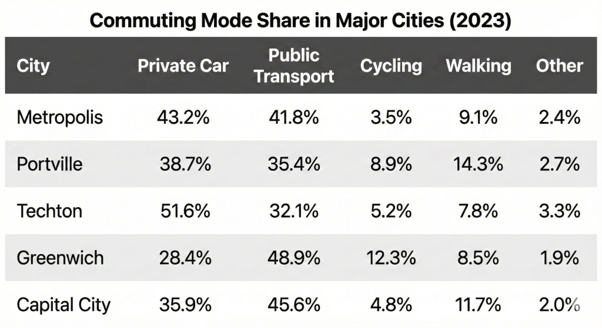
The table below presents data on the percentage of people using different modes of transport to commute to work in five major cities in 2023.

Summarise the information by selecting and reporting the main features, and make comparisons where relevant.
Academic Writing Task 1 Static Table practice image
BAND 9

Part 1 · Band 9 Sample Answer

The table compares the proportions of workers commuting by five different means of transport in five large cities in 2023.

Overall, private cars and public transport together accounted for the vast majority of journeys in every city. Cars were the leading mode in Metropolis, Portville and Techton, whereas public transport ranked first in Greenwich and Capital City. Other forms of transport had the smallest share throughout.

Techton was the most car-dependent city, with 51.6% of commuters driving, while its public transport figure was 32.1%. Metropolis showed a far more even division between these two modes, at 43.2% and 41.8% respectively. Cars also led in Portville, although the difference was relatively modest: 38.7% travelled by car compared with 35.4% using public transport. By contrast, Greenwich recorded the lowest proportion of motorists, at 28.4%, and the highest use of public transport, at 48.9%. Capital City followed a similar pattern, with respective shares of 35.9% and 45.6%.

Active travel was less common but varied noticeably. Greenwich had the highest cycling rate, at 12.3%, followed by Portville at 8.9%; Metropolis had the lowest, at 3.5%. Walking peaked in Portville at 14.3%, ahead of Capital City’s 11.7%, while Techton had the smallest share at 7.8%. Finally, the “other” category represented only 1.9% to 3.3% of commuters, with the minimum in Greenwich and the maximum in Techton.

BAND 8

Part 1 · Band 8 Sample Answer

The table shows the percentages of commuters who used five modes of transport in Metropolis, Portville, Techton, Greenwich and Capital City in 2023.

Overall, travelling by private car or public transport was much more common than cycling, walking or using other means. Private cars were the most popular choice in three cities, while public transport had the largest share in Greenwich and Capital City. The “other” category was the least used option in all five locations.

Private car use was highest in Techton, where it accounted for 51.6% of commuters. The figures were lower in Metropolis and Portville, at 43.2% and 38.7% respectively, although cars still ranked first in both cities. Greenwich had the lowest car share, at 28.4%, compared with 35.9% in Capital City. Public transport displayed a different pattern. Its largest proportion was recorded in Greenwich at 48.9%, followed by Capital City at 45.6% and Metropolis at 41.8%. Portville and Techton had smaller shares of 35.4% and 32.1%.

Cycling was most popular in Greenwich, at 12.3%, but represented only 3.5% of journeys in Metropolis. The corresponding figures in Portville, Techton and Capital City were 8.9%, 5.2% and 4.8%. Walking reached a high of 14.3% in Portville, whereas Techton recorded the lowest level, at 7.8%. Metropolis, Greenwich and Capital City stood at 9.1%, 8.5% and 11.7%. Use of other modes remained very limited, ranging from 1.9% in Greenwich to 3.3% in Techton.

BAND 7

Part 1 · Band 7 Sample Answer

The table provides information about how people travelled to work in five major cities in 2023. The figures are given as percentages for five different types of transport.

Overall, cars and public transport were the two main commuting methods in every city. Cars were the most widely used option in Metropolis, Portville and Techton, while public transport was more popular in Greenwich and Capital City. Other transport had the lowest percentage in each city.

Techton had the highest proportion of people commuting by car, at 51.6%. This was followed by Metropolis at 43.2% and Portville at 38.7%. The car figures for Capital City and Greenwich were lower, at 35.9% and 28.4%. In contrast, Greenwich had the largest public transport share, at 48.9%. Capital City ranked second at 45.6%, followed by Metropolis with 41.8%. Public transport was used by 35.4% of commuters in Portville and 32.1% in Techton.

The smaller categories showed different patterns. Cycling was highest in Greenwich at 12.3%, while Metropolis had the lowest figure of 3.5%. Portville also had a fairly high cycling share, at 8.9%. Walking was most common in Portville, where it represented 14.3% of commuters, followed by Capital City at 11.7%. The other three cities recorded walking figures below 10%. Finally, other forms of transport accounted for very small shares, from 1.9% in Greenwich to 3.3% in Techton.

Academic Writing Task 2

Task 2 · Problems and Solutions Essay

Task 2 Prompt

You should spend about 40 minutes on this task. Write at least 250 words.

Write about the following topic:

Traffic congestion is a major problem in many cities around the world.

Why is this happening?

What measures can be taken to address this problem?

Give reasons for your answer and include any relevant examples from your own knowledge or experience.

BAND 9

Part 2 · Band 9 Sample Answer

Severe traffic congestion has become a routine feature of urban life across much of the world. It arises principally because the demand for road space has grown far faster than its supply, reinforced by planning and economic incentives that favour private vehicles. Addressing it therefore requires both attractive alternatives to driving and policies that manage road demand.

One major cause is the combination of urban population growth and rising car ownership. Roads in established city centres cannot easily be widened, yet more residents and commuters attempt to use them each year. Car-dependent development intensifies this pressure: when housing, employment and essential services are widely separated, driving may be the only practical choice. In many cities, public transport is too slow, unreliable or poorly connected to compete. Travel is also concentrated into narrow periods because schools and workplaces begin and finish at similar times. Cheap parking and roads that are free at the point of use further encourage motorists to drive even when their journeys impose delays on everyone else. Simply adding lanes rarely provides a lasting solution, since initially faster roads tend to attract additional trips.

Cities should first make alternatives genuinely convenient. Frequent buses and rail services need integrated fares, safe interchanges and routes that connect residential districts with major employment areas. Dedicated bus lanes are particularly valuable because they move more people through limited street space and prevent buses from being trapped in the congestion they are intended to reduce. Safe walking and cycling networks can replace shorter car journeys, while mixed-use planning can reduce the distance between homes, shops and workplaces over time.

Demand-management measures are also necessary. Congestion charges, higher central parking fees and workplace parking levies can discourage low-priority trips at peak times. Revenue from these policies should be invested in public transport, with discounts for low-income travellers and exemptions for essential users to avoid unfairness. Employers can contribute by allowing remote work, flexible starting times and staff travel programmes. Freight deliveries can similarly be scheduled outside the busiest hours.

In conclusion, congestion results not merely from too few roads but from urban layouts, weak alternatives and incentives that make simultaneous car travel the default. A durable response must combine better public and active transport with fair pricing, more compact development and flexible travel schedules. No single measure will eliminate delays, but this coordinated approach can reduce both the number and concentration of vehicles on city streets.

BAND 8

Part 2 · Band 8 Sample Answer

Traffic congestion affects cities of almost every size and causes wasted time, air pollution and unreliable journeys. The problem is mainly driven by increasing car use, poor urban planning and inadequate alternatives. It can be reduced through a combination of better public transport, controls on unnecessary driving and changes to how cities are developed.

The first cause is rapid growth in urban populations and private car ownership. As incomes rise, many households purchase vehicles, but the amount of road space in crowded city centres changes very little. Large numbers of people also travel at the same time because most schools and offices follow similar schedules. Another cause is suburban expansion. Affordable homes are often built far from workplaces and services, leaving residents with long daily journeys. If buses are infrequent, trains are overcrowded or different services do not connect properly, commuters naturally choose cars. Free or inexpensive parking can make this choice even more attractive.

An effective response should begin with reliable and affordable public transport. Cities could increase service frequency, introduce simple integrated ticketing and create dedicated bus lanes so that public vehicles remain faster than cars during busy periods. Safe cycle routes and wider pavements would also allow more people to avoid driving for short trips. These improvements need to cover outer residential areas, not only central districts, because many congested journeys begin in the suburbs.

Governments should also manage demand for limited road space. Charging vehicles to enter the busiest districts at peak times and increasing parking fees would encourage some commuters to change their route, time or mode of travel. The money raised should fund public transport so that drivers have a realistic alternative. Meanwhile, employers could offer flexible hours or remote work, spreading journeys across the day. In the longer term, planning authorities should permit more housing near employment centres and require new neighbourhoods to include shops, schools and transport links.

In conclusion, congestion occurs when growing numbers of vehicles compete for limited roads, particularly at peak times, and when city design leaves commuters with few alternatives. Expanding reliable transport, supporting walking and cycling, charging appropriately for scarce road space and building more connected communities would tackle these causes together. Road construction alone is unlikely to provide a permanent answer because additional capacity can quickly fill with new traffic.

BAND 7

Part 2 · Band 7 Sample Answer

Traffic congestion is a serious issue in many cities, making journeys slower and increasing pollution. This situation is caused by a growing number of private vehicles, limited public transport and the way modern cities are organised. Several practical measures can reduce the problem.

One important cause is population growth. As more people move to cities, more workers and students need to travel each day. At the same time, car ownership is increasing because many people find driving more comfortable and convenient than taking a bus. However, city roads often cannot be expanded, especially in old or densely built areas. Congestion becomes particularly severe during the morning and evening because schools and businesses have similar opening hours.

Poor public transport is another reason. If buses are late, trains are crowded or services do not reach outer neighbourhoods, residents may have no realistic choice except to drive. Furthermore, many people live far from their workplaces because housing has spread into suburbs. This creates longer journeys and puts even more cars on major roads.

To address these problems, local governments should improve public transport. Buses and trains need to be frequent, affordable and connected to each other. Dedicated bus lanes can make services faster during busy periods, giving drivers a reason to leave their cars at home. Cities should also build safe cycle paths and pavements so that short journeys can be made without a vehicle.

It may also be necessary to discourage unnecessary driving. Higher parking charges in city centres or a fee for entering the busiest areas could reduce the number of cars. The money collected could be used to improve transport services. Employers can allow staff to begin work at different times or work from home on certain days, which would reduce pressure during peak hours. Finally, future housing should be built near public transport, shops and workplaces to shorten daily journeys.

In conclusion, urban congestion is mainly the result of rising car use, poor transport choices and long journeys between homes and workplaces. Better buses and trains, safer active travel, reasonable charges on driving and more careful urban planning can all help. These measures will be most effective when introduced together rather than separately.

FREE PRACTICE RESOURCES

Download the IELTS Practice PDF Pack.

Get Listening, Reading, and Writing practice materials for self-study. Use a computer to download the 1.9GB pack.

Download PDF Pack
Chat History
My Notes