ACADEMIC WRITING SAMPLE ANSWERS

Academic Writing Sample Answers Practice 14 Test 03

This original practice page includes Task 1 (Static Mixed Chart) and Task 2 (Agree or Disagree Essay), with Band 9, Band 8, and Band 7 sample answers for IELTS preparation.
Academic Writing Task 1

Task 1 · Static Mixed Chart

Task 1 Prompt

You should spend about 20 minutes on this task. Write at least 150 words.

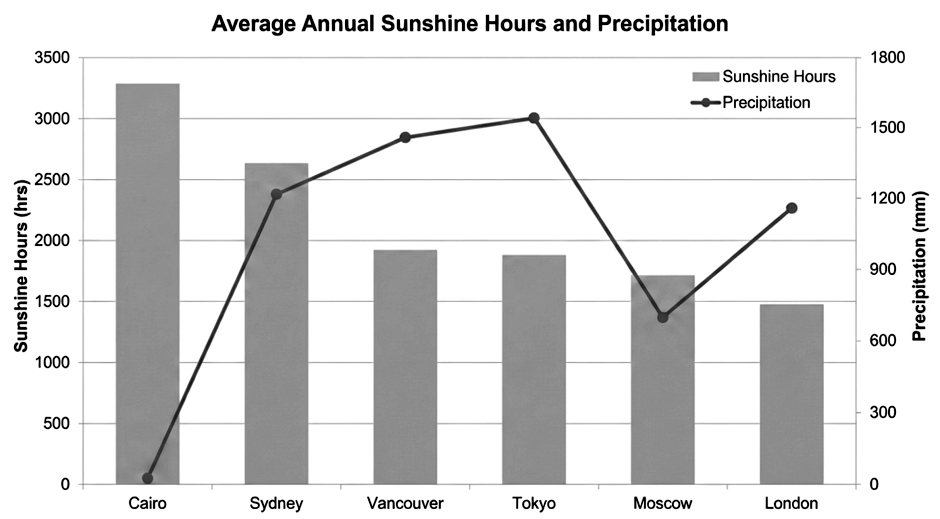
The bar chart and line graph below show the average annual hours of sunshine and the average annual precipitation in six selected cities around the world.

Summarise the information by selecting and reporting the main features, and make comparisons where relevant.
Academic Writing Task 1 Static Mixed Chart practice image
BAND 9

Part 1 · Band 9 Sample Answer

The bar chart compares average yearly sunshine totals in six international cities, while the line graph presents their average annual precipitation.

Overall, Cairo was by far the sunniest and driest location, whereas London received the least sunshine. Tokyo recorded the greatest precipitation, closely followed by Vancouver. Although the less sunny cities generally had higher rainfall than Cairo, there was no consistent inverse relationship between the two measures, as illustrated particularly by Moscow.

Cairo enjoyed approximately 3,300 hours of sunshine annually, around 700 more than Sydney, the second-ranked city at roughly 2,600 hours. The remaining four locations all received fewer than 2,000 hours. Vancouver and Tokyo were similar, at about 1,900 hours each, although the former was marginally sunnier. Moscow registered approximately 1,700 hours, while London had the lowest total, at just under 1,500.

The precipitation figures followed a markedly different ranking. Cairo received almost no rain, with an annual total of only around 25 millimetres. This contrasted sharply with Sydney, whose figure was approximately 1,200 mm. Precipitation then rose to about 1,450 mm in Vancouver and peaked at roughly 1,550 mm in Tokyo, despite these two cities having nearly identical sunshine totals. Moscow interrupted this upward pattern: although it had the second-lowest amount of sunshine, its precipitation was only around 700 mm. Finally, London recorded approximately 1,150 mm, substantially more than Moscow but slightly less than Sydney.

BAND 8

Part 1 · Band 8 Sample Answer

The charts provide information about the average number of sunshine hours and the average amount of precipitation recorded annually in six cities worldwide.

Overall, Cairo had considerably more sunshine than any other city and almost no precipitation. At the other extreme, London recorded the fewest sunshine hours, while Tokyo was the wettest location. The ranking for precipitation did not simply reverse the ranking for sunshine, since Moscow was relatively dry despite receiving little sun.

Annual sunshine in Cairo stood at around 3,300 hours. Sydney ranked second with approximately 2,600 hours, about 700 fewer than Cairo. There was then a sizeable fall to Vancouver and Tokyo, which both received close to 1,900 hours, with Vancouver’s figure being slightly higher. Moscow had roughly 1,700 hours of sunshine, and London recorded the lowest total at about 1,500 hours.

Regarding precipitation, Cairo’s annual figure was negligible, at only around 25 mm. Sydney received approximately 1,200 mm, while the totals for Vancouver and Tokyo were higher, at roughly 1,450 mm and 1,550 mm respectively. Tokyo therefore had the greatest precipitation among the six cities. The figure then fell sharply to about 700 mm in Moscow before rising again to approximately 1,150 mm in London. Thus, London received about 450 mm more precipitation than Moscow even though it had around 200 fewer hours of sunshine. Vancouver and Tokyo, meanwhile, were very similar in sunshine but differed by roughly 100 mm in precipitation.

BAND 7

Part 1 · Band 7 Sample Answer

The bar chart shows the average annual hours of sunshine in six cities, and the line graph compares their average yearly precipitation in millimetres.

Overall, Cairo was the sunniest city and had by far the lowest level of precipitation. London received the least sunshine, whereas Tokyo recorded the highest amount of precipitation. In general, most cities with fewer sunshine hours had much more precipitation than Cairo, although Moscow was an exception.

Cairo had approximately 3,300 hours of sunshine per year, making it clearly higher than Sydney at around 2,600 hours. Vancouver and Tokyo each received close to 1,900 hours, with the figure for Vancouver being slightly greater. Sunshine was lower in Moscow, at roughly 1,700 hours, and London had the smallest total of about 1,500 hours.

There were large differences in precipitation. Cairo recorded almost none, at only around 25 mm annually. By comparison, the figure for Sydney was approximately 1,200 mm. Precipitation was even higher in Vancouver, at about 1,450 mm, and reached its highest point of roughly 1,550 mm in Tokyo. However, Moscow received only around 700 mm despite having relatively few hours of sunshine. Finally, London’s annual precipitation stood at approximately 1,150 mm. This was lower than the totals for Sydney, Vancouver and Tokyo but considerably higher than those for Cairo and Moscow.

Academic Writing Task 2

Task 2 · Agree or Disagree Essay

Task 2 Prompt

You should spend about 40 minutes on this task. Write at least 250 words.

Write about the following topic:

Some people believe that installing surveillance cameras in public areas is the most effective way to create a safe and secure living environment.

To what extent do you agree or disagree?

Give reasons for your answer and include any relevant examples from your own knowledge or experience.

BAND 9

Part 2 · Band 9 Sample Answer

Surveillance cameras have become a familiar feature of streets, transport hubs and shopping districts. They can deter certain offences and provide valuable evidence, but I disagree that installing them is the most effective means of creating a secure living environment. Safety depends more fundamentally on capable institutions, thoughtful urban design and the prevention of crime before it occurs.

Cameras offer several clear benefits. Visible monitoring may discourage opportunistic acts such as vandalism, theft or assaults in well-defined locations. When an incident does occur, recorded images can help establish its sequence, identify suspects and protect innocent people from false accusations. Live systems can also alert trained staff to an emergency, allowing police or medical assistance to arrive sooner. In a busy railway station, for example, cameras monitored by responsible personnel may reveal an abandoned bag or a person in distress that would otherwise go unnoticed.

However, these advantages are narrower than they first appear. A camera usually records an offence rather than preventing the motives or circumstances behind it. Determined offenders may conceal their identity, exploit blind spots or move to an unmonitored street, displacing danger instead of reducing it. Equipment that is poorly maintained or footage that nobody reviews promptly offers little immediate protection. Extensive monitoring also creates privacy and governance risks. Without strict limits on access, retention and facial recognition, systems designed for public safety can be misused to track lawful behaviour or particular communities. A neighbourhood in which residents feel constantly watched is not necessarily one in which they feel secure.

More effective policy should therefore combine targeted surveillance with measures that address both opportunities for crime and its underlying causes. Well-lit streets, active public spaces, reliable late-night transport and buildings designed with clear sightlines provide natural protection without recording everyone. Community-based policing can build trust, encourage residents to report concerns and supply local knowledge that technology lacks. Fast emergency services, support for vulnerable young people, mental-health care and programmes that reduce repeat offending can prevent harm more directly. Cameras may strengthen these arrangements at genuinely high-risk sites, but they require independent oversight, clear signage and regular evaluation.

In conclusion, surveillance cameras are a useful component of public safety, especially for investigation and rapid detection. Nevertheless, I disagree that they are the most effective solution. A genuinely secure environment is produced by prevention, trusted public services and well-designed shared spaces, with proportionate surveillance serving as support rather than the foundation.

BAND 8

Part 2 · Band 8 Sample Answer

Many towns and cities use surveillance cameras in streets, parks and transport facilities to improve public safety. I partly agree that cameras can make these places more secure, but I do not consider them the most effective measure on their own. They work best as one part of a wider strategy involving policing, environmental design and crime prevention.

Cameras can discourage some people from committing offences because they know that their actions may be recorded. This is particularly useful in locations where theft, vandalism or violence is likely to occur. Footage can also help the police identify an offender, confirm witness accounts and understand exactly what happened. If cameras are watched in real time, staff may notice a fight or other emergency and request assistance quickly. These benefits can reassure members of the public and make investigations more efficient.

Nevertheless, surveillance has important limitations. Cameras cannot physically stop an offence, and experienced criminals may cover their faces or choose nearby places without monitoring. Crime may therefore be moved rather than prevented. The systems are also ineffective when the image quality is poor, equipment is broken or nobody examines the footage. In addition, recording people continuously raises privacy concerns. Authorities must prevent footage from being accessed without a valid reason or kept indefinitely. Otherwise, a policy intended to increase security may reduce public trust.

Several other measures can provide more direct protection. Local governments should improve street lighting, remove hidden areas and ensure that public transport remains available at night. Police officers who regularly communicate with residents can learn about local problems and respond before they become serious. Schools, youth services and programmes for former offenders can also address some of the reasons why crime develops. Meanwhile, rapid emergency responses can limit harm when an incident occurs. Cameras should be installed mainly in higher-risk locations and supported by clear rules, trained operators and regular reviews of whether they are useful.

In conclusion, surveillance cameras can deter opportunistic crime, supply evidence and support faster responses. However, I disagree that simply installing them is the most effective way to create a safe living environment. Lasting security requires a balanced approach that combines carefully controlled surveillance with trusted policing, safer public spaces and measures that prevent offending.

BAND 7

Part 2 · Band 7 Sample Answer

Surveillance cameras are now common in many public places. Some people believe that they are the best way to provide a safe and secure environment. I agree that cameras are useful, but I disagree that they are the most effective solution because they cannot prevent every crime and may create privacy problems.

There are several reasons why cameras can improve safety. People may decide not to steal, damage property or behave violently if they know they are being recorded. If a crime takes place, the police can use the video to identify the offender and check what happened. Cameras can also be monitored by security workers. For example, if they see a fight at a station, they can contact the police immediately. In this way, cameras can support both crime prevention and investigation.

However, cameras have clear weaknesses. They cannot physically stop someone from committing an offence. Criminals may hide their faces, choose an area without cameras or damage the equipment. This means that crime can move from one street to another instead of disappearing. Cameras are also less useful if nobody is watching them or if the recordings are unclear. Furthermore, the public may worry about being recorded everywhere. Footage could be viewed by the wrong people or used for purposes unrelated to safety unless strong rules are followed.

Other measures are needed to make communities genuinely secure. Better street lighting and open public spaces can reduce places where offenders can hide. More police officers in local communities can respond to problems and build relationships with residents. Governments should also support young people, improve education and help former offenders find work, as these actions may prevent crime in the longer term. Emergency services must be able to respond quickly when serious incidents occur.

In conclusion, surveillance cameras can discourage some offences and provide useful evidence, so they have an important role in public safety. Nevertheless, I do not believe they are the most effective method by themselves. Cameras should be used in suitable locations alongside good policing, safer street design, clear privacy protections and social programmes that address the causes of crime.

FREE PRACTICE RESOURCES

Download the IELTS Practice PDF Pack.

Get Listening, Reading, and Writing practice materials for self-study. Use a computer to download the 1.9GB pack.

Download PDF Pack
Chat History
My Notes