ACADEMIC WRITING SAMPLE ANSWERS

Academic Writing Sample Answers Practice 14 Test 04

This original practice page includes Task 1 (Dynamic Table) and Task 2 (Discuss Both Views and Give Your Opinion), with Band 9, Band 8, and Band 7 sample answers for IELTS preparation.
Academic Writing Task 1

Task 1 · Dynamic Table

Task 1 Prompt

You should spend about 20 minutes on this task. Write at least 150 words.

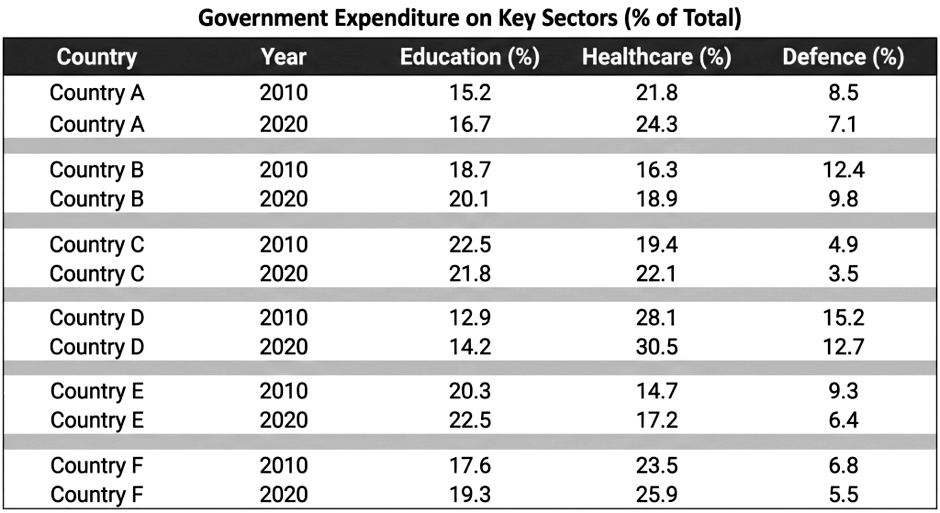
The table below shows the changes in the proportion of government expenditure on three key sectors across six countries from 2010 to 2020.

Summarise the information by selecting and reporting the main features, and make comparisons where relevant.
Academic Writing Task 1 Dynamic Table practice image
BAND 9

Part 1 · Band 9 Sample Answer

The table compares the percentages of government spending allocated to education, healthcare and defence in six countries in 2010 and 2020.

Overall, expenditure shifted away from defence over the decade: its share fell in every country, while healthcare rose universally. Education also gained a larger proportion in all cases except Country C. Healthcare remained the largest sector in Countries A, D and F, whereas education generally led in B, C and E.

Country D consistently devoted the highest share to healthcare, increasing it from 28.1% to 30.5%. Countries A and F followed, rising from 21.8% to 24.3% and from 23.5% to 25.9% respectively. Elsewhere, healthcare grew from 16.3% to 18.9% in B, from 19.4% to 22.1% in C, and from 14.7% to 17.2% in E. Increases across this sector were notably similar, ranging from 2.4 to 2.7 percentage points.

Education showed more varied movement. Country C had the highest share in 2010, at 22.5%, but this slipped to 21.8%, allowing healthcare to become marginally larger there by 2020. Country E, by contrast, recorded the strongest rise, from 20.3% to a table-high 22.5% in 2020. Education also increased moderately in A, B, D and F, reaching 16.7%, 20.1%, 14.2% and 19.3% respectively.

Defence was the smallest category throughout. Country D spent the most on it in both years, despite a decline from 15.2% to 12.7%, while Country C recorded the lowest figures, falling from 4.9% to 3.5%. The steepest reduction occurred in Country E, at 2.9 percentage points.

BAND 8

Part 1 · Band 8 Sample Answer

The table presents the proportions of government expenditure assigned to education, healthcare and defence in six countries in 2010 and 2020.

Overall, all six governments increased the share spent on healthcare and reduced the proportion for defence. Education spending also rose in five countries, with Country C being the only exception. Healthcare received the largest allocation in Countries A, D and F, while education generally ranked first in B, C and E.

Healthcare expenditure increased by similar amounts across the countries. Country D had the highest figures, rising from 28.1% to 30.5%. Countries F and A followed, with their shares growing from 23.5% to 25.9% and from 21.8% to 24.3%. Country C recorded an increase from 19.4% to 22.1%, while B and E reached 18.9% and 17.2% respectively in 2020.

For education, Country C began with the largest allocation of 22.5%, but this declined slightly to 21.8%. Country E moved in the opposite direction, increasing from 20.3% to 22.5%, the highest level in 2020. The other four countries experienced rises of between 1.3 and 1.7 percentage points. Nevertheless, Country D continued to spend the smallest proportion on education, at 14.2% in 2020.

Defence accounted for the lowest share in every country. The largest allocation was in Country D, although it fell from 15.2% to 12.7%. Country B also dropped from 12.4% to 9.8%, while Country C reduced its already low share from 4.9% to 3.5%. The greatest fall was seen in Country E, from 9.3% to 6.4%.

BAND 7

Part 1 · Band 7 Sample Answer

The table shows how much of total government expenditure was spent on education, healthcare and defence in six countries in 2010 and 2020.

Overall, the percentage for healthcare increased in every country, while defence spending fell everywhere. Education also rose in all countries apart from Country C. Healthcare was the biggest category in Countries A, D and F, whereas education received the largest share in B and E. In Country C, education was highest in 2010, but healthcare became slightly higher by 2020.

Country D spent the largest proportion on healthcare in both years, with an increase from 28.1% to 30.5%. Healthcare also rose from 23.5% to 25.9% in Country F and from 21.8% to 24.3% in Country A. The figures for Countries B, C and E reached 18.9%, 22.1% and 17.2% respectively in 2020.

In education, Country C recorded the highest figure in 2010 at 22.5%, although this fell to 21.8% ten years later. Country E showed the greatest increase, from 20.3% to 22.5%. The proportions also grew in Countries A, B, D and F, reaching 16.7%, 20.1%, 14.2% and 19.3%. Country D had the lowest education spending in both years.

Defence was the smallest sector in all six countries. Country D had the highest defence share, but this decreased from 15.2% to 12.7%. Country B’s figure also fell, from 12.4% to 9.8%. Country C spent the least on this sector, at 4.9% in 2010 and 3.5% in 2020. Country E experienced the largest drop, of 2.9 percentage points.

Academic Writing Task 2

Task 2 · Discuss Both Views and Give Your Opinion

Task 2 Prompt

You should spend about 40 minutes on this task. Write at least 250 words.

Write about the following topic:

The development of artificial intelligence (AI) is progressing rapidly. Some people worry that AI will eventually replace human workers in many industries, leading to widespread unemployment. Others believe that AI will create new types of jobs and enhance human capabilities.

Discuss both views and give your own opinion.

Give reasons for your answer and include any relevant examples from your own knowledge or experience.

BAND 9

Part 2 · Band 9 Sample Answer

Rapid advances in artificial intelligence have revived a longstanding fear that machines will make human labour unnecessary. That concern is credible for particular occupations and during the transition to an AI-intensive economy. Nevertheless, I believe permanent mass unemployment is unlikely: AI will more often reorganise work around a new division of tasks, although public policy will determine whether the benefits are widely shared.

Those predicting extensive job losses have strong grounds for anxiety. Unlike earlier industrial machines, modern AI can perform cognitive tasks once considered protected from automation, including drafting routine documents, translating text and producing basic computer code. A single system can be deployed widely, encouraging employers to reduce staffing in administration, customer support and other information-heavy functions. Even where an occupation survives, fewer junior employees may be required. This is troubling because entry-level work enables people to gain the judgement needed for senior roles. Furthermore, new opportunities may demand different skills or arise in different locations, so a displaced clerk cannot instantly become an AI engineer. Significant structural unemployment could therefore persist during adjustment.

The opposing view is also persuasive. Technologies usually automate components of jobs rather than every responsibility within them. AI may analyse medical images, for example, but clinicians must still interpret results in context, communicate uncertainty and remain accountable for treatment. By removing repetitive tasks, such tools can allow teachers, designers, engineers and small-business owners to devote more time to interpersonal, strategic and creative work. Entirely new roles are also likely to emerge in system evaluation, safety, workflow design, specialised data management and regulatory compliance. Productivity gains may lower the cost of existing services and make previously unaffordable ones viable, generating demand that is difficult to predict in advance.

In my view, the decisive issue is not whether AI creates more tasks than it destroys in the abstract, but whether workers can move between them. Governments and employers should fund practical retraining linked to actual vacancies rather than generic technology courses. Schools should combine digital competence with reasoning, communication and domain knowledge, which remain valuable when tools change. Income support, career guidance and portable benefits can protect workers during transitions, while competition policy can prevent the gains from being captured by a few dominant firms.

In conclusion, AI will undoubtedly displace some workers and could cause serious unemployment in exposed sectors. However, it will also create occupations and amplify distinctly human capabilities. I therefore expect transformation rather than the disappearance of work, provided institutions actively help people acquire new skills and distribute productivity gains fairly.

BAND 8

Part 2 · Band 8 Sample Answer

Artificial intelligence is developing quickly and can now complete tasks that previously required trained employees. Some people therefore expect major job losses, while others argue that the technology will generate new work and make people more productive. In my opinion, AI will cause painful disruption in some industries, but it is more likely to transform employment than eliminate it on a widespread and permanent basis.

The risk of replacement is real because AI can process information rapidly and operate at relatively low cost. Businesses may use it to answer routine customer questions, prepare standard reports, review simple applications or produce basic written material. If one system allows a smaller team to handle the same workload, companies may reduce recruitment or dismiss existing staff. Workers in administrative and repetitive digital roles appear particularly exposed. Moreover, people who lose these positions may not possess the technical or professional skills needed for newly created jobs. Even if employment eventually recovers, certain regions and groups could experience unemployment for years.

However, AI can also complement workers rather than replace them. Doctors can use it to identify patterns in medical information, while retaining responsibility for diagnosis and communication with patients. Teachers may generate practice materials more quickly and spend additional time supporting individual learners. In these cases, the tool increases human productivity without removing the need for judgement, empathy and accountability. AI development will also create jobs in areas such as system testing, cybersecurity, maintenance, training and legal oversight. As businesses become more efficient, they may expand existing services or develop entirely new ones, creating work that is not currently easy to imagine.

I believe the final outcome will depend greatly on how governments, educational institutions and employers respond. Training should be affordable, practical and connected to real labour-market needs. Employees also need opportunities to learn while they are still working, rather than receiving help only after redundancy. Temporary income support can give displaced people time to retrain. Meanwhile, schools should teach students how to use AI critically alongside communication, problem-solving and subject knowledge.

In conclusion, fears of job losses are justified because AI will automate many routine tasks and some complete roles. Nevertheless, the technology can also enhance human performance and produce new occupations. With effective retraining and worker protection, AI is more likely to change the nature of employment than to create permanent mass unemployment.

BAND 7

Part 2 · Band 7 Sample Answer

The rapid growth of artificial intelligence has created disagreement about its effect on employment. Some people fear that machines will replace workers in many sectors and cause widespread unemployment. Others think that AI will create different jobs and help people work more effectively. I believe that both effects will occur, but AI is more likely to change most jobs than remove the need for human workers completely.

There are clear reasons to worry about job losses. AI systems can perform many routine tasks quickly and do not need breaks or salaries. For example, they can answer common customer questions, organise information, check standard documents and produce simple content. Companies may therefore employ fewer people in call centres, offices and other workplaces where tasks are repetitive. This change could happen faster than workers can retrain. An employee who has spent many years in an administrative role may find it difficult to move immediately into a technical job, leading to a period of unemployment.

On the other hand, new technology often creates opportunities as well as removing old ones. AI systems need people to develop, test, maintain and monitor them. New roles may also appear in online safety, data protection and the regulation of automated decisions. In addition, many occupations require human qualities that AI cannot fully provide. A teacher must understand the needs and emotions of students, while a nurse needs to communicate with patients and respond to unexpected situations. AI can help these professionals by completing paperwork or finding useful information, allowing them to focus on more important duties.

In my view, governments and businesses must prepare workers for this transition. Colleges should offer flexible courses in useful digital and professional skills. Employers should train existing staff to work with AI instead of replacing them whenever possible. People who do lose their jobs need financial support and clear advice about available careers. Schools should also develop communication, creativity and critical thinking because these abilities remain valuable in many types of work.

In conclusion, AI will replace certain jobs, especially those involving predictable tasks, and this may cause serious short-term unemployment. However, it will also create new roles and improve the abilities of human workers. If societies invest in training and protect people during career changes, the overall result can be positive rather than a future without work.

FREE PRACTICE RESOURCES

Download the IELTS Practice PDF Pack.

Get Listening, Reading, and Writing practice materials for self-study. Use a computer to download the 1.9GB pack.

Download PDF Pack
Chat History
My Notes