ACADEMIC WRITING SAMPLE ANSWERS

Academic Writing Sample Answers Practice 12 Test 04

This original practice page includes Task 1 (Dynamic Mixed Chart) and Task 2 (Agree or Disagree Essay), with Band 9, Band 8, and Band 7 sample answers for IELTS preparation.
Academic Writing Task 1

Task 1 · Dynamic Mixed Chart

Task 1 Prompt

You should spend about 20 minutes on this task. Write at least 150 words.

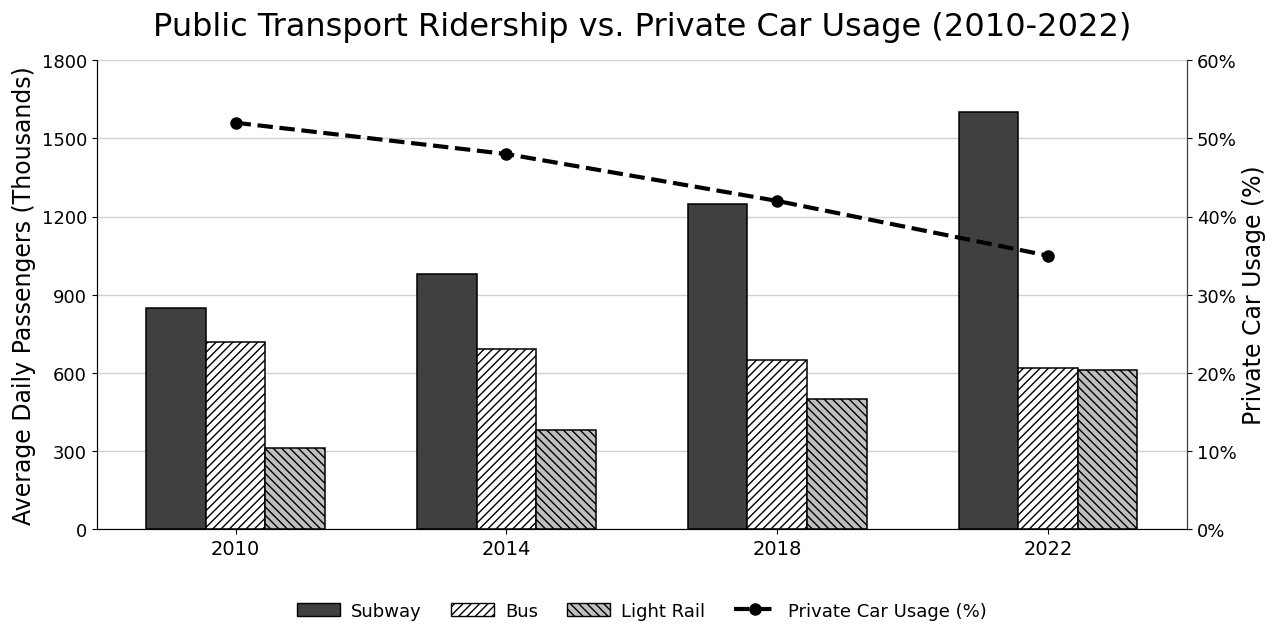
The bar chart and line graph below illustrate the average number of daily passengers, in thousands, using three major public transport systems and the percentage of daily journeys made by private car in a metropolitan city from 2010 to 2022.

Summarise the information by selecting and reporting the main features, and make comparisons where relevant.
Academic Writing Task 1 Dynamic Mixed Chart practice image
BAND 9

Part 1 · Band 9 Sample Answer

The combined chart compares average daily ridership on the subway, buses and light rail in a metropolitan city at four-year intervals between 2010 and 2022, alongside the proportion of daily trips made by private car.

Overall, subway and light-rail patronage rose substantially, contributing to an increase in public transport use, while the share of journeys undertaken by car declined consistently. The subway was the most heavily used system throughout and experienced the largest absolute growth. Bus ridership, in contrast, fell gradually, and by 2022 it was only marginally higher than the light-rail figure.

In 2010, the subway carried approximately 850,000 passengers per day, ahead of buses at around 720,000. Light rail was considerably less popular, serving only about 320,000 daily users. Subway ridership then climbed to just under one million in 2014 and 1.25 million in 2018, before rising more sharply to 1.6 million by 2022. This represented an overall gain of roughly 750,000 passengers.

Light rail followed a similarly upward trajectory, though from a much lower base. Its daily total increased from 320,000 to about 380,000 in 2014, then reached 500,000 in 2018 and approximately 610,000 in the final year. Meanwhile, bus use slipped from around 720,000 to 690,000 and then 650,000, finishing at roughly 620,000. Consequently, the initial 400,000-passenger gap between buses and light rail had virtually disappeared by 2022. Private car usage moved in the opposite direction to overall public ridership, falling steadily from 52% of daily journeys in 2010 to 48%, 42% and finally 35%.

BAND 8

Part 1 · Band 8 Sample Answer

The bar and line chart presents average daily passenger numbers for three forms of public transport in a city from 2010 to 2022. It also shows the percentage of journeys made by private car in the same four years.

Overall, the subway remained the most popular public transport system and recorded strong growth. Light-rail usage also rose, whereas the number of bus passengers declined slightly. At the same time, private cars accounted for a steadily decreasing share of daily travel.

Approximately 850,000 passengers used the subway each day in 2010, compared with around 720,000 bus users and 320,000 light-rail passengers. Subway ridership increased to just under one million in 2014 before reaching about 1.25 million in 2018. Growth continued during the final four years, and the figure rose to approximately 1.6 million in 2022, nearly twice its initial level.

Daily light-rail use grew more steadily, from about 320,000 in 2010 to 380,000 four years later. It then reached 500,000 in 2018 and around 610,000 by 2022. Bus ridership followed the opposite pattern, falling gradually from roughly 720,000 to 690,000, 650,000 and finally 620,000. As a result, light rail had almost caught up with buses at the end of the period, despite a large difference between them in 2010. Private car use also declined in every interval. Its share of journeys fell from approximately 52% in 2010 to 48% in 2014 and 42% in 2018, before reaching 35% in 2022, an overall decrease of 17 percentage points.

BAND 7

Part 1 · Band 7 Sample Answer

The chart shows the average number of passengers using the subway, buses and light rail each day in a metropolitan city between 2010 and 2022. Passenger totals are given in thousands, while the line indicates the percentage of daily journeys made by private car.

Overall, the subway was the most widely used public transport system in all four years, and its passenger numbers increased considerably. Light-rail usage also grew, but bus use declined slowly. In addition, the proportion of journeys made by car fell throughout the period.

In 2010, around 850,000 people used the subway daily. This figure rose to approximately 980,000 in 2014 and then to 1.25 million in 2018. By 2022, subway ridership had reached about 1.6 million, which was nearly double the 2010 level.

Bus passenger numbers showed a different trend. They decreased from roughly 720,000 per day in 2010 to 690,000 in 2014 and 650,000 in 2018. The final figure was around 620,000. By comparison, light-rail use rose from approximately 320,000 to 380,000 during the first four years, before increasing to 500,000 in 2018 and about 610,000 in 2022. Therefore, light rail had almost the same number of passengers as buses by the end. Meanwhile, private car usage fell steadily from around 52% of journeys in 2010 to 48% in 2014. It declined further to 42% in 2018 and reached 35% in 2022, a total reduction of approximately 17 percentage points.

Academic Writing Task 2

Task 2 · Agree or Disagree Essay

Task 2 Prompt

You should spend about 40 minutes on this task. Write at least 250 words.

Write about the following topic:

Some people believe that the widespread use of computers and the internet has dramatically reduced people's capacity for original and creative thought.

To what extent do you agree or disagree?

Give reasons for your answer and include any relevant examples from your own knowledge or experience.

BAND 9

Part 2 · Band 9 Sample Answer

Computers and the internet now mediate much of how people obtain information, solve problems and produce creative work. It is understandable that some regard this dependence as a threat to originality. Although digital habits can encourage imitation and intellectual passivity, I largely disagree that the technology has dramatically reduced people’s underlying capacity for creative thought. Its effect depends more on patterns of use than on the tools themselves.

The concern is not without foundation. Search engines provide immediate answers, so users may retrieve an existing solution before attempting to formulate one independently. Templates, recommendation systems and highly visible online trends can also narrow creative choices. A designer repeatedly shown the same popular visual style, for instance, may reproduce its features unconsciously, while writers under pressure may assemble familiar online phrases rather than develop a distinctive voice. Constant notifications and rapid movement between short pieces of content further reduce the uninterrupted attention often required for difficult creative work. If people routinely outsource both memory and initial thinking, certain skills are likely to weaken through lack of practice.

However, these outcomes do not demonstrate a general loss of creative capacity. The same technologies give individuals access to materials, audiences and forms of collaboration that were previously unavailable to most of them. An aspiring musician can learn production techniques, record at home and exchange ideas with performers on another continent. Programmers can adapt open-source components to build products that would once have required a large company, and visual artists can combine photography, animation and interactive media in genuinely new ways. Exposure to existing work can produce imitation, but it can also provide the knowledge from which originality develops. Creativity has rarely meant inventing without influence; it usually involves connecting familiar elements in an unexpected and purposeful manner.

The decisive factor is therefore whether technology replaces thought or extends it. Schools and workplaces should require people to question sources, compare alternatives and explain the reasoning behind a finished product. Periods of distraction-free work and tasks that begin without an online search can preserve independent thinking. At the same time, digital tools should remain available for research, testing and collaboration once an initial direction has been formed.

In conclusion, computers and the internet can make shallow copying easier and sustained concentration harder. Nevertheless, they have also broadened creative participation and enabled new kinds of expression. I therefore reject the claim of a dramatic general decline: when used deliberately, these technologies expand rather than diminish the possibilities for original thought.

BAND 8

Part 2 · Band 8 Sample Answer

The widespread use of computers and the internet has changed the way people research, communicate and create. Some argue that easy access to existing ideas has seriously weakened originality. I accept that excessive dependence on digital tools can discourage independent thinking, but I disagree that they have dramatically reduced people’s creative capacity overall.

There are clear reasons for concern. When a search engine can supply an answer within seconds, people may not spend time exploring a problem for themselves. Online templates also make it simple to produce acceptable presentations, designs or written documents without making many original decisions. In addition, social media algorithms tend to promote popular material, which can cause users to follow the same formats, subjects and styles. Frequent notifications may make the problem worse by interrupting concentration. Creative thinking often requires time to develop uncertain ideas, and this becomes difficult when attention is repeatedly drawn to messages or short videos.

Nevertheless, digital technology also provides powerful support for creativity. People can learn skills from online demonstrations, access art and information from different cultures, and communicate with others who share specialised interests. Someone living far from a major city can now study music production, publish a song and receive useful responses without attending an expensive institution. Computers have also created new fields of expression, including digital animation, game design and interactive storytelling. These activities do not eliminate human imagination; they require users to make choices about purpose, structure, style and audience. Existing information can become the starting point for an original combination rather than something that is merely copied.

In my view, the main danger is not access to technology but passive use of it. Education should therefore focus on habits that preserve independent thought. Students can be asked to develop an initial idea before searching online, assess whether sources are reliable and explain why they selected a particular solution. Individuals can also turn off unnecessary notifications and reserve uninterrupted time for reading, planning or practising a skill. In this way, computers assist the later stages of research and production without controlling the whole process.

In conclusion, the internet can encourage imitation, and constant computer use may reduce concentration when it is poorly managed. Even so, it also expands access to knowledge, creative tools and collaboration. I therefore largely disagree with the statement, since technology changes how creativity is exercised rather than removing the human ability to think originally.

BAND 7

Part 2 · Band 7 Sample Answer

Computers and the internet are used for education, work and entertainment by a large part of the population. Some people believe this has greatly reduced the ability to think creatively because information and ready-made content are always available. I partly disagree with this view. Technology can encourage lazy thinking, but it can also give people more opportunities to create and develop ideas.

On the one hand, people may become less original if they depend too heavily on online material. When students receive a difficult task, they can search for an answer immediately instead of thinking about possible solutions first. Workers may also use standard templates for reports, advertisements or presentations without changing them in a meaningful way. Social media adds to this problem because users often copy popular videos, images and phrases in order to gain attention. Furthermore, messages and notifications can interrupt concentration. It is difficult to develop a complex idea when a person is constantly moving between websites and short pieces of content.

On the other hand, the same technology can support creativity in many ways. The internet gives people access to lessons, examples and information that may not be available where they live. For example, a person can learn how to edit videos, play an instrument or write computer code through online materials and then produce an original project. Computers also provide tools for creating music, films, illustrations and games at a much lower cost than in the past. People from different countries can work together online and combine their experiences. Seeing existing work does not always lead to copying; it can help someone understand a subject and create a new approach.

I believe the result mainly depends on how computers and the internet are used. Schools should ask students to explain their ideas and compare different solutions instead of rewarding copied information. It can also be useful to begin a task without searching online, so that an individual develops an independent starting point. After that, the internet can be used for research and improvement. Turning off notifications during creative work would also make deeper concentration easier.

In conclusion, digital technology can weaken originality when people use it passively or copy the first answer they find. However, it also offers knowledge, creative tools and opportunities for cooperation. For this reason, I do not believe it has dramatically reduced creative thought in general; responsible use can actually increase it.

FREE PRACTICE RESOURCES

Download the IELTS Practice PDF Pack.

Get Listening, Reading, and Writing practice materials for self-study. Use a computer to download the 1.9GB pack.

Download PDF Pack
Chat History
My Notes