Task 1 · Process Diagram
You should spend about 20 minutes on this task. Write at least 150 words.
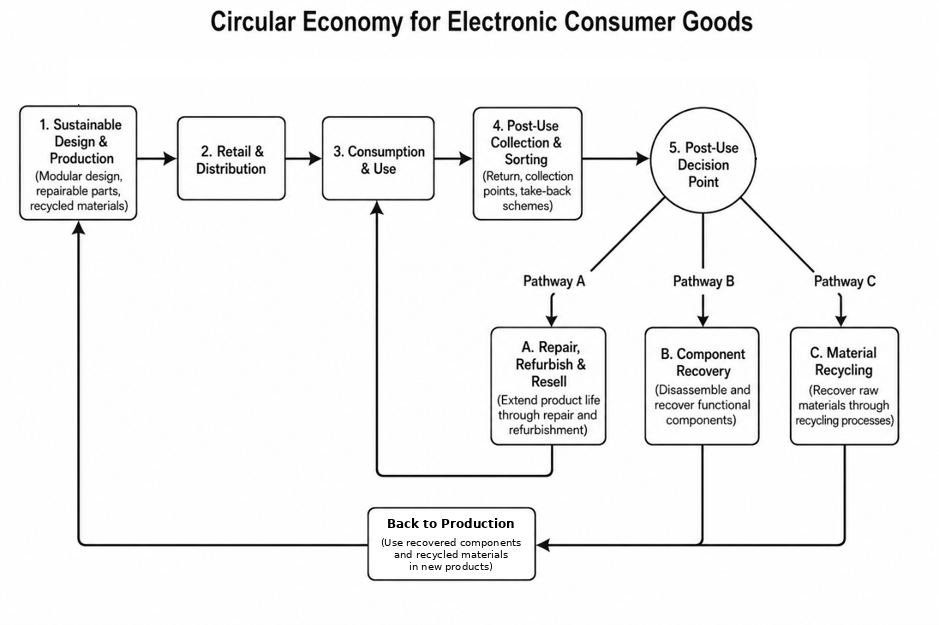
The diagram below illustrates the circular economy model for electronic consumer goods, showing the stages from sustainable design and production to retail, consumption, post-use collection and sorting, and three possible recovery pathways: repair and resale, component recovery and material recycling.
Summarise the information by selecting and reporting the main features.
Want to see your estimated band score?
Check your writing scorePart 1 · Band 9 Sample Answer
The diagram depicts a circular system for electronic consumer goods, beginning with sustainable product design and continuing through sale, use and post-use handling. It also shows how products, components and raw materials can re-enter the cycle through three recovery routes.
Overall, goods pass through five stages before reaching a decision point, where they are directed towards repair and resale, component recovery or material recycling. None of these routes constitutes a final endpoint: repaired products return to consumers, whereas recovered components and recycled materials are fed back into production.
The process starts with sustainable design and production. At this stage, products are made using modular construction, repairable parts and recycled materials. Finished electronics are then supplied through retail and distribution channels before entering the consumption and use phase. Once consumers have finished with them, the goods are returned through collection points or take-back schemes. They are subsequently sorted and sent to the post-use decision point.
Under Pathway A, suitable goods are repaired or refurbished and then resold. This extends their useful life and leads them back to the consumption stage without requiring remanufacture. Pathway B is used when functional components can be recovered: products are disassembled and usable parts are removed. In Pathway C, the remaining goods are processed to reclaim raw materials through recycling.
The outputs of the latter two pathways converge at the return-to-production stage. Recovered components and recycled materials are incorporated into new products and transferred back to sustainable design and production, thereby completing the larger loop.
Part 1 · Band 8 Sample Answer
The diagram shows the circular economy process for electronic consumer products. It follows goods from sustainable design and manufacturing through distribution and use to collection, sorting and three different methods of recovery.
Overall, the system contains five main stages before used products reach a decision point. They can then be repaired and resold, taken apart to recover working components, or recycled for raw materials. All three pathways return either products or resources to an earlier stage, making the process circular.
First, electronic goods are designed and produced using modular designs, parts that can be repaired and recycled materials. They then pass to retailers and distributors before being purchased and used by consumers. At the end of this period, products are returned through collection points or take-back programmes. After being collected and sorted, they arrive at the post-use decision point.
The first option is to repair, refurbish and resell suitable products. This pathway extends their life and sends them directly back to the consumption and use stage. Alternatively, products can be disassembled so that functional components are recovered. The third route involves material recycling, through which raw materials are obtained.
Components from the second pathway and materials from the third are brought together at the back-to-production stage. These recovered resources are used in new electronic goods. They then return to the initial sustainable design and production stage, completing the main cycle.
Part 1 · Band 7 Sample Answer
The diagram illustrates how electronic consumer goods move through a circular economy. It shows the main stages from design and production to use and collection, followed by three possible ways of recovering used products.
Overall, electronics pass through five stages before a decision is made about their future. They may be repaired and sold again, separated into reusable components or recycled into raw materials. Each route returns products or resources to an earlier part of the process.
First, electronic goods are designed and produced. This stage uses modular designs, repairable parts and recycled materials. The products are then sent to retail and distribution before reaching the consumption and use stage. When they are no longer required, consumers return them through collection points or take-back schemes. The goods are sorted before reaching the post-use decision point.
In Pathway A, suitable products are repaired or refurbished and then resold. This extends their useful life, and they return directly to the consumption stage. In Pathway B, products are taken apart so that working components can be recovered. Pathway C uses recycling processes to obtain raw materials from the used goods.
The components recovered through Pathway B and the materials produced through Pathway C both go to the back-to-production stage. They are used to make new products and return to sustainable design and production. This connection completes the cycle, while repaired goods form a shorter loop back to consumers.