ACADEMIC WRITING SAMPLE ANSWERS

Academic Writing Sample Answers Practice 9 Test 03

This original practice page includes Task 1 (Dynamic Mixed Chart) and Task 2 (Two-part Question), with Band 9, Band 8, and Band 7 sample answers for IELTS preparation.
Academic Writing Task 1

Task 1 · Dynamic Mixed Chart

Task 1 Prompt

You should spend about 20 minutes on this task. Write at least 150 words.

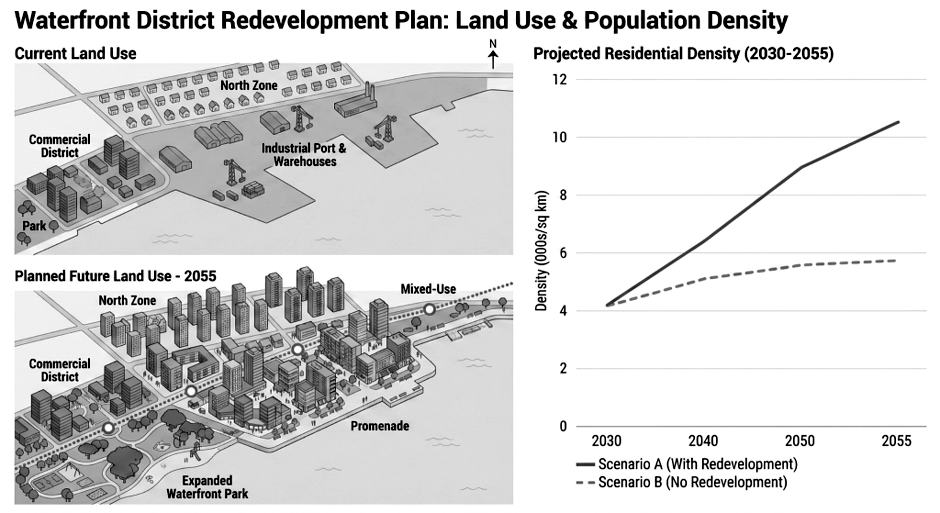
The maps and chart below illustrate the current and planned land use of a coastal city’s central waterfront district and show the projected residential population density under two different scenarios from 2030 to 2055.

Summarise the information by selecting and reporting the main features, and make comparisons where relevant.
Academic Writing Task 1 Dynamic Mixed Chart practice image
BAND 9

Part 1 · Band 9 Sample Answer

The maps compare the present layout of a central waterfront district with its proposed configuration in 2055, while the chart forecasts residential density with and without redevelopment.

Overall, the plan replaces a low-rise residential and industrial waterfront with a much denser mixed-use neighbourhood offering more public space. The commercial district is retained, whereas the park is enlarged and the working port disappears. Density is projected to rise far more sharply under redevelopment.

At present, detached houses occupy the North Zone, while an industrial port and warehouses cover the central and eastern shoreline. The Commercial District lies to the west beside a small park. By 2055, numerous high-rise blocks will occupy the North Zone. The port facilities and warehouses will be replaced by closely spaced mixed-use buildings extending eastwards. Meanwhile, the park will expand along the western waterfront, and a promenade will follow the southern and eastern shore. The commercial area remains in broadly the same location.

Both projections begin at just over 4,000 residents per square kilometre in 2030. With redevelopment, density climbs to approximately 6,500 in 2040 and 9,000 in 2050, before reaching about 10,500 by 2055. Without it, the figure rises to around 5,000 and 5,600 respectively, then levels off at roughly 5,700. The final gap is therefore nearly 5,000 residents per square kilometre.

BAND 8

Part 1 · Band 8 Sample Answer

The diagrams show the current land use of a coastal city’s central waterfront and the redevelopment planned for 2055. The graph compares projected residential density under redevelopment and no-redevelopment scenarios.

Overall, the waterfront will change from a low-density area containing housing and industry into a densely built mixed-use district. Commercial land remains in the west, while recreational space expands substantially. Redevelopment is also expected to produce a much greater rise in population density.

Currently, the North Zone consists mainly of small houses. To its south-east, warehouses and port equipment occupy much of the shoreline, while the Commercial District and a small park lie in the west. By 2055, high-rise blocks will replace the houses in the North Zone. The port and warehouses will also be removed, making way for a large mixed-use area. In addition, the park will extend across more of the western waterfront, and a promenade will run along the southern and eastern coast. The Commercial District stays in approximately its present position.

Density starts at around 4,200 people per square kilometre in both scenarios in 2030. With redevelopment, it rises to about 6,500 in 2040 and 9,000 in 2050, reaching approximately 10,500 by 2055. Without redevelopment, it grows to roughly 5,000 and 5,600 respectively, then finishes at about 5,700. The redeveloped district is therefore predicted to be almost twice as densely populated in 2055.

BAND 7

Part 1 · Band 7 Sample Answer

The maps illustrate the current land use of a central waterfront district and the changes planned by 2055. The graph presents two projections for residential population density.

Overall, the area will become more densely developed, with new residential and mixed-use buildings replacing houses and industrial facilities. The park will expand and a promenade will be added. Population density grows much faster if redevelopment occurs.

At present, the North Zone contains small houses. The centre and east of the waterfront are occupied by an industrial port, warehouses and cranes. In the west, there is a Commercial District beside a small park. Under the plan, high-rise blocks will replace the houses in the North Zone. The port and warehouses will become a mixed-use neighbourhood containing many new buildings. The Commercial District remains in the west, but the park will be considerably larger. A promenade will also be constructed along the southern and eastern coast.

In 2030, both scenarios show just over 4,000 residents per square kilometre. With redevelopment, this figure rises to approximately 6,500 in 2040 and 9,000 in 2050, then reaches around 10,500 in 2055. Without redevelopment, density grows more slowly to about 5,000 and 5,600 respectively, before ending at roughly 5,700. The difference is therefore almost 5,000 people per square kilometre by 2055.

Academic Writing Task 2

Task 2 · Two-part Question

Task 2 Prompt

You should spend about 40 minutes on this task. Write at least 250 words.

Write about the following topic:

The accelerating pace of technological and social change is creating a widening ‘experience gap’ between generations. Older generations may hold positions of power based on experience in systems that are becoming obsolete, while younger generations are ‘digital natives’ but lack institutional authority. Some argue this dynamic hampers effective decision-making in both the public and private sectors.

To what extent do you agree that intergenerational tension, stemming from differing experiences of technological change, is a significant obstacle to progress in contemporary society? What measures could be taken to better harness the unique strengths of different age groups in facing future challenges?

Give reasons for your answer and include any relevant examples from your own knowledge or experience.

BAND 9

Part 2 · Band 9 Sample Answer

Rapid technological change has altered the value of different kinds of experience. I agree that the resulting tension between generations can be a substantial barrier to progress when authority is concentrated among people whose expertise was formed under obsolete conditions. However, age differences themselves are not the fundamental problem; institutions become ineffective when they fail to combine established judgement with emerging knowledge.

The experience gap can distort decisions in two directions. Senior leaders may apply assumptions developed when markets, communication and public expectations changed slowly. A board that treats artificial intelligence merely as conventional software, for example, may underestimate its implications for privacy, employment and accountability. Younger specialists may recognise these risks and opportunities but lack the status to influence strategy. This can delay adaptation and create resentment. Conversely, digital fluency does not automatically provide an understanding of regulation, organisational memory or the unintended consequences of reform. An inexperienced team may introduce a technically elegant system that fails because it ignores how frontline staff or vulnerable citizens actually behave. Progress is therefore obstructed most seriously when either form of expertise dismisses the other.

Nevertheless, generational tension should not be overstated. Many older people adapt readily to new tools, while access to technology varies widely within younger generations. Conflicts attributed to age may actually reflect hierarchy, professional rivalry or unequal access to training. The central challenge is consequently to redesign decision-making, rather than simply replace older leaders with younger ones.

One effective measure would be to create age-diverse project teams in which authority is genuinely shared. Younger members should not serve merely as technical advisers after decisions have been made; they could jointly lead projects with experienced managers and hold voting rights. Reciprocal mentoring could support this structure: one participant might explain new digital practices, while the other transfers knowledge about negotiation, ethics and institutional constraints. Organisations should also use limited trials and transparent evaluation before adopting major innovations. Pilot programmes allow technically confident employees to test ideas while enabling experienced colleagues to identify practical risks.

Finally, continuous learning must apply to every career stage. Employers and governments can fund regular retraining, document knowledge before senior staff retire and assess leadership partly on whether it develops successors. These steps reduce both technological exclusion and the loss of valuable institutional memory.

In conclusion, I agree that the experience gap is a significant obstacle where rigid hierarchies turn difference into conflict. The solution is not generational replacement, but shared authority, two-way learning and evidence-based experimentation that convert contrasting experience into complementary expertise.

BAND 8

Part 2 · Band 8 Sample Answer

Technological change is occurring so quickly that people entering the workforce today often possess skills that were uncommon when current leaders began their careers. I agree to a considerable extent that this difference can create tension and slow progress. Yet the knowledge of older generations remains valuable, so the aim should be cooperation rather than transferring all authority to younger people.

This tension can hinder organisations when senior decision-makers are reluctant to reconsider familiar methods. A company may continue relying on an outdated business model because its leaders succeeded under that model for decades. Younger employees who understand digital platforms or automation may see a better approach, but their proposals can be rejected because they lack seniority. Similar difficulties occur in government when policies fail to reflect how citizens now communicate, study or work online. As a result, institutions may respond slowly to cybercrime, misinformation or changes in employment.

However, younger people also have limitations. Knowing how to use new technology is different from understanding how to manage a large institution, balance competing interests or recognise long-term risks. Experienced workers may remember why earlier reforms failed and can prevent the repetition of expensive mistakes. In addition, technological ability is not determined entirely by age, since many older professionals remain highly adaptable. The obstacle is therefore not diversity of experience itself, but a culture in which status prevents open discussion.

Several measures could improve cooperation. First, public bodies and companies should form mixed-age teams for projects involving major technological change. Both senior managers and younger specialists should participate from the beginning and share responsibility for the outcome. This would combine practical judgement with current technical knowledge. Second, mentoring should operate in both directions. Experienced staff can teach leadership, negotiation and professional standards, while younger colleagues can demonstrate new tools and changing patterns of consumer behaviour.

Organisations should also provide regular digital training instead of assuming that older employees cannot adapt. At the same time, promotion systems should give younger staff a genuine route into decision-making positions based on ability rather than years of service alone. Finally, new approaches can be tested through small pilot schemes before full implementation. This gives innovators room to experiment while allowing experienced employees to identify weaknesses.

In conclusion, intergenerational tension is a significant barrier when authority and new knowledge are separated. Age-diverse teams, two-way mentoring, continued training and fairer access to leadership can ensure that digital confidence and institutional experience reinforce each other.

BAND 7

Part 2 · Band 7 Sample Answer

The speed of technological development has created important differences between age groups. Older people often have more professional experience and hold senior positions, while younger people are usually more familiar with recent digital tools. I largely agree that tension between these groups can delay progress, although both generations have strengths that society needs.

One problem is that experienced leaders may be too confident in methods that worked in the past. For instance, managers may resist online services or automation because they do not fully understand them or fear that established working practices will disappear. Younger employees may then feel ignored, even when their technical knowledge could help an organisation become more efficient. In government, a similar gap can lead to public services that do not match the ways in which people now communicate and access information.

On the other hand, younger generations should not assume that digital skills make older experience unnecessary. Senior workers often understand legal requirements, customer needs and the practical difficulties of introducing change. A new system may appear efficient but create serious problems if its designers do not understand the organisation in which it will operate. Therefore, conflict becomes an obstacle mainly when one generation refuses to respect the knowledge of the other.

Mixed-age teams are one useful solution. When a company introduces a new technology, younger technical staff and experienced managers should plan the change together. The younger members can explain how the system works, while older colleagues can identify financial, legal or human risks. Both groups should have a real influence on the final decision rather than one side simply offering advice.

Mentoring programmes could also work in two directions. Older employees can share leadership skills and institutional knowledge, while younger workers help them become confident with new technology. Regular training should be available to everyone so that skills do not become outdated. At the same time, promotion should depend on ability and performance, giving capable younger people greater access to leadership roles. Testing new ideas on a small scale before introducing them widely would also allow different generations to learn from one another without creating unnecessary risk.

In conclusion, I agree that intergenerational tension can significantly slow social and organisational progress, especially when power and technical knowledge are divided. Mixed teams, shared decision-making, two-way mentoring and continuous training would allow society to benefit from both innovation and experience.

FREE PRACTICE RESOURCES

Download the IELTS Practice PDF Pack.

Get Listening, Reading, and Writing practice materials for self-study. Use a computer to download the 1.9GB pack.

Download PDF Pack
Chat History
My Notes