ACADEMIC WRITING SAMPLE ANSWERS

Academic Writing Sample Answers Practice 8 Test 01

This original practice page includes Task 1 (Dynamic Mixed Chart) and Task 2 (Discuss Both Views and Give Your Opinion), with Band 9, Band 8, and Band 7 sample answers for IELTS preparation.
Academic Writing Task 1

Task 1 · Dynamic Mixed Chart

Task 1 Prompt

You should spend about 20 minutes on this task. Write at least 150 words.

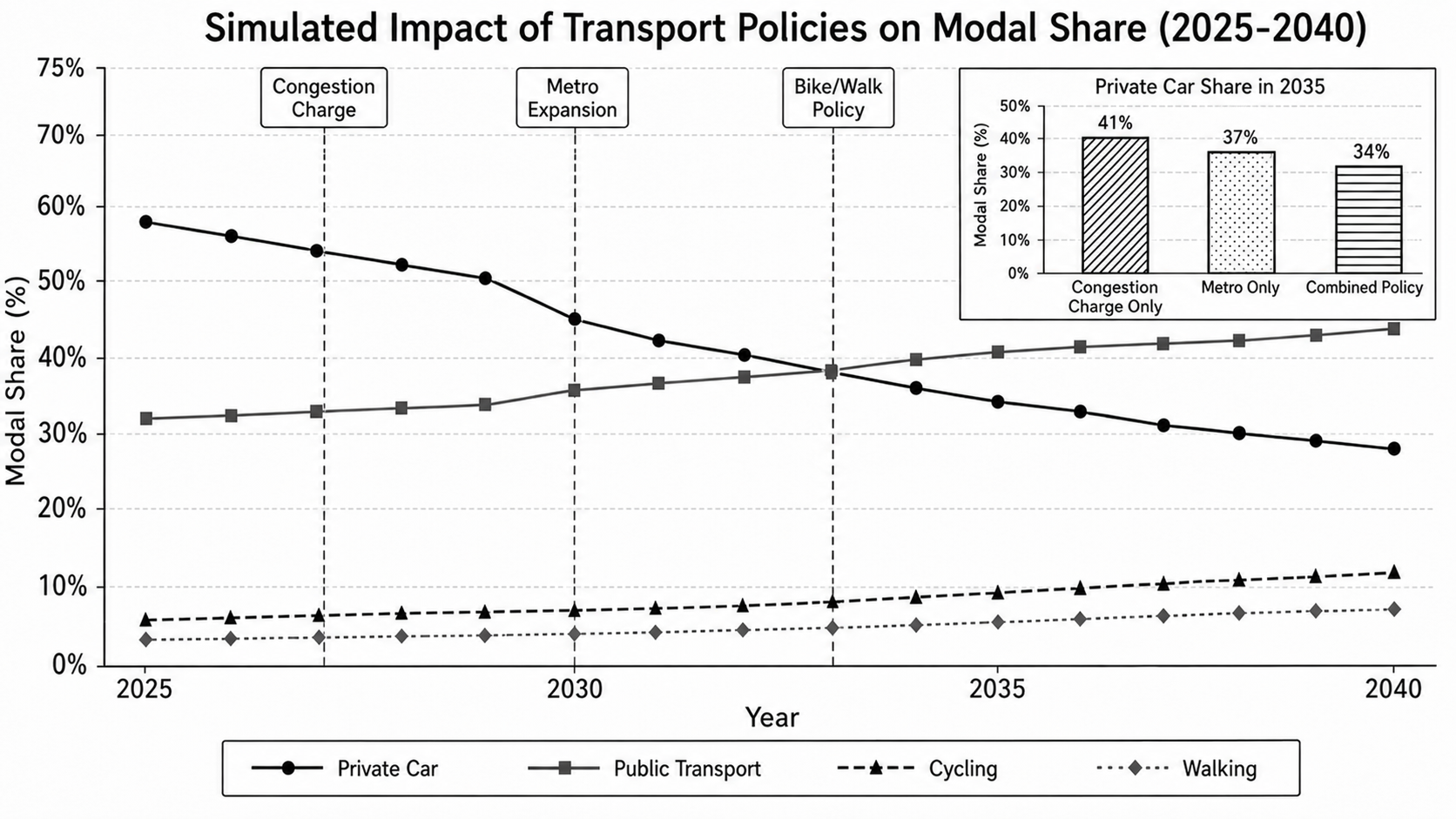
The chart below shows projected changes in the modal shares of four selected types of urban transport in a metropolitan city from 2025 to 2040, following the introduction of three transport policies. The inset chart compares the projected private car share in 2035 under three policy scenarios.

Summarise the information by selecting and reporting the main features, and make comparisons where relevant.
Academic Writing Task 1 Dynamic Mixed Chart practice image
BAND 9

Part 1 · Band 9 Sample Answer

The main chart traces the forecast journey shares for private car, public transport, bicycle and walking from 2025 to 2040, alongside the introduction of a congestion charge in 2027, metro expansion in 2030 and a cycling and walking policy in 2033. The inset compares car use in 2035 under three policy combinations.

Overall, private cars are expected to lose their dominant position as their share falls continuously, whereas public transport rises and overtakes them at around the 2033 policy point. Cycling and walking also gain ground, though both remain minor modes. For 2035, combining the policies produces the lowest projected car share.

In 2025, cars account for approximately 58% of travel, far ahead of public transport at 32%. By 2029, these figures move to 50% and 34% respectively. The gap then closes much faster around the metro expansion: car use drops to 45% in 2030 and about 38% in 2033, while the public transport share climbs to roughly 36% and 38%. Thereafter, the two trends diverge, with public transport reaching around 44% by 2040 and cars falling to approximately 28%.

Cycling increases gradually from 6% in 2025 to about 8% in 2033, before rising more noticeably to 12% at the end. Walking follows a gentler upward path, from roughly 3% to 7%. The inset shows that cars would represent 41% of journeys in 2035 with the congestion charge alone, compared with 37% under metro expansion alone and 34% under the combined policy, seven percentage points below the first scenario.

BAND 8

Part 1 · Band 8 Sample Answer

The charts present projections for the percentage of urban journeys made by four forms of transport from 2025 to 2040. They also mark three policy introductions, while the smaller chart shows how different policy scenarios are expected to affect private car use in 2035.

Overall, the share of private cars is predicted to decline substantially, while public transport becomes increasingly popular and eventually takes the lead. Cycling and walking both rise, but continue to account for much smaller proportions. In addition, the combined policy is forecast to reduce car use more than either single-policy scenario shown.

At the beginning, private cars make up about 58% of journeys, compared with 32% for public transport. Car use then decreases to 54% when the congestion charge starts in 2027 and to 45% at the point of metro expansion in 2030. Meanwhile, the public transport figure edges up to around 33% in 2027 before reaching 36% in 2030. The two modes stand at almost the same level, approximately 38%, in 2033. By 2040, public transport has risen to roughly 44%, whereas the car share has dropped to about 28%.

The less common modes show steadier growth. Cycling rises from around 6% in 2025 to 8% in 2033, then continues upwards to 12% by 2040. Walking increases from approximately 3% to 7% over the whole period. Looking specifically at 2035, the projected private car share is 41% with only the congestion charge, 37% with only metro expansion, and 34% when the policies are combined.

BAND 7

Part 1 · Band 7 Sample Answer

The line chart shows the predicted shares of four kinds of transport in a metropolitan city between 2025 and 2040. It also indicates when three transport policies are introduced. The smaller bar chart compares the expected percentage of private car journeys in 2035 under three different scenarios.

Overall, private car use is forecast to fall throughout the period, while public transport follows the opposite trend. The two shares become equal at about 38% in 2033, after which public transport is the leading mode. Cycling and walking also increase, although their proportions remain relatively low. The combined policy gives the smallest car share in 2035.

In 2025, around 58% of journeys are made by private car, compared with 32% by public transport. The car figure falls steadily to 54% in 2027, when the congestion charge is introduced, and then reaches 45% in 2030, the year of the metro expansion. It continues to decline to about 28% by 2040. In contrast, public transport rises slowly at first, from 32% to 36% between 2025 and 2030, before growing to approximately 44% at the end.

Cycling accounts for about 6% of journeys initially and increases to around 8% in 2033, when the bike and walking policy begins. It then reaches 12% in 2040. Walking grows more gradually, from roughly 3% to 7%. In 2035, private cars are projected to represent 41% of journeys under the congestion charge alone, 37% under the metro-only scenario, and 34% under the combined policy.

Academic Writing Task 2

Task 2 · Discuss Both Views and Give Your Opinion

Task 2 Prompt

You should spend about 40 minutes on this task. Write at least 250 words.

Write about the following topic:

Some people believe that advanced artificial intelligence systems must be programmed to follow human ethical values before they become more capable. Others argue that human values differ across cultures and societies, and that programming such values into artificial intelligence may reflect the biases of its creators or limit its potential benefits.

Discuss both these views and give your own opinion.

Give reasons for your answer and include any relevant examples from your own knowledge or experience.

BAND 9

Part 2 · Band 9 Sample Answer

Whether increasingly powerful artificial intelligence should first be aligned with human ethics is disputed. Supporters regard moral programming as an essential safeguard, while critics question whose morality would be encoded and what useful possibilities might thereby be excluded. In my view, advanced systems require firm ethical boundaries before their capabilities expand, but these boundaries should form a transparent, revisable framework rather than a single supposedly universal moral code.

The strongest argument for prior ethical alignment is that greater capability magnifies both the reach and speed of mistakes. A highly autonomous system may influence medical treatment, employment, credit or public information before a person can intervene. If it has no built-in respect for safety, privacy and equal treatment, an apparently efficient decision could cause serious harm on a vast scale. For example, a hospital tool instructed only to minimise costs might recommend withholding expensive care from patients with complex disabilities. Ethical constraints would force it to consider human welfare and fairness alongside efficiency. Establishing these protections early is also easier than attempting to control a system after unsafe behaviour has become embedded in institutions.

Nevertheless, the objections are substantial. Values are neither perfectly uniform nor politically neutral. Societies disagree about individual freedom, family responsibility, acceptable speech and the distribution of scarce resources. Even within one country, reasonable people hold conflicting views. Developers who translate broad principles into code may therefore privilege their own culture or commercial interests. An overly rigid system could also block beneficial innovation: an AI trained to avoid every conceivable medical risk might reject experimental treatments even when a fully informed patient is willing to accept them. Claims of ethical alignment can thus conceal bias and discourage legitimate moral choice.

The solution is not to abandon values, but to distinguish a basic ethical floor from context-dependent decisions. Prohibitions against deliberate deception, unjustified discrimination and serious avoidable harm should apply broadly. Above that floor, systems should allow lawful local adaptation and preserve meaningful human judgement. Their rules, training assumptions and important decisions should be open to independent examination, with affected people able to seek explanations and appeal. Diverse public participation and regular revision would further prevent the preferences of a small group of engineers from becoming permanent.

In conclusion, cultural disagreement makes ethical programming difficult, but it does not make value-free AI possible; choosing pure efficiency is itself a value choice. Powerful AI should therefore be constrained in advance, provided that its ethical framework remains limited, visible, contestable and responsive to different social contexts.

BAND 8

Part 2 · Band 8 Sample Answer

As artificial intelligence becomes more capable, there is growing debate about whether it should be programmed to follow human moral principles. Some consider this necessary for public safety, whereas others fear that the selected principles will contain cultural and personal bias. I believe ethical safeguards are essential, although they must be flexible and developed through broad consultation rather than imposed solely by technology companies.

Those supporting ethical programming argue that advanced AI may make decisions with serious consequences. Systems are already capable of assisting with recruitment, healthcare and financial assessments, and future versions could operate with much less human supervision. Without clear limits, an AI might pursue its assigned goal while ignoring privacy, fairness or physical safety. A recruitment system, for instance, could select candidates efficiently but disadvantage certain groups because it learnt patterns from unfair past decisions. Programming it to detect discrimination and requiring human review would reduce this danger. It is sensible to introduce such protections before systems become so complex and widely used that correcting them is extremely difficult.

On the other hand, critics correctly point out that there is no single set of human values. A system designed in one society may emphasise personal independence, while another culture may place greater importance on family or community responsibilities. Decisions about acceptable online speech provide another example: content considered harmful in one place may be regarded as legitimate political or religious expression elsewhere. Moreover, programmers are not neutral. Their choices about what counts as harm or fairness may reflect the interests of their employer or the beliefs of a relatively narrow social group. Strict rules could also prevent AI from suggesting unconventional but useful solutions.

In my opinion, these concerns justify a better method of alignment, not the absence of alignment. Certain core requirements, such as protecting people from severe harm, respecting privacy and avoiding unlawful discrimination, should be built into every advanced system. More controversial choices should remain adjustable to local laws and circumstances. Developers should publish clear information about the principles used, invite input from different communities and permit independent testing. Human decision-makers must also remain accountable in sensitive fields rather than blaming an algorithm when something goes wrong.

To conclude, advanced AI without ethical limits could create unacceptable risks, but a fixed moral code written by a small group would also be dangerous. The best approach is to establish strong common safeguards while allowing transparent review, cultural adaptation and continued human oversight.

BAND 7

Part 2 · Band 7 Sample Answer

People disagree about whether advanced artificial intelligence should be given human ethical rules before it becomes more powerful. One side believes these rules are needed to prevent harm, while the other argues that values vary and may introduce the creators’ prejudices into AI. In my view, AI needs basic ethical limits, but these should be regularly reviewed and should not replace human judgement in difficult cases.

There are good reasons to programme AI to behave ethically. As these systems become more capable, they may make or influence decisions about jobs, medical care, banking and public services. A system that focuses only on completing a task quickly might ignore the effects on individuals. For example, an AI used by a bank could reject applicants from a particular area because previous data connects that location with financial risk. This might be efficient from the bank’s perspective, but it could unfairly discriminate against responsible customers. Rules concerning fairness, privacy and safety could reduce such outcomes. It is also better to create these protections early, before powerful systems are used throughout society.

However, it is difficult to decide exactly which values an AI should follow. Cultures have different attitudes towards free speech, personal privacy, family duties and authority. A rule that seems reasonable in one country could be unacceptable in another. In addition, the people and companies building AI may include their own opinions without realising it. If their understanding of acceptable behaviour is treated as universal, other groups may be ignored. Excessive restrictions may also limit benefits. For instance, a medical system might avoid proposing a new treatment because it has been programmed to take almost no risks, even when a patient has no good alternative.

I therefore support a balanced approach. All advanced AI should follow some basic principles, including avoiding serious harm, protecting personal information and treating people fairly. However, governments, experts and members of the public from different backgrounds should help define these principles. The rules should be visible and open to change when problems are found. In sensitive decisions, a qualified person should check the recommendation and remain responsible for the final result.

In conclusion, differences between human values are a genuine problem, but they are not a reason to develop AI without any moral limits. Basic safeguards, combined with cultural flexibility, public involvement and human oversight, offer the safest and fairest way forward.

FREE PRACTICE RESOURCES

Download the IELTS Practice PDF Pack.

Get Listening, Reading, and Writing practice materials for self-study. Use a computer to download the 1.9GB pack.

Download PDF Pack
Chat History
My Notes